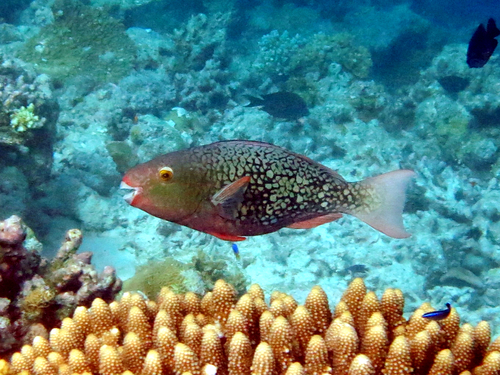


Redlip Parrotfish
scarus rubroviolaceus
The Redlip Parrotfish is a vibrant, active resident of Indo-Pacific coral reefs, instantly recognizable by its sturdy beak and bright coloration. Belonging to the family Labridae, these fish are crucial ecological architects. They spend their days grazing on turf algae, using their fused teeth to scrape rock surfaces clean. This behavior not only controls algae growth, which otherwise smothers coral reefs, but also helps break down reef substrate into fine white sand. Watching a Redlip Parrotfish in the wild is a delight, as they glide gracefully through shallow waters, often making audible crunching sounds as they feed. Their complex life cycle, featuring dramatic color changes and sex transitions, makes them a fascinating study in evolutionary biology.
Habitat: Found in shallow, sunlit coral reefs, lagoons, and rocky seaward reef slopes.
Adult males in the terminal phase display a striking bi-colored pattern: a dark blue-grey or dark green front half contrasted with a lighter green-blue rear body, accented by a bright pinkish-red upper lip. Females and initial-phase males are more subdued, exhibiting a reddish-brown coloration with fine dark scales. They possess a robust, oblong body shape and a powerful, bird-like beak formed by fused teeth.
Category
FishRarity
Common
Danger
1/5 · Very low
Snaps
Be the first to snap!
During their sex and color transition, their behavior also shifts from submissive herding to highly territorial defense of a harem.
Their beak is actually made of fused teeth, which are harder than copper, brass, and even some types of steel.
They are major producers of sand; a single large parrotfish can excrete hundreds of pounds of fine white sand each year.
At night, this species can secrete a thick, transparent bubble of mucus around itself to mask its scent from predators like moray eels.
Equipped with specialized throat teeth that grind ingested rock and coral into sand, allowing them to digest tiny algae trapped inside.
They are protogynous hermaphrodites, meaning individuals can change their sex from female to male when dominant males are absent.
Mainly grazes on turf algae growing on rocky surfaces and coral skeletons, swallowing rock fragments in the process.
Age differences: Juveniles consume a higher ratio of small invertebrates before transitioning to an almost entirely herbivorous scraping diet as adults.
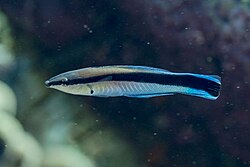
Labroides dimidiatus
The Redlip Parrotfish is frequently cleaned of parasites by this small fish at dedicated reef cleaning stations.
Triaenodon obesus
This large predator hunts juvenile and adult parrotfish along reef drop-offs.
Acanthurus triostegus
Competes directly for territory and the best algal grazing spots on shallow flats.
No trait badges are assigned for this object yet.
No aliases listed yet.
Collections for this object will appear here as more themes are added.
Danger
1/5 · Very low
No special safety notes yet.
Look at body shape, where the fins sit and their outline, mouth position, stripes and spots. Young fish and breeding adults can wear different patterns, and aquarium color varieties can look nothing like wild fish. Fish Identifier: upload a photo and compare the visible details.
30+ cm
1+ kg
10+ years
15 km/h
Mainly grazes on turf algae growing on rocky surfaces and coral skeletons, swallowing rock fragments in the process.
Found in shallow, sunlit coral reefs, lagoons, and rocky seaward reef slopes.
Grazing
Zoom in to split clusters and explore where this object has been snapped.
Recent snaps will appear here as new observations are added.
Take the discovery with you
Snap it with Snappit to identify it, learn what makes it special, and add the discovery to your collection.