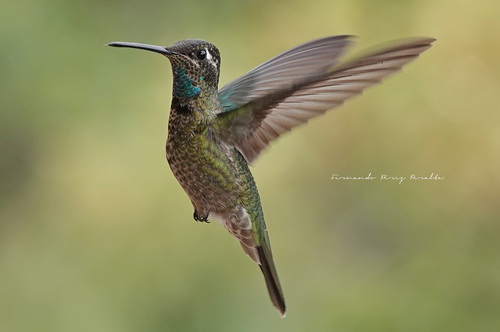


Rivoli'S Hummingbird
eugenes fulgens
Rivoli's Hummingbird is one of the largest and most spectacular hummingbird species in North America, renowned for its dazzling, gem-like coloration and remarkable aerial maneuvers. Formerly grouped with the Talamanca Hummingbird under the name 'Magnificent Hummingbird', this high-altitude specialist thrives in the cool montane pine-oak woodlands of the southwestern United States down through Central America. Due to its larger body size, its wings produce a deeper, audible humming sound during flight compared to smaller relatives, adding a dramatic presence to the forest clearings and backyard feeders it visits.
Habitat: Found in high-altitude pine-oak forests, humid montane woodlands, and shaded canyons, often near mountain streams.
Adult males of this large hummingbird species are striking, characterized by an iridescent emerald-green throat (gorget), a brilliant violet-purple crown, and a bronze-green back that contrasts with a dark chest. Females and juveniles are more subtly adorned, featuring bronze-green upperparts, pale gray underparts, a distinctive white spot behind the eye, and dark tail feathers tipped with white. Both sexes possess a remarkably long, straight, black bill suited for feeding on deep tubular flowers.
Category
BirdsRarity
Common
Danger
1/5 · Very low
Snaps
Be the first to snap!
At nearly 14 centimeters in length, it is the second-largest hummingbird species found within the United States.
Because of its larger size, the sound of its wings is a low-frequency hum, noticeably deeper than the high-pitched buzz of smaller hummingbird species.
They were previously combined with the Talamanca Hummingbird under the collective name 'Magnificent Hummingbird' until genetic studies split them in 2017.
To survive freezing mountain temperatures, they can lower their metabolic rate and body temperature drastically overnight to conserve valuable energy.
They possess specialized photoreceptors allowing them to see ultraviolet light, which helps them detect hidden patterns on nectar-rich flowers.
Using a rapid, figure-eight wing stroke, they can hover with absolute precision, fly backward, and navigate tight floral clusters with ease.
Feeds extensively on the sugary nectar of tubular flowers, supplementing this high-energy source with tiny insects and spiders for protein.
Age differences: Nestlings are fed a concentrated slurry of regurgitated insects and spiders to provide the necessary protein for rapid physical growth before transitioning to a nectar-heavy diet.
Penstemon pinifolius
Feeds on the nectar of this plant and acts as an important pollinator in montane pine-oak ecosystems.
Cynanthus latirostris
Competes directly with other local hummers at mountain feeding stations and flower patches.

Selasphorus rufus
Frequently contested by this highly aggressive migrant species during the summer breeding season.
No trait badges are assigned for this object yet.
No aliases listed yet.
Collections for this object will appear here as more themes are added.
Danger
1/5 · Very low
No special safety notes yet.
Compare the silhouette, bill shape, tail length, wing bars and markings around the eyes. The same small brown bird at your feeder can look quite different in breeding plumage, winter plumage or its first year. Bird Identifier: upload a photo and compare the visible details.
11+ cm
18+ cm
0.007+ kg
3+ years
48 km/h
Feeds extensively on the sugary nectar of tubular flowers, supplementing this high-energy source with tiny insects and spiders for protein.
Found in high-altitude pine-oak forests, humid montane woodlands, and shaded canyons, often near mountain streams.
Zoom in to split clusters and explore where this object has been snapped.
Recent snaps will appear here as new observations are added.
Take the discovery with you
Snap it with Snappit to identify it, learn what makes it special, and add the discovery to your collection.