


Rock Spikemoss
selaginella rupestris
Rock Spikemoss is a resilient, primitive plant that thrives in some of the most inhospitable environments. Belonging to an ancient lineage of vascular plants called lycophytes, it is far more closely related to clubmosses and ferns than to true mosses. This remarkable survivor forms dense, evergreen carpets over sun-baked rocky surfaces, bringing life to stark granite ledges and sandy barrens where other flora struggle to take root. Its defining characteristic is its incredible ability to withstand prolonged periods of severe drought, curling into a dormant, gray-brown ball until rain returns to rejuvenate it. This spectacular recovery showcases the absolute resilience of ancient plant designs in the modern world.
Habitat: Found in dry, exposed rocky outcrops, granite ledges, and thin, sandy soils in full sunlight.
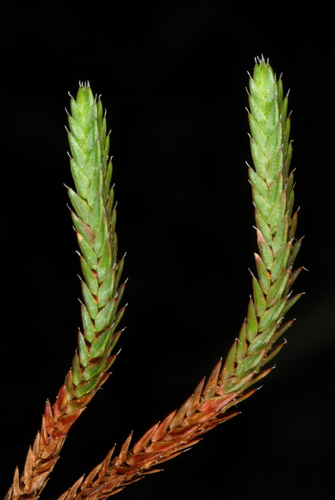
This species grows in low-spreading, moss-like mats reaching heights of only 2 to 6 centimeters, though creeping stems can stretch up to 15 centimeters. The foliage consists of densely packed, scale-like leaves that are narrow, dark green to grayish-green, and tipped with a distinctive fine, white bristle. During dry conditions, the entire plant rolls inward, presenting a dusty, dehydrated brown appearance, which quickly unfurls back into a vibrant green carpet upon contact with water. It produces small, square-shaped cones called strobili at the tips of its branches, which contain the spores used for reproduction.
Category
PlantsRarity
Common
Danger
1/5 · Very low
Snaps
Be the first to snap!
Despite its common name, Rock Spikemoss is not a moss but a lycophyte, representing a lineage of plants over 400 million years old.
It reproduces via microscopic spores rather than seeds, carrying out a complex alternation of generations typical of primitive vascular plants.
The tiny white hair at the tip of each leaf acts as a natural sunblock, reflecting harsh solar radiation away from the plant.
The plant can lose up to 90 percent of its water content during droughts and survive in a dormant state, rapidly restoring its metabolic functions and greening up within hours of rainfall.
It curls its stems and scale-like leaves inward when dry, reducing the surface area exposed to the sun and wind to prevent further moisture loss.
Employs specialized, thread-like structures called rhizophores that grow downward to securely anchor the plant onto bare stone and absorb scarce nutrients.
As a photoautotrophic plant, it produces energy through photosynthesis by capturing sunlight and converting carbon dioxide and water into sugars.
No trait badges are assigned for this object yet.
No aliases listed yet.
Collections for this object will appear here as more themes are added.
Danger
1/5 · Very low
No special safety notes yet.
Start with the whole plant, then compare leaf arrangement, leaf edges, stems and any flowers or fruit. Opposite leaves grow in pairs; alternate leaves come one at a time along the stem. These details tell you far more together than a single green leaf does. Plant Identifier: upload a photo and compare the visible details.
5-15 cm
0.001-0.05 kg
5-20 years
As a photoautotrophic plant, it produces energy through photosynthesis by capturing sunlight and converting carbon dioxide and water into sugars.
Found in dry, exposed rocky outcrops, granite ledges, and thin, sandy soils in full sunlight.
Zoom in to split clusters and explore where this object has been snapped.
Recent snaps will appear here as new observations are added.
Take the discovery with you
Snap it with Snappit to identify it, learn what makes it special, and add the discovery to your collection.


















