



Saanen Goat
Capra hircus
The Saanen is a Swiss breed of domestic goat (Capra hircus) named after the Saanen valley in the Bernese Oberland, in western Switzerland. It has a short white coat over pale skin and may be horned or hornless. Bred for milk, it is the most productive dairy goat in Switzerland and has spread to more than 80 countries.
Also known as Saanen, Saanenziege, Saanen Dairy Goat
Rarity: Common
~70° head dip the eyes correct for
~5.5 h cud chewing a day
Trees goats even climb them
Happy faces goats go to firstStill debated
Up to 13 months after weaning, calls still known
37 kHz highest note heard
838 kg milk in one lactation
Pale skin under the white coat
Tap a pin on the model or a part below.
~70° head dip the eyes make up for
78 Hz–37 kHz goat hearing range
Chromosome 10 where the wattle gene sits
~330 min cud chewing a day
838 kg milk per lactation (Swiss average)
White coat and skin
90 cm buck height at the shoulder
Doe, buck, kid or the coloured Sable. Pick one to change the model.
Signs to look for when you visit goats.
Photos from Wikimedia Commons. Pick a photo with a 3D button to change the model.
Measured values from studies and breed standards. Some are for goats in general.
Tap Myth or Fact for each claim, then check the answer.
0 of 8 answered
Goats are curious browsers that nibble and taste things to check whether they are food, such as paper and cardboard. They don't eat metal cans.[5]
Both males and females can grow beards.[5]
Goat pupils are wide, horizontal rectangles, typical of prey animals with eyes on the sides of the head.[1]
Those are wattles. They are inherited from a parent, appear in both sexes and have a soft cartilage core.[6, 5]
In a 2018 study, goats went to photos of happy people first and spent longer with them, at least when the happy face was on the right.[11]
Mothers still reacted more to their earlier kids' calls 7–13 months after weaning.[13]
White is dominant and can hide colour genes, so coloured kids sometimes appear. In the USA they can be registered as Sables.[15, 2]
The white coat sits on pale skin, and Saanens do not tolerate strong sun well. They need shade.[2, 4]
Records for Saanens and for goats in general.
Goats in temperate places breed with the seasons, so a herd's year follows the length of the days.
From wild mountain goats to a white dairy breed found worldwide.
Three well-known breeds of the same species, Capra hircus, bred for different jobs.
| Saanen | Boer | Anglo-Nubian | |
|---|---|---|---|
| Origin[2, 19, 14] | Saanen valley, Switzerland | Eastern Cape, South Africa (from about 1920) | Britain (1800s), from British and imported lop-eared goats |
| Bred for[2, 19, 14] | Milk | Meat | Milk; kids also grow well for meat |
| Ears[2, 19, 14] | Upright, pointing forwards | Broad and drooping | Long and drooping |
| Colour[4, 19, 14] | White coat, white skin | White body, red-brown head, pigmented skin | Any colour, solid or mottled |
| Milk a day[2, 19, 14] | About 3.2 kg (838 kg in 264 days) | 1.5–2.5 kg | About 3.9 kg |
| Milk fat[4, 19, 14] | Over 3.42% (Swiss goal) | About 7.7% | About 4.8% |
| Countries[2, 19, 14] | 80+ | 72 (2025) | 60+ |
Boer and Anglo-Nubian figures are breed averages from summaries and vary a lot between herds.
No. The Saanen is a domestic breed kept in more than 80 countries.
12 questions. Every answer is somewhere on this page.
Question 1 of 12Score 0
Answer: Switzerland. It is named after the Saanen valley in the Bernese Oberland, Switzerland.
Answer: Horizontal rectangles. Goats have wide, horizontal pupils, like many prey animals.
Answer: They roll to keep the pupils level. The eyes counter-roll so the pupils stay roughly level with the ground.
Answer: Happy faces. Goats went to happy faces first, at least when they were on the right.
Answer: 7–13 months. Mothers still reacted more to their earlier kids' calls 7–13 months after weaning.
Answer: 37 kHz. Goats heard from 78 Hz up to 37 kHz.
Answer: Wattles. Wattles, or tassels, have a soft cartilage core and run in families.
Answer: 838 kg. The Swiss average is 838 kg over 264 days.
Answer: Their pale skin is sensitive to strong sun. Saanens are pale-skinned and do not tolerate strong sun well.
Answer: A coloured goat of Saanen breeding. Sables are Saanen-type goats in any colour but white or cream.
Answer: Argan trees. Tree-climbing goats spit out argan seeds while chewing their cud.
Answer: About 150 days. Goat pregnancy lasts about 150 days, and twins are the usual result.
Diet, food web, safety and badges from the Snappit field guide.
Saanen goats are browsers that nibble leaves, twigs and shrubs, plus hay on farms, turning them into nutritious milk.
Primary Foods
Age differences: Young kids drink milk from their mother before transitioning to solid plant foods.

HumanKept by
Saanen goats are kept by people, mainly for their milk.
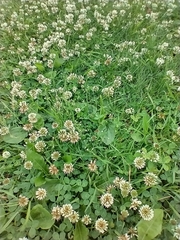
White CloverEats
Saanen goats graze on white clover and other pasture plants.
Danger 1/5 · Very low
Saanen goats are friendly, but it's best to approach them calmly and with an adult.
Compare ears, muzzle, tail, feet and coat markings. Size is hard to judge without something nearby for scale, and young mammals may not have adult coloring yet. Mammal Identifier: upload a photo and compare the visible details.
70-90 cm
60-90 kg
8-12 years
Saanen goats are browsers that nibble leaves, twigs and shrubs, plus hay on farms, turning them into nutritious milk.
1-3
145-155 days
From the Saanen valley and the neighbouring Obersimmental in the Canton of Bern, Switzerland. Since the 19th century they have been exported widely and are now reported from more than 80 countries.
In Switzerland, Saanens average 838 kg of milk in a lactation of 264 days, about 3.2 kg a day. Swiss breeders aim for more than 830 kg in 220 days.
Some do and some don't. Saanens can be horned or naturally hornless, and the Swiss breed standard accepts both.
Their skin is pale, and the breed does not tolerate strong sun well, so Saanens need shade in hot, sunny places. Coloured Sable Saanens have darker skin, which helps protect them.
Colour. Sables are Saanen-type goats in any colour except white or cream. New Zealand recognised them in the 1980s, and the USA has registered them as a separate breed since 2005.
No. Goats are curious browsers that nibble and taste things to check whether they are food, including paper and cardboard, but they don't eat metal cans.
Wide, horizontal pupils give prey animals a sharp, panoramic view of the ground around them. When a goat lowers its head, its eyes roll so the pupils stay roughly level.
Approach goats calmly with an adult and follow the farm's rules. Afterwards, wash your hands with soap and running water to help stop germs from spreading.
Take the discovery with you
Snap it with Snappit to identify it, learn what makes it special, and add the discovery to your collection.


 Herbivorous