
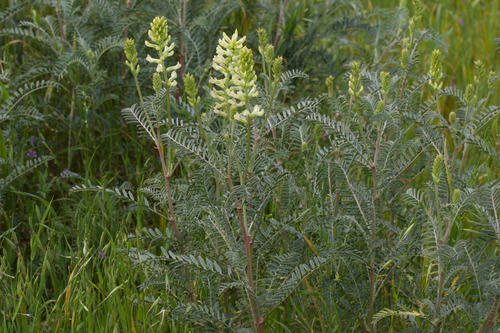


San Joaquin Milkvetch
astragalus asymmetricus
The San Joaquin Milkvetch is an eye-catching, robust perennial herb native exclusively to California's Central Valley and the surrounding foothills. Belonging to the diverse Fabaceae (pea) family, this plant is known for its tall, leafy, erect stems and striking clusters of cream-colored flowers. It plays a unique role in its dry, grassy ecosystems, adapted to thrive under the intense summer heat of California's interior valley. While it looks delicate, it is a tough survivor with a chemically complex makeup. Historically, members of the Astragalus genus are notorious for their chemical defenses, earning some species the name 'locoweed' due to their toxic effects on grazing livestock. For nature enthusiasts exploring California's oak woodlands and open grasslands, spotting this endemic milkvetch is a treat, especially when its highly unusual, asymmetric seed pods swing in the breeze.
Habitat: Typically found in the dry grasslands, oak woodlands, and open scrublands of California's Central Valley and Coast Ranges, often thriving in clay or sandy-loam soils.
This erect perennial herb stands between 50 to 120 centimeters tall, supported by thick, hollow, pale green stems covered in fine, clean hairs. Its leaves are divided into numerous small, oval leaflets arranged in pairs along a central stalk. During spring, it produces dense, showy clusters of tubular, cream-colored to pale yellow pea-like flowers. The most distinguishing feature of this plant is its seed pods: they are heavily inflated, hanging downwards on long, thin stalks, and noticeably lopsided or asymmetric in shape.
Category
PlantsRarity
Common
Danger
1/5 · Very low
Snaps
Be the first to snap!
Like several other Astragalus species, it is classified as a 'locoweed' because it contains swainsonine, an alkaloid toxic to the nervous systems of horses and cattle.
The papery, inflated seed pods act like tiny balloons, allowing them to float on water or roll along the ground in high winds to spread their seeds.
The species name 'asymmetricus' directly references the plant's highly unusual, lopsided seed pods that hang unevenly from their stalks.
It can absorb and concentrate high levels of selenium from the soil, making its tissues toxic to herbivores and deterring grazing.
Hosts symbiotic Rhizobium bacteria in its root nodules to convert atmospheric nitrogen into usable nutrients, enriching poor soils.
Produces highly inflated, lightweight, asymmetric seed pods that act as sails, catching the wind easily to disperse seeds away from the parent plant.
As an autotrophic plant, the San Joaquin Milkvetch produces its own energy via photosynthesis, converting sunlight, water, and carbon dioxide into sugars.
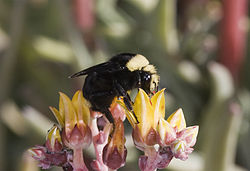
Bombus vosnesenskii
Provides nectar and pollen, relying on this native bee species for pollination.
Bos taurus
Occasionally grazes the foliage, which can lead to severe toxic neurological symptoms known as locoweed poisoning.
Apis mellifera
Visits the creamy blossoms during spring to forage for nectar and assist in pollination.
No trait badges are assigned for this object yet.
No aliases listed yet.
Collections for this object will appear here as more themes are added.
Danger
1/5 · Very low
No special safety notes yet.
Start with the whole plant, then compare leaf arrangement, leaf edges, stems and any flowers or fruit. Opposite leaves grow in pairs; alternate leaves come one at a time along the stem. These details tell you far more together than a single green leaf does. Plant Identifier: upload a photo and compare the visible details.
50-120 cm
3-10 years
As an autotrophic plant, the San Joaquin Milkvetch produces its own energy via photosynthesis, converting sunlight, water, and carbon dioxide into sugars.
Typically found in the dry grasslands, oak woodlands, and open scrublands of California's Central Valley and Coast Ranges, often thriving in clay or sandy-loam soils.
Zoom in to split clusters and explore where this object has been snapped.
Recent snaps will appear here as new observations are added.
Take the discovery with you
Snap it with Snappit to identify it, learn what makes it special, and add the discovery to your collection.


















