

Sandhill Milkweed
asclepias humistrata
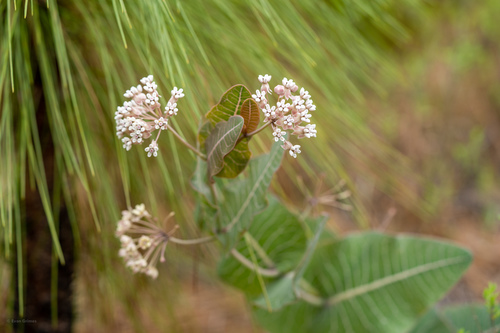
Sandhill Milkweed (Asclepias humistrata) is a remarkable perennial wildflower native to the sandy pinelands and scrublands of the southeastern United States. Unlike many upright milkweed species, it exhibits a unique sprawling, prostrate growth habit, running along the ground like a vine. This hardy plant plays a crucial ecological role as a larval host for monarch butterflies, providing essential nourishment to caterpillars in dry, fire-dependent sandhill ecosystems where other vegetation struggles to survive.
Habitat: Found in dry, sandy soils, particularly in longleaf pine sandhills, scrub, and open sand dunes.
This plant is easily identified by its sprawling stems that trail along the ground, usually growing 30 to 90 centimeters in length. The most striking feature is its large, thick, ovate leaves, which clasp the stem directly and feature brilliant, contrast-rich veins colored in shades of lavender, pink, or deep purple. In late spring, it produces rounded, umbrella-like clusters of intricate flowers that range in color from pale pinkish-purple to off-white, attracting a variety of native pollinators.
Category
PlantsRarity
Common
Danger
1/5 · Very low
Snaps
Be the first to snap!
Caterpillars feeding on this plant actually store the milkweed's toxins in their own bodies, making them poisonous to birds and other predators.
Its heavily colored, contrasting purple veins are thought to serve as aposematic (warning) signals to warn herbivores of its high toxicity.
The scientific name 'humistrata' translates to 'spread on the ground', directly referencing its unique flat, prostrate growth habit.
Produces a toxic milky latex rich in cardenolides (cardiac glycosides) that deters most herbivores from eating its foliage.
Possesses a very deep, fleshy taproot that stores water and nutrients, allowing it to thrive in extremely dry, fast-draining sandy soils.
Adapted to fire-prone ecosystems, easily resprouting from its deep taproot shortly after wildfires sweep through its habitat.
As a photoautotroph, Sandhill Milkweed generates its own energy using sunlight, water, carbon dioxide, and minerals absorbed through its root system.

Danaus plexippus
Provides critical food and habitat for developing larvae, which sequester the plant's toxins for their own defense.

Oncopeltus fasciatus
Feeds on the seeds, leaves, and stems, accumulating the plant's toxic cardiac glycosides.
Xylocopa micans
Visits the flowers for nectar, acting as an effective pollinator in dry pine ecosystems.
No trait badges are assigned for this object yet.
No aliases listed yet.
Collections for this object will appear here as more themes are added.
Danger
1/5 · Very low
No special safety notes yet.
Start with the whole plant, then compare leaf arrangement, leaf edges, stems and any flowers or fruit. Opposite leaves grow in pairs; alternate leaves come one at a time along the stem. These details tell you far more together than a single green leaf does. Plant Identifier: upload a photo and compare the visible details.
30-90 cm
5-20 years
As a photoautotroph, Sandhill Milkweed generates its own energy using sunlight, water, carbon dioxide, and minerals absorbed through its root system.
Found in dry, sandy soils, particularly in longleaf pine sandhills, scrub, and open sand dunes.
Zoom in to split clusters and explore where this object has been snapped.
Recent snaps will appear here as new observations are added.

Florida, US
You might spot Lady Lupine, Woolly Pawpaw, and Tarflower.
View guide →

Alabama, US
You might spot Scarlet Calamint and Golden Silk Spider.
View guide →
Florida, US
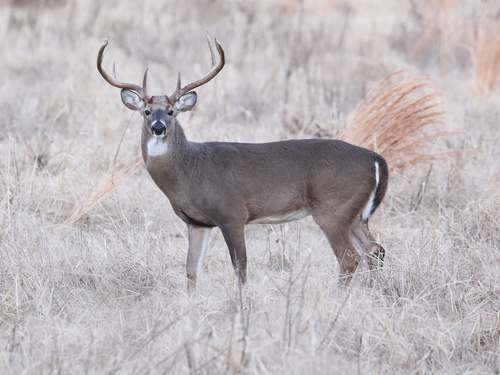
You might spot White-Tailed Deer, American Alligator, and Garberia.
View guide →

Georgia, US
You might spot Monarch, Sandhill Milkweed, and Fiery Skipper.
View guide →
Take the discovery with you
Snap it with Snappit to identify it, learn what makes it special, and add the discovery to your collection.