
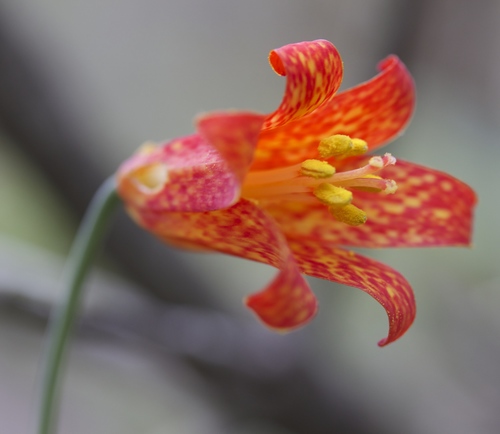


Scarlet Fritillary
fritillaria recurva
The Scarlet Fritillary (Fritillaria recurva) is a striking perennial wildflower native to the dry, open woodlands and chaparral slopes of northern California and southern Oregon. Standing as a brilliant beacon in the early spring understory, this bulbous herb is highly prized by hikers and botanists alike for its unusually vibrant coloration. Unlike many of its more muted relatives in the lily family, this species produces nodding, bell-shaped blossoms of brilliant scarlet and orange, which serve as crucial early-season nectar sources for migrating hummingbirds. The plant grows from a specialized bulb surrounded by small, rice-grain-like bulblets, allowing it to survive hot, dry summers safely underground and burst into bloom as soon as the spring temperatures begin to warm.
Habitat: Found in dry, open coniferous forests, oak woodlands, and chaparral slopes, often on clay or serpentine soils in southern Oregon and northern California.
This plant is easily recognized by its terminal, nodding, bell-shaped flowers that range in color from scarlet red to deep orange on the outside, and are heavily checkered with yellow on the inside. A key identifying feature is its tepals, which are strongly recurved, or swept backward at the tips. The flowers hang singly or in loose clusters of up to nine on slender, upright stems that grow 30 to 90 centimeters tall, surrounded by narrow, lance-shaped leaves arranged in whorls along the lower stem.
Category
PlantsRarity
Common
Danger
1/5 · Very low
Snaps
Be the first to snap!
Hummingbirds are the primary evolutionary driver behind the flower's bright red color, as bees cannot easily see red light, leaving the nectar primarily for avian pollinators.
Native American tribes of the Pacific Northwest historically harvested the starchy, rice-like bulbs of related Fritillaria species, steaming or boiling them into a nutritious food source.
The bulbs of the Scarlet Fritillary are covered in tiny, white offset bulbs that look exactly like grains of white rice, earning them the nickname 'rice-root'.
The backward-curving tepals expose bright interior markings and guide hummingbirds perfectly into contact with the plant's reproductive organs.
The underground bulb produces numerous small, detachable offsets resembling grains of rice, allowing the plant to propagate vegetatively.
The plant completely withers after a short spring flowering window, storing all its resources underground to endure harsh summer droughts.
As a photosynthetic plant, the Scarlet Fritillary manufactures its own food using sunlight, water, carbon dioxide, and essential nutrients absorbed from the soil.

Selasphorus rufus
Serves as a primary pollinator, attracted to the scarlet, tubular flowers for nectar.

Calypte anna
Feeds on the nectar during early spring migration, helping to cross-pollinate the blossoms.

Odocoileus hemionus
Occasionally browses on the tender emerging shoots and flower buds in early spring.
No trait badges are assigned for this object yet.
No aliases listed yet.
Collections for this object will appear here as more themes are added.
Danger
1/5 · Very low
No special safety notes yet.
Start with the whole plant, then compare leaf arrangement, leaf edges, stems and any flowers or fruit. Opposite leaves grow in pairs; alternate leaves come one at a time along the stem. These details tell you far more together than a single green leaf does. Plant Identifier: upload a photo and compare the visible details.
30-90 cm
0.02-0.15 kg
5-15 years
As a photosynthetic plant, the Scarlet Fritillary manufactures its own food using sunlight, water, carbon dioxide, and essential nutrients absorbed from the soil.
Found in dry, open coniferous forests, oak woodlands, and chaparral slopes, often on clay or serpentine soils in southern Oregon and northern California.
Photosynthesis
Zoom in to split clusters and explore where this object has been snapped.
Recent snaps will appear here as new observations are added.
Take the discovery with you
Snap it with Snappit to identify it, learn what makes it special, and add the discovery to your collection.


















