





poison hemlock
Conium maculatum
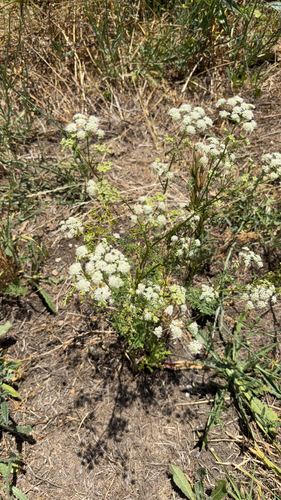
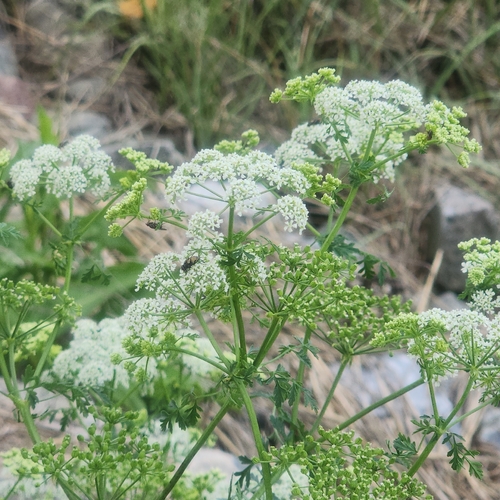
Poison hemlock is a tall plant with pretty white flowers that can be found in some fields and along roadsides. It is very important to remember that this plant is not safe to touch or eat!
Habitat: Wetlands
The poison hemlock has hollow stems marked with distinctive purple blotches, and finely divided, fern-like leaves. Its small white flowers grow in flat-topped clusters resembling tiny umbrellas.
Category
PlantsRarity
Rare
Danger
5/5 · Extreme
Snaps
53
Even touching poison hemlock can cause a rash or skin irritation for some sensitive people.
Its scientific name, Conium, means “whirl” or “dizzy” in Greek, describing its effect.
Socrates, a famous ancient Greek, was condemned to die by drinking poison hemlock.
This plant is often mistaken for edible wild carrots or parsley, which is very dangerous!
Poison hemlock produces potent alkaloids, helping it defend against almost all hungry animals that try to eat it.
Poison hemlock can rapidly grow and spread in disturbed soils, helping it quickly outcompete native plants for space.
Poison hemlock produces thousands of tiny seeds per plant, ensuring its successful reproduction and wide dispersal.
Apis mellifera
Visits flowers, but nectar can be toxic.
Musca domestica
One of many generalist insect pollinators.
Cavariella aegopodii
Specialized aphid feeds on its sap.
Marked with spots or patches of a different color.
Flowering plants are any plants that produce flowers as part of their reproductive cycle.
Biennial plants complete their life cycle over two growing seasons, typically forming foliage in the first year and flowering/seeding in the second.
This trait signifies organisms belonging to a very old evolutionary group with ancestors dating back millions of years.

This habitat trait identifies species found in wetlands, which are areas of land saturated with water, either permanently or seasonally, including marshes, swamps, and bogs.

Toxic organisms contain substances that are poisonous and can cause adverse effects upon exposure.

Poisonous organisms produce toxins that can cause harm when ingested, inhaled, or absorbed through contact.
No aliases listed yet.
Danger
5/5 · Extreme
Never touch or eat any part of the poison hemlock plant. Always ask an adult if you're unsure about a plant.
The easiest way to identify poison hemlock is to use the Snappit nature identifier app.
100-300 cm
50-100 cm
0.2-0.5 cm
Late spring to summer
No
Deadly
Biennial
Zoom in to split clusters and explore where this object has been snapped.
Jun 14, 2026
Arastradero PreservePhoto attribution
no rights reserved
License: CC0 1.0 ↗
Image may be shown cropped inside the card frame.
Jun 6, 2026
Ocean City Residential Historic DistrictPhoto attribution
(c) Peter A. Greenberg, some rights reserved (CC BY)
License: CC BY 4.0 ↗
Image may be shown cropped inside the card frame.

California, US
You might spot Acorn Woodpecker and Western Fence Lizard.
View guide →

Illinois, US
You might spot Chicory, Hackberry Emperor, and Compass Plant.
View guide →

Ohio, US
You might spot Large White Trillium, Fire Pink, and Christmas Fern.
View guide →
Maryland, US
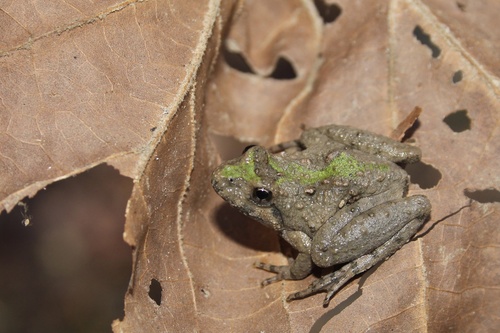
You might spot Northern Cricket Frog and Common Whitetail.
View guide →

California, US
You might spot Sunburst Anemone, Ochre Sea Star, and Striped Shore Crab.
View guide →

Colorado, US
You might spot Common Starlily and Wholeleaf Paintbrush.
View guide →
Take the discovery with you
Snap it with Snappit to identify it, learn what makes it special, and add the discovery to your collection.









.jpg&width=800)



_001.jpg&width=800)




