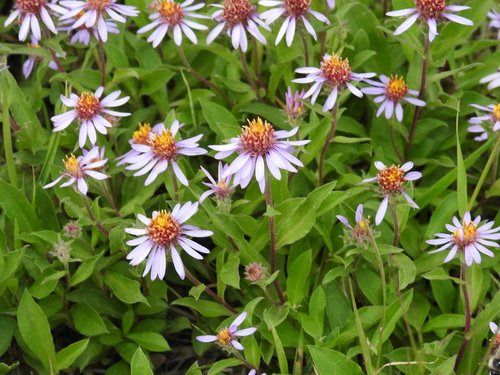


Siberian Aster
eurybia sibirica
The Siberian Aster (Eurybia sibirica) is a hardy, perennial wildflower that thrives in the cold, rugged terrains of the subarctic and alpine regions. Part of the aster family, this resilient plant brings vibrant bursts of purple and gold to rocky slopes, gravelly riverbanks, and open woodlands. It plays a vital ecological role, providing early-to-mid-season nectar for northern pollinators when resources can be scarce. Its ability to tolerate extreme cold and poor soils makes it a true survivor of the northern wilderness, capturing the hearts of hikers and botanists alike with its delicate, star-like blooms set against harsh backdrops.
Habitat: Found in gravelly riverbars, subalpine meadows, open coniferous forests, and rocky slopes of arctic and subarctic regions.
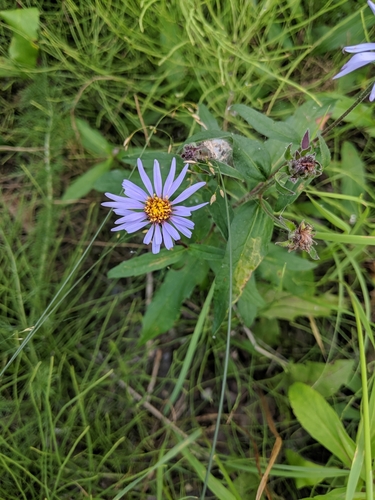
This perennial herb grows between 10 to 60 centimeters tall, featuring lance-shaped, alternate green leaves that often have slightly serrated margins. The daisy-like flower heads are concentrated at the top of reddish-brown, finely haired stems. Each flower showcases narrow violet-to-purple ray florets surrounding a central disc. This central disc starts as a bright yellow and gradually matures to a reddish-purple hue as the flower ages.
Category
PlantsRarity
Common
Danger
1/5 · Very low
Snaps
1
In addition to dispersing seeds via the wind, the Siberian Aster can propagate vegetatively, forming dense clonal colonies from a single parent plant.
The genus name 'Eurybia' comes from the Greek word for 'wide' or 'broad', referencing the extensive distribution of these hardy northern asters.
The plant's preference for gravelly, disturbed areas makes it a pioneer species that helps stabilize riverbeds and prevent soil erosion.
Produces natural cryoprotectant compounds in its cells, allowing it to withstand sub-zero arctic temperatures without tissue damage.
Utilizes creeping underground rhizomes to anchor securely in unstable gravel riverbeds and rapidly regenerate after physical disturbances.
Changes its central disc color from yellow to reddish-purple after pollination, signaling to visiting insects which flowers no longer contain nectar.
As a photoautotrophic plant, the Siberian Aster synthesizes its own food using sunlight, carbon dioxide, water, and essential soil minerals.
Bombus polaris
The bumblebee feeds on nectar and serves as a primary pollinator of the flower.
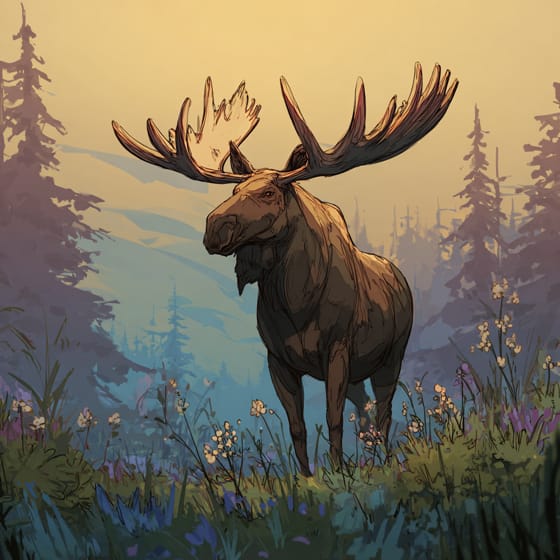
Alces alces
Browses on the leafy green stems of the aster during the early summer season.
Glomus intraradices
Helps the aster absorb vital nutrients, especially phosphorus, in nutrient-poor northern soils.
No trait badges are assigned for this object yet.
No aliases listed yet.
Collections for this object will appear here as more themes are added.
Danger
1/5 · Very low
No special safety notes yet.
The easiest way to identify Siberian Aster is to use the Snappit nature identifier app.
10-60 cm
3-10 years
As a photoautotrophic plant, the Siberian Aster synthesizes its own food using sunlight, carbon dioxide, water, and essential soil minerals.
Found in gravelly riverbars, subalpine meadows, open coniferous forests, and rocky slopes of arctic and subarctic regions.
Zoom in to split clusters and explore where this object has been snapped.
Jul 17, 2019
Gakona Historic DistrictPhoto attribution
(c) Alexandria 'Alex' Wenninger, some rights reserved (CC BY)
License: CC BY 4.0 ↗
Image may be shown cropped inside the card frame.
Take the discovery with you
Snap it with Snappit to identify it, learn what makes it special, and add the discovery to your collection.












.jpg&width=800)



_001.jpg&width=800)




