
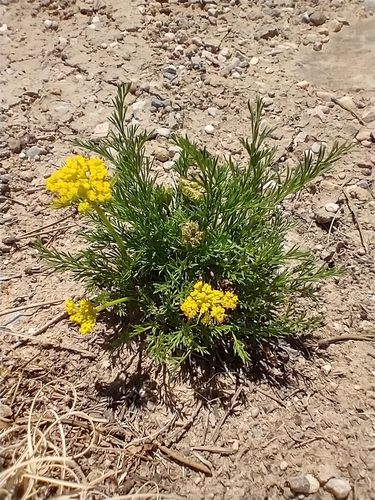


Slender Wildparsley
musineon tenuifolium
Slender Wildparsley (Musineon tenuifolium) is a charming, low-growing perennial herb native to the rocky ridges and windswept prairies of the Western Great Plains and Rocky Mountain foothills. A resilient member of the carrot family (Apiaceae), this tough little plant is beautifully adapted to thrive in harsh, barren soils where few other species can survive. By forming compact, cushion-like rosettes, it hugs the ground to shelter itself from drying prairie winds, adding a delicate touch of green and bright yellow to otherwise stark, rocky terrains during the spring and early summer months.
Habitat: Found on dry, rocky or gravelly hillsides, limestone outcrops, and barren clay slopes in foothill and prairie ecosystems.
This species is characterized by its highly dissected, bright green to blue-green foliage, featuring compound leaves with extremely narrow, thread-like segments that give it a feather-like appearance. It grows in low, spreading tufts or rosettes reaching heights of only 5 to 25 centimeters. During its blooming period from May to July, it sends up short, leafless stalks tipped with dense, umbrella-like clusters (umbels) of tiny, brilliant yellow flowers that eventually mature into small, ribbed, dry seeds.
Category
PlantsRarity
Common
Danger
1/5 · Very low
Snaps
Be the first to snap!
Because of its ability to thrive on harsh clay barrens and rocky outcrops, it acts as a pioneer species that helps stabilize loose soil and prevent erosion on steep slopes.
It is a wild cousin of commercial kitchen staples like carrots, celery, parsley, and parsnips, all sharing the distinctive umbrella-shaped flower structure.
The scientific species name 'tenuifolium' literally translates to 'slender-leaved' in Latin, directly referencing its thread-like leaf segments.
Its highly divided, thread-like leaves minimize surface area, significantly reducing water loss through transpiration in arid conditions.
Develops a tough, deep taproot that anchors the plant firmly in unstable rocky soils and accesses deep, hard-to-reach moisture reserves.
Grows in a prostrate, low-profile mat structure that deflects strong prairie winds and creates a microclimate to conserve ambient moisture.
As a primary producer, Slender Wildparsley creates its own energy using sunlight, water, carbon dioxide, and essential minerals from the soil.

Papilio polyxenes
The larvae of this butterfly feed on the nutrient-rich foliage of Slender Wildparsley, which serves as an essential developmental host.
Bombus huntii
This native pollinator visits the bright yellow umbels for nectar and pollen, facilitating cross-pollination for the plant.

Lepus californicus
This herbivore grazes on the exposed green leaves of the plant, especially in early spring when other vegetation is scarce.
No trait badges are assigned for this object yet.
No aliases listed yet.
Collections for this object will appear here as more themes are added.
Danger
1/5 · Very low
No special safety notes yet.
Start with the whole plant, then compare leaf arrangement, leaf edges, stems and any flowers or fruit. Opposite leaves grow in pairs; alternate leaves come one at a time along the stem. These details tell you far more together than a single green leaf does. Plant Identifier: upload a photo and compare the visible details.
5-25 cm
3-10 years
As a primary producer, Slender Wildparsley creates its own energy using sunlight, water, carbon dioxide, and essential minerals from the soil.
Found on dry, rocky or gravelly hillsides, limestone outcrops, and barren clay slopes in foothill and prairie ecosystems.
Zoom in to split clusters and explore where this object has been snapped.
Recent snaps will appear here as new observations are added.
Take the discovery with you
Snap it with Snappit to identify it, learn what makes it special, and add the discovery to your collection.


















