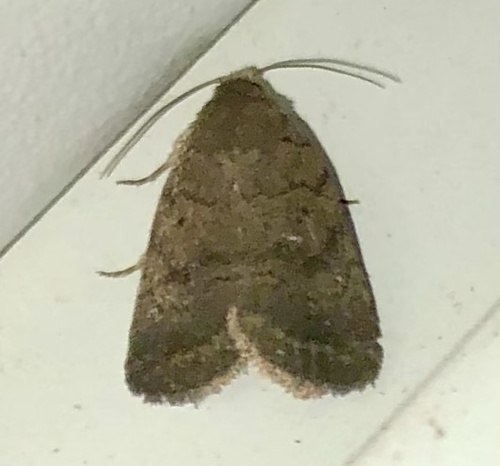


Slowpoke Moth
athetis tarda
The Slowpoke Moth (Athetis tarda) is a subtle yet fascinating member of the owlet moth family, Noctuidae. Found throughout eastern North America, this small, unassuming moth gets its common name from its relatively lethargic movements when disturbed and its sluggish behavior. Unlike more vibrant species, it relies on camouflage, blending seamlessly into dried leaves, bark, and forest floor debris. While it may not draw immediate attention with flashy colors, the Slowpoke Moth plays a crucial role in its local ecosystems. As caterpillars, they serve as efficient decomposers and herbivores, feeding on low-growing vegetation, while the adults act as pollinators during their nocturnal flights. This species is a wonderful example of the quiet, unseen biodiversity that thrives in woodlands and suburban gardens alike.
Habitat: Typically found in deciduous forests, open woodlands, old fields, and suburban gardens where low-growing herbaceous plants are abundant.
The Slowpoke Moth has a wingspan ranging from 2 to 3 cm, featuring forewings colored in earthy shades of grayish-brown, clay, or tan, often with a slightly mottled texture. Its markings are subtle, including faint, dark wavy lines and a small, often indistinct dark spot near the center of each forewing. In contrast, the hindwings are noticeably lighter, often a semi-translucent grayish-white or pale buff with darker veins and a thin dark border. When resting, it folds its wings flat over its back in a triangular shape, mimicking a piece of bark or a dead leaf.
Category
InsectsRarity
Common
Danger
1/5 · Very low
Snaps
Be the first to snap!
Like many owlet moths, it has specialized hearing organs on its thorax that can detect the echolocation clicks of hunting bats, allowing it to take evasive action.
The common name 'Slowpoke' is a playful nod to both its slow, sluggish movements when cold and its late flight season relative to other moths.
While resting, this moth presses its body flat against tree trunks, perfectly aligning its wing pattern with the bark textures to escape visual detection.
Its mottled grayish-brown forewings mimic dead leaves and tree bark perfectly, rendering it virtually invisible to predators when resting.
Instead of flying away when threatened, it often drops to the ground and plays dead, relying on its leaf-like appearance to escape notice.
Equipped with highly sensitive compound eyes and antennae, it navigates and locates nectar sources in complete darkness.
Caterpillars feed on low-growing herbaceous plants and leaf litter, while the adult moths drink nectar from various flowers.

Taraxacum officinale
The caterpillars feed on the leaves of this abundant weed.

Myotis lucifugus
The adult moths are hunted during their nocturnal flights by this common bat species.

Leucauge venusta
Opportunistic spiders capture the adult moths in webs woven in vegetation.
No trait badges are assigned for this object yet.
No aliases listed yet.
Collections for this object will appear here as more themes are added.
Danger
1/5 · Very low
No special safety notes yet.
Compare resting wing shape, forewing markings, antennae and body build. Small brown moths can hinge on fine details a phone photo can't always catch. Moth Identifier: upload a photo and compare the visible details.
1+ cm
2+ cm
0.0001+ kg
1+ years
8 km/h
Caterpillars feed on low-growing herbaceous plants and leaf litter, while the adult moths drink nectar from various flowers.
Typically found in deciduous forests, open woodlands, old fields, and suburban gardens where low-growing herbaceous plants are abundant.
Zoom in to split clusters and explore where this object has been snapped.
Recent snaps will appear here as new observations are added.
Take the discovery with you
Snap it with Snappit to identify it, learn what makes it special, and add the discovery to your collection.