
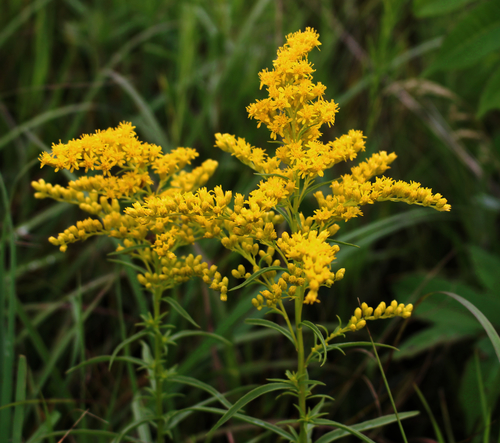


Solidago Subsect. Junceae
junceae
Solidago Subsection Junceae, commonly known as the early goldenrods, represents a beautiful and resilient group of perennial wildflowers within the aster family. Renowned for their brilliant yellow blooms that announce the transition from summer to autumn, these plants are crucial players in their native ecosystems. Unlike many other goldenrod species that bloom late in the fall, members of subsection Junceae showcase their vibrant, plume-like flower heads as early as mid-summer. This early flowering strategy provides an invaluable food source for a diverse range of pollinators when other nectar sources begin to dwindle. These hardy wildflowers are highly adaptable, often colonizing dry, nutrient-poor soils where other plants struggle to survive. Their extensive, fibrous root systems help stabilize soil and prevent erosion, while their tough, slender stems stand resilient against wind and weather. For nature enthusiasts and gardeners alike, they are a symbol of late-summer warmth and ecological vitality.
Habitat: Found in dry, open soils of prairies, fields, pastures, roadsides, and open upland woodlands.
Members of Solidago subsect. Junceae are distinguished by their hairless, often reddish-green stems growing to a height of 30 to 120 cm. Their leaves are lance-shaped, with the lower basal leaves being significantly larger, sharply toothed, and tapering to winged petioles, while the upper stem leaves are smaller, narrower, and smooth-edged. The defining visual feature is the arrangement of their small, yellow flower heads, which are crowded along the upper sides of spreading, recurved branches, creating a distinctive, one-sided plume-like golden spray.
Category
PlantsRarity
Common
Danger
1/5 · Very low
Snaps
Be the first to snap!
Despite popular belief, goldenrods like the Junceae subsection do not cause hay fever; their pollen is too heavy to be wind-blown and is instead carried by insects.
Early goldenrod is one of the earliest blooming goldenrods in North America, with its golden displays starting as early as July.
The genus name Solidago comes from the Latin 'solido', meaning 'to make whole' or 'to heal', referring to the plant's traditional use in herbal medicine.
Launches its flowering phase earlier in the summer than most other goldenrods, securing early access to insect pollinators.
Possesses a deep, robust root system and waxy leaf coatings that conserve moisture in dry, nutrient-poor environments.
Releases chemical compounds from its roots into the surrounding soil to inhibit the germination of competing plant species.
Synthesizes its own energy using sunlight, water, and carbon dioxide through the process of photosynthesis.
Apis mellifera
Provides essential nectar and pollen during mid-to-late summer.
Trirhabda canadensis
Feeds on the leaves, stems, and flower heads of the plant.

Odocoileus virginianus
Occasionally browses the foliage and young stems in early spring.
No trait badges are assigned for this object yet.
Collections for this object will appear here as more themes are added.
Danger
1/5 · Very low
No special safety notes yet.
Start with the whole plant, then compare leaf arrangement, leaf edges, stems and any flowers or fruit. Opposite leaves grow in pairs; alternate leaves come one at a time along the stem. These details tell you far more together than a single green leaf does. Plant Identifier: upload a photo and compare the visible details.
30-120 cm
3-10 years
Synthesizes its own energy using sunlight, water, and carbon dioxide through the process of photosynthesis.
Found in dry, open soils of prairies, fields, pastures, roadsides, and open upland woodlands.
Zoom in to split clusters and explore where this object has been snapped.
Recent snaps will appear here as new observations are added.
Take the discovery with you
Snap it with Snappit to identify it, learn what makes it special, and add the discovery to your collection.

















