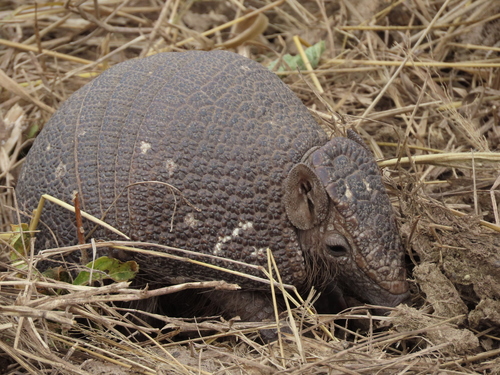


Southern Three-Banded Armadillo
tolypeutes matacus
The Southern Three-Banded Armadillo is a fascinating and highly specialized mammal native to the dry forests and grasslands of South America. Unlike most other armadillo species, it possesses the extraordinary ability to roll itself into a completely sealed, near-impenetrable ball when threatened. By nesting its head and tail tightly together, it creates a seamless armor plating of keratinized scales that confounds even the most persistent predators. These charming creatures are largely solitary and spend much of their time searching for food. With their endearing, active nature and unique defensive posture, they are a true wonder of evolutionary adaptation.
Habitat: Inhabits dry deciduous forests, savanna grasslands, and thorn scrub of the Gran Chaco region in South America.
This small, dome-shaped mammal typically measures around 22 to 27 centimeters in length, excluding its short tail, and is covered in a brownish-gray armor composed of hardened dermal scutes. It features three distinct, moveable bands across its back, which grant it the flexibility to roll into a perfect sphere. Its head and tail are also armored with triangular shields that lock together perfectly like puzzle pieces when it curls up. Its forefeet are equipped with robust claws designed for digging, while its hindfeet end in fused, hoof-like claws, giving it a distinctive, tip-toed walk.
Category
MammalsRarity
Common
Danger
1/5 · Very low
Snaps
Be the first to snap!
They are one of only two species of armadillo that can roll into a completely sealed, flawless sphere.
They walk on the tips of their front claws, giving them an amusing, tip-toeing gait that looks like they are walking on high heels.
Unlike most armadillos, they do not dig deep burrows for shelter, choosing instead to sleep in abandoned anteater burrows or under dense vegetation.
It can roll into a perfect, sealed sphere, tucking its head and tail side-by-side to lock out predators.
The gap between its body and shell traps air, acting as an insulating layer to conserve warmth or prevent overheating.
Uses its highly sensitive nose to detect insect larvae buried several centimeters beneath the soil.
Feeds primarily on insects, especially ants and termites, using its strong claws to tear open nests and bark.
Age differences: Young armadillos nurse on milk before transitioning to solid insects around two to three months of age.

Panthera onca
Large felids like jaguars are among the few predators with jaws strong enough to occasionally crack their armor.
Atta sexdens
The armadillo tears open ant mounds to feast on the larvae and adult insects.
No trait badges are assigned for this object yet.
No aliases listed yet.
Collections for this object will appear here as more themes are added.
Danger
1/5 · Very low
No special safety notes yet.
Compare ears, muzzle, tail, feet and coat markings. Size is hard to judge without something nearby for scale, and young mammals may not have adult coloring yet. Mammal Identifier: upload a photo and compare the visible details.
22+ cm
1+ kg
12+ years
15 km/h
Feeds primarily on insects, especially ants and termites, using its strong claws to tear open nests and bark.
Inhabits dry deciduous forests, savanna grasslands, and thorn scrub of the Gran Chaco region in South America.
Foraging
Zoom in to split clusters and explore where this object has been snapped.
Recent snaps will appear here as new observations are added.
Take the discovery with you
Snap it with Snappit to identify it, learn what makes it special, and add the discovery to your collection.