





Spotted Longhorn Beetle
Rutpela maculata
The Spotted Longhorn Beetle is a colorful bug with long antennae and pretty spots on its body. It loves to live in forests and can often be seen resting on flowers.
Habitat: Forests
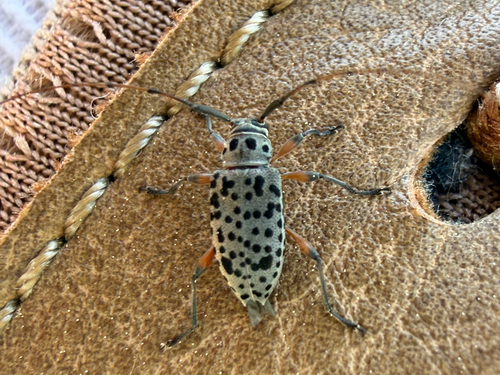
The Spotted Longhorn Beetle is slender and elongated, typically yellow-brown to orange with distinct black spots arranged in rows across its wing cases. Its long, segmented antennae are usually as long as or longer than its body, making it visually distinct from other patterned beetles.
Category
InsectsRarity
Common
Danger
1/5 · Very low
Snaps
3
Wow! Its larvae can live inside wood for over a year before becoming an adult beetle!
Wow! Some longhorn beetles can make a squeaking sound by rubbing parts of their body!
Wow! The unique spot patterns on its back are like a special fingerprint; no two are exactly alike!
Wow! Their scientific name, 'maculata,' actually means 'spotted' in Latin!
Spotted Longhorn Beetle can detect scents and vibrations from a distance because its long, jointed antennae act like sophisticated sensory organs.
Spotted Longhorn Beetle helps pollinate flowers by accidentally transferring pollen as it feeds on nectar and pollen from various plants.
Spotted Longhorn Beetle larvae can bore tunnels through decaying wood because their strong mandibles allow them to chew through tough plant fibers.
Adults feast on flower pollen and nectar, while larvae munch on decaying wood.
Age differences: Adults feed on pollen and nectar; larvae feed on decaying wood.
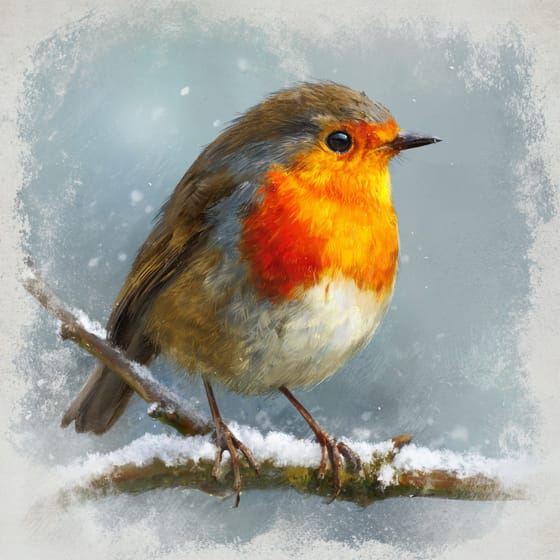
Erithacus rubecula
Robins are known to prey on insects like this beetle.
Heracleum sphondylium
It visits and pollinates the flowers of hogweed.
Quercus robur
Larvae feed on decaying wood from oak trees.
Marked with spots or patches of a different color.
Solitary animals live alone for most of their lives, only interacting with others for mating or parental care.
Camouflaged describes organisms that possess coloring or patterns that allow them to blend into their environment.
Colorful describes organisms or objects displaying a wide range of bright and distinct colors.

This trait characterizes organisms whose diet consists entirely or primarily of plant material.

Describes plants that are particularly attractive and beneficial to a wide range of pollinating organisms.

Forest habitats are terrestrial environments dominated by dense tree cover, supporting a high diversity of plant and animal life.

Diurnal animals are primarily active during daylight hours, typically resting or sleeping at night.

Describes organisms that transfer pollen, enabling the fertilization and reproduction of plants.
No aliases listed yet.
Danger
1/5 · Very low
Be gentle and watch from a distance; don't touch bugs without asking an adult.
The easiest way to identify Spotted Longhorn Beetle is to use the Snappit nature identifier app.
16-28 mm
8-14 mm
30-60 days
8 km/h
Adults feast on flower pollen and nectar, while larvae munch on decaying wood.
Forests
Foraging
Zoom in to split clusters and explore where this object has been snapped.
Jun 3, 2026
Lebanon Green Historic DistrictPhoto attribution
(c) Sawyer Baran, some rights reserved (CC BY)
License: CC BY 4.0 ↗
Image may be shown cropped inside the card frame.

Tennessee, US
You might spot Monarch and Eastern Tiger Swallowtail.
View guide →

Connecticut, US
You might spot Monarch, Downy Woodpecker, and Red-Tailed Hawk.
View guide →

US
You might spot American Holly and Eastern Gray Squirrel.
View guide →
Take the discovery with you
Snap it with Snappit to identify it, learn what makes it special, and add the discovery to your collection.







.jpg&width=800)


