
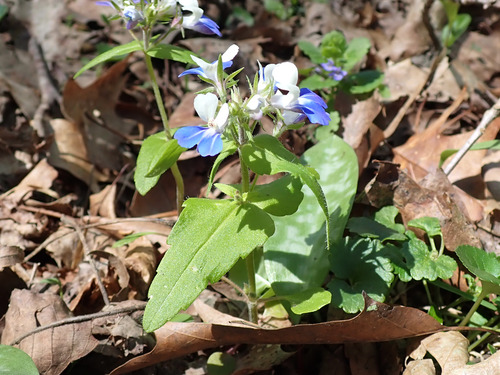


Spring Blue-Eyed Mary
collinsia verna
The Spring Blue-Eyed Mary (Collinsia verna) is a delightful winter annual wildflower native to the rich, moist woodlands of eastern North America. Appearing like a carpet of delicate blue and white stars, this plant is one of the earliest signs of spring, emerging rapidly to bloom before the forest canopy closes. It is beloved by naturalists and gardeners alike for its striking two-toned flowers, which present a clean split between pure white upper petals and deep, violet-blue lower petals. Because it is a winter annual, its seeds germinate in the autumn, allowing the young seedlings to overwinter under the snow. This head start gives them the advantage of blooming early in the spring, seizing the abundant sunlight and moisture before taller vegetation dominates. Watching a patch of Spring Blue-Eyed Mary wave in a gentle spring breeze is a truly magical experience for any woodland explorer.
Habitat: Typically found in rich, moist deciduous forests, alluvial floodplains, and shaded ravines with fertile, loamy soil.
This slender, upright wildflower typically grows between 15 to 40 centimeters tall, featuring simple, opposite leaves that are lance-shaped to ovate with finely toothed margins. The most distinctive feature is its half-inch flowers, which are arranged in whorls of two to six in the upper leaf axils. Each flower has a deeply two-lipped corolla: the two upper lobes are pristine white, while the three lower lobes are a vivid, striking sky-blue or violet-blue. This sharp color contrast makes them easily recognizable from a distance during their peak blooming period from mid-April to early June.
Category
PlantsRarity
Common
Danger
1/5 · Very low
Snaps
Be the first to snap!
It is a 'winter annual,' meaning its seeds sprout in autumn, survive under the winter snow, and quickly flower in spring.
The genus name Collinsia honors Zaccheus Collins, an 18th-century American botanist and philanthropist.
The unique two-toned white and blue flowers resemble small, elegant eyes looking up from the forest floor, hence the name 'Blue-Eyed Mary'.
Germinating in autumn, this plant overwinters as a tiny rosette under snow cover, giving it an early-start advantage in the spring.
The stark white upper petals contrast sharply with the blue lower petals to act as a highly visible nectar guide for early spring insects.
It quickly completes its entire life cycle from spring flowering to seed dispersal before the overhead tree canopy fully shades the forest floor.
As a photosynthetic plant, it generates its own energy from sunlight, water, and carbon dioxide while absorbing essential nutrients from moist forest soils.
Osmia lignaria
Visits the flowers for nectar and pollen, serving as a primary pollinator during early spring.

Bombus bimaculatus
The queens visit the blossoms early in the season to forage for energy-rich nectar.

Odocoileus virginianus
Occasionally browses on the tender spring foliage, though it is not a preferred food source.
No trait badges are assigned for this object yet.
No aliases listed yet.
Collections for this object will appear here as more themes are added.
Danger
1/5 · Very low
No special safety notes yet.
Start with the whole plant, then compare leaf arrangement, leaf edges, stems and any flowers or fruit. Opposite leaves grow in pairs; alternate leaves come one at a time along the stem. These details tell you far more together than a single green leaf does. Plant Identifier: upload a photo and compare the visible details.
15+ cm
0.01+ kg
1+ years
As a photosynthetic plant, it generates its own energy from sunlight, water, and carbon dioxide while absorbing essential nutrients from moist forest soils.
Typically found in rich, moist deciduous forests, alluvial floodplains, and shaded ravines with fertile, loamy soil.
Zoom in to split clusters and explore where this object has been snapped.
Recent snaps will appear here as new observations are added.
Take the discovery with you
Snap it with Snappit to identify it, learn what makes it special, and add the discovery to your collection.


















