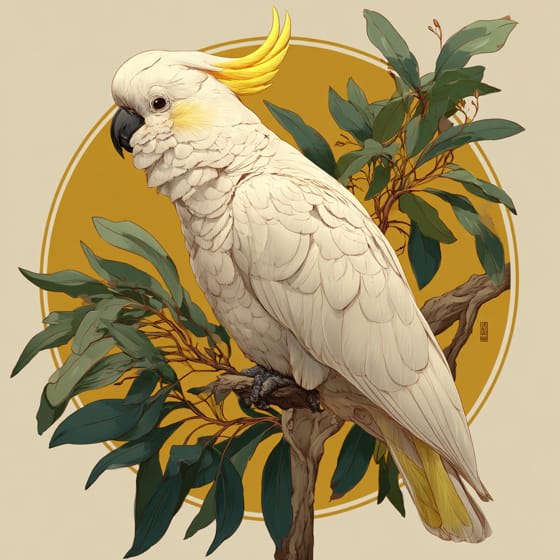





Sulphur-crested Cockatoo
Cacatua galerita
The Sulphur-crested Cockatoo is a lively bird known for its striking yellow crest! They are very social and often travel in groups.
Habitat: Forests and woodlands of Australia
The Sulphur-crested Cockatoo is a large, striking white parrot known for its prominent forward-curving yellow crest. It has a robust dark grey-black beak, with pale yellow washing on the underwings and tail. Their bright yellow crest can be raised or lowered to express mood.
Category
BirdsRarity
Rare
Danger
2/5 · Low
Snaps
Be the first to snap!
Cockatoos are very social, living in flocks of hundreds.
Their powerful beaks can snap wires and destroy timber.
These clever birds can learn to open complicated latches.
They can hang upside down using just one foot while eating!
Sulphur-crested Cockatoo can perfectly imitate human speech and various sounds because of their clever vocal cords.
Sulphur-crested Cockatoo can use and manipulate simple tools, demonstrating high intelligence and problem-solving skills.
Sulphur-crested Cockatoo has an incredibly strong beak that helps them crack open tough nuts and chew through wood.
These omnivores munch on seeds, nuts, fruits, and even small insects.

Eucalyptus globulus
Consumes seeds and nuts from eucalyptus trees.

Ficus macrophylla
Feeds on the fruits of large fig trees.
Accipiter fasciatus
Can be prey for larger birds of prey.
Feathered describes animals, primarily birds, possessing a covering of feathers.
Crested describes animals possessing a prominent tuft of feathers, hair, or skin on their head.
Social animals live in organized groups, cooperating for survival benefits such as foraging, defense, and raising offspring.
This trait identifies organisms whose diet includes both plant and animal matter.

Singing animals produce complex vocalizations, often for purposes of attracting mates, defending territory, or communicating within their species.

This trait describes organisms that manipulate external objects to achieve a specific goal.

This trait signifies organisms belonging to a very old evolutionary group with ancestors dating back millions of years.

Forest habitats are terrestrial environments dominated by dense tree cover, supporting a high diversity of plant and animal life.

This trait characterizes organisms with an exceptionally long lifespan compared to others of their kind.
Danger
2/5 · Low
Watch quietly from a distance and never try to feed or chase wild animals.
The easiest way to identify Sulphur-crested Cockatoo is to use the Snappit nature identifier app.
44-55 cm
100-110 cm
0.78-0.92 kg
20-70 years
55 km/h
These omnivores munch on seeds, nuts, fruits, and even small insects.
Forests and woodlands of Australia
Zoom in to split clusters and explore where this object has been snapped.
Recent snaps will appear here as new observations are added.

New York, US
You might spot Giraffes, Kangaroos, Wallabies and Allies, and Capybara.
View guide →
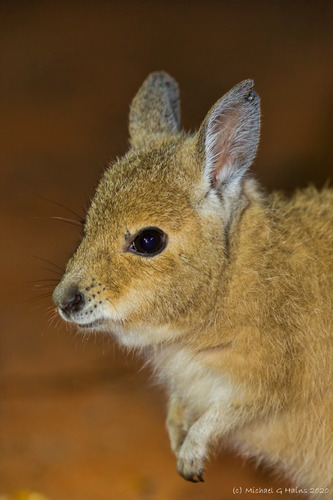
Kentucky, US
You might spot Kangaroos, Possums, Wombats, and Allies and Emu.
View guide →
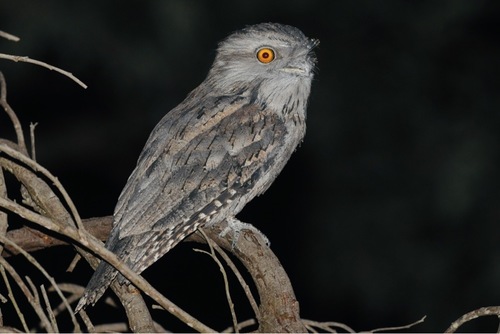
Florida, US
You might spot Tawny Frogmouth, Round-Leaf Wattle, and Noisy Miner.
View guide →
Take the discovery with you
Snap it with Snappit to identify it, learn what makes it special, and add the discovery to your collection.




.jpg&width=800)










