.jpg&width=800)





Bewick's Wren
Thryomanes bewickii
Bewick's Wrens are small, lively birds with a cheerful song. They love to hop around in bushes and trees, looking for tasty bugs to eat. Their cute, round bodies and long tails make them fun to watch!
Habitat: Urban areas, forests, and shrubby places
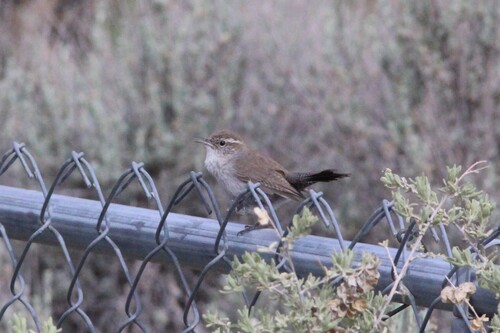
The Bewick's Wren is a small, slender bird with a grayish-brown back and whitish belly. It has a distinctive long white stripe above its eye and a relatively long tail often held cocked, showing barred outer feathers.
Category
BirdsRarity
Common
Danger
1/5 · Very low
Snaps
19
Bewick's Wrens can even learn parts of songs from other nearby bird species!
Male Bewick's Wrens sometimes build multiple "dummy" nests to impress a female!
Sadly, they have almost completely disappeared from the eastern U.S. where they once were common!
Their scientific name, *Thryomanes*, means 'rush-loving', referring to their preferred dense habitats!
Bewick's Wren can sing over 20 unique songs because of complex vocal cords, helping find mates and defend territory.
Bewick's Wren can dart quickly through dense shrubs and thickets, helping them hide from predators and find tasty insects.
Bewick's Wren has a long, twitchy tail that helps signal to other wrens and keep balance while hopping.
These tiny birds mostly feast on small insects and spiders found scurrying in plants!

Felis catus
A common predator in suburban areas.
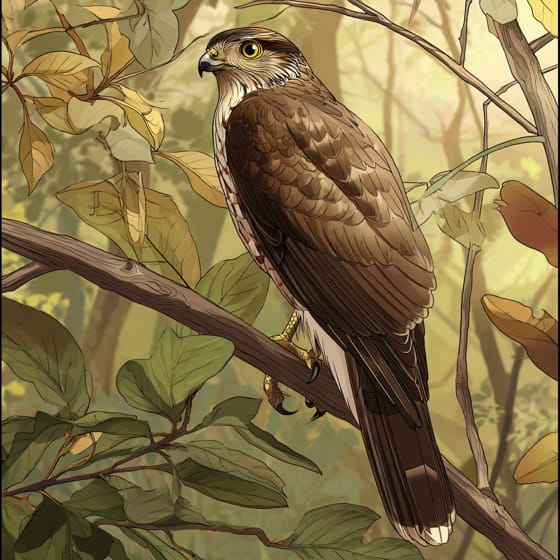
Accipiter cooperii
A frequent avian predator of small birds.

Quercus gambelii
Nests and forages in dense oak and shrub thickets.

Popillia japonica
Feeds on larvae and adults of various beetles.
Feathered describes animals, primarily birds, possessing a covering of feathers.
Social animals live in organized groups, cooperating for survival benefits such as foraging, defense, and raising offspring.
Singing animals produce complex vocalizations, often for purposes of attracting mates, defending territory, or communicating within their species.
Arboreal animals live primarily in trees, utilizing them for shelter, food, and protection from predators.

This trait identifies organisms whose diet primarily consists of insects and other small invertebrates.

Forest habitats are terrestrial environments dominated by dense tree cover, supporting a high diversity of plant and animal life.

Diurnal animals are primarily active during daylight hours, typically resting or sleeping at night.

This habitat trait indicates species that can coexist with humans in urban and suburban environments, utilizing man-made structures and green spaces.
No aliases listed yet.
Danger
1/5 · Very low
Enjoy watching birds from a distance and don't try to touch them.
The easiest way to identify Bewick's Wren is to use the Snappit nature identifier app.
12-14 cm
18-20 cm
0.008-0.012 kg
1-5 years
40 km/h
These tiny birds mostly feast on small insects and spiders found scurrying in plants!
Urban areas, forests, and shrubby places
Zoom in to split clusters and explore where this object has been snapped.
May 4, 2026
Gallup Commercial Historic DistrictPhoto attribution
(c) William Harmon, some rights reserved (CC BY)
License: CC BY 4.0 ↗
Image may be shown cropped inside the card frame.

California, US
You might spot Peridot Sweat Bee and Western Fence Lizard.
View guide →

California, US
You might spot Western Fence Lizard and Eastern Fox Squirrel.
View guide →

Washington, US
You might spot Rock Pigeon, American Crow, and Pigeon Guillemot.
View guide →

California, US
You might spot Western Fence Lizard, Duck, and Canada Goose.
View guide →

Texas, US
You might spot Giraffes, African Lion, and Eastern Black Rhinoceros.
View guide →

Nevada, US
You might spot African Lion, Tiger, and Zebra.
View guide →
Take the discovery with you
Snap it with Snappit to identify it, learn what makes it special, and add the discovery to your collection.




.jpg&width=800)








