




Sweet Alyssum
Lobularia maritima
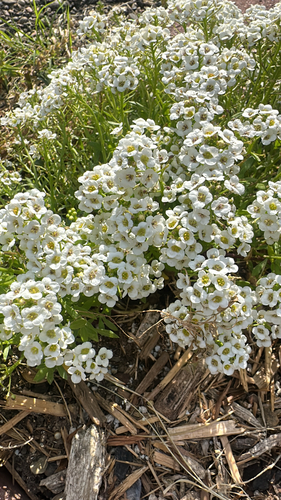
Sweet Alyssum is a delicate flower with clusters of tiny, fragrant blooms. It attracts butterflies and bees with its sweet scent and bright colors.
Habitat: Gardens, Coastal areas
The Sweet Alyssum has a sprawling growth habit, creating dense carpets of tiny, four-petaled flowers. These delicate blossoms typically appear in shades of pure white, soft pinks, lavender, and royal purple, often forming a cloud-like display. Its compact clusters make it visually distinct as a delicate groundcover.
Category
PlantsRarity
Common
Danger
1/5 · Very low
Snaps
3
Gardeners sometimes call it "Carpet of Snow" because of its dense, white flower clusters!
Its Greek name "Alyssum" means "without madness," as it was once believed to cure rabies!
Its tiny seeds can sprout and grow in surprisingly small cracks, brightening up walls or paths!
Some varieties can actually change color from white to pink or purple as their tiny flowers mature!
Sweet Alyssum releases a strong, sweet fragrance, acting as a beacon to guide insects to its tiny flowers for pollination.
This plant grows low and wide, forming a dense 'living carpet' that helps keep moisture in the soil and suppresses weeds.
Sweet Alyssum can produce tiny blossoms almost continuously for months, ensuring it creates many seeds for new plants.
Apis mellifera
collects nectar and pollen from its flowers.
Episyrphus balteatus
feeds on nectar, helping spread pollen between blossoms.
Hippodamia convergens
uses the plant's nectar and shelter while hunting garden pests.
Annual plants complete their entire life cycle, from germination to seed production, within a single growing season.
Cluster flowers are inflorescences where individual flowers are arranged closely together on a common stem.
Spring blooming plants produce their flowers during the spring season, often signifying the end of winter and the start of new growth.
Fragrant flowers emit a pleasant aroma, often to attract pollinators or for defense.

Coastal habitats are dynamic environments located along the interface between land and sea, influenced by tides, waves, and saltwater.
Danger
1/5 · Very low
Enjoy looking at these flowers, but avoid picking them to let them grow and attract more insects.
The easiest way to identify Sweet Alyssum is to use the Snappit nature identifier app.
10-30 cm
15-60 cm
0.2-0.5 cm
Spring, Summer, Fall
Yes
None
Annual
Zoom in to split clusters and explore where this object has been snapped.
Jun 6, 2026
Athens Lunatic AsylumPhoto attribution
no rights reserved
License: CC0 1.0 ↗
Image may be shown cropped inside the card frame.

Massachusetts, US
You might spot Common Eastern Bumble Bee, Bee, and American Robin.
View guide →

Ohio, US
You might spot Christmas Fern, Multiflora Rose, and American Beech.
View guide →

California, US
You might spot Western Gull, Great Blue Heron, and Anna's Hummingbird.
View guide →

California, US
You might spot Sea Lion, Western Gull, and Anna's Hummingbird.
View guide →

California, US
You might spot Western Gull, Sea Lion, and Great Blue Heron.
View guide →

California, US
You might spot Western Gull, Sea Lion, and Great Blue Heron.
View guide →
Take the discovery with you
Snap it with Snappit to identify it, learn what makes it special, and add the discovery to your collection.








.jpg&width=800)


_001.jpg&width=800)




