





sweet cicely
Osmorhiza
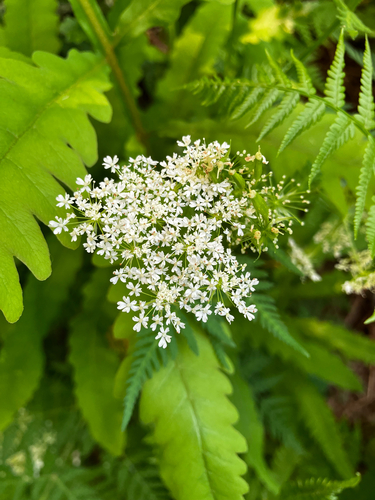
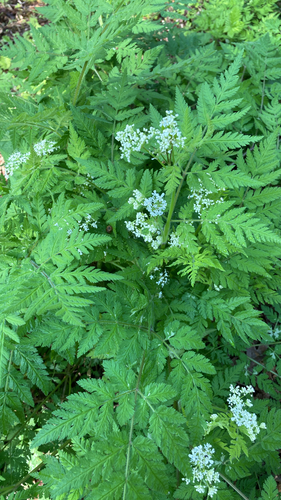
Sweet cicely is a lovely plant with feathery leaves and white flowers. It grows in shady places and has a sweet smell that attracts butterflies and bees!
Habitat: Forests
The sweet cicely has delicate, fern-like leaves, deeply cut and a vibrant bright green. It produces clusters of tiny, star-like white flowers at the top of tall, hollow stems, making it distinctively elegant in damp, shady spots.
Category
PlantsRarity
Common
Danger
1/5 · Very low
Snaps
2
Its seeds, resembling tiny green cigars, taste surprisingly like licorice!
Roman soldiers are believed to have carried sweet cicely seeds across Europe!
Rubbing its leaves releases a unique, delightful anise-like perfume!
This plant was once used to sweeten tart fruits before sugar was common!
Sweet cicely releases a strong, sweet anise fragrance that helps it attract pollinators and deter some grazing animals.
Sweet cicely produces abundant seeds that self-sow easily, helping it quickly colonize suitable shady and moist environments.
Sweet cicely has a natural sugar content in its leaves and roots, allowing it to sweeten foods without added sugar.
Apis mellifera
visiting its small white flowers for nectar
Bombus terrestris
feeding on nectar from the flower umbels
Myzus persicae
sucking sap from leaves and stems
Aromatic plants produce and emit fragrant volatile organic compounds, often for defense or to attract pollinators.
Flowering plants are any plants that produce flowers as part of their reproductive cycle.
Shade tolerant plants are adapted to grow and thrive in areas with low light levels, requiring less direct sunlight.
Spring blooming plants produce their flowers during the spring season, often signifying the end of winter and the start of new growth.

Fragrant flowers emit a pleasant aroma, often to attract pollinators or for defense.

Medicinal plants possess chemical compounds that can be used for therapeutic purposes to treat illnesses or maintain health.

Edible plants are those parts of a plant that are considered safe for human consumption.

Describes plants that are particularly attractive and beneficial to a wide range of pollinating organisms.

Forest habitats are terrestrial environments dominated by dense tree cover, supporting a high diversity of plant and animal life.
No aliases listed yet.
Danger
1/5 · Very low
Always check with an adult before touching or tasting any plants.
The easiest way to identify sweet cicely is to use the Snappit nature identifier app.
60-120 cm
30-60 cm
0.3-0.5 cm
Late spring to early summer
Yes
None
Perennial
Zoom in to split clusters and explore where this object has been snapped.
May 29, 2026
Litchfield Historic DistrictPhoto attribution
(c) Bryan Connolly, some rights reserved (CC BY)
License: CC BY 4.0 ↗
Image may be shown cropped inside the card frame.
Apr 25, 2025
FairhavenPhoto attribution
(c) larndesolen, some rights reserved (CC BY)
License: CC BY 4.0 ↗
Image may be shown cropped inside the card frame.

Washington, US
You might spot Bigleaf Maple, Mule Deer, and Oregon Grape.
View guide →

Connecticut, US
You might spot Buttonbush, Ragged-Robin, and Green Frog.
View guide →

British Columbia, CA
You might spot Western Columbine and Mountain Lady's-Slipper.
View guide →
Take the discovery with you
Snap it with Snappit to identify it, learn what makes it special, and add the discovery to your collection.







.jpg&width=800)


_001.jpg&width=800)


