

Tapirs
tapiridae
Tapirs are ancient, hog-like mammals belonging to the order Perissodactyla, making them close relatives of horses and rhinoceroses. Characterized by their compact, muscular bodies and highly flexible, prehensile noses, tapirs have roamed the Earth for tens of millions of years, earning them the title of 'living fossils.' They play a crucial ecological role as 'forest gardeners' by dispersing seeds across vast distances through their feces, thereby maintaining the structural diversity and health of their forest ecosystems. Known for being shy, solitary, and excellent swimmers, these remarkable creatures navigate dense undergrowth with ease.
Habitat: Found in dense tropical rainforests, grasslands, and montane cloud forests, almost always near bodies of water.
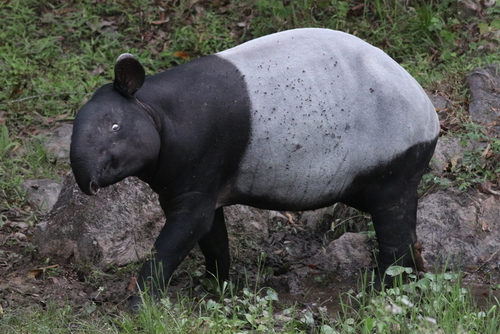
Tapirs have a distinctive barrel-shaped body, short legs, and a short, stubby tail. Their most prominent feature is their prehensile snout, which is actually an extension of the nose and upper lip. Depending on the species, their coat is either a uniform dark brown or black, or a striking high-contrast black-and-white pattern as seen in the Malayan tapir. Calves of all species are born with dark coats covered in white stripes and spots for camouflage, which fade as they mature.
Category
MammalsRarity
Common
Danger
1/5 · Very low
Snaps
Be the first to snap!
Tapir calves have watermelon-like patterns of stripes and spots that act as perfect camouflage in the dappled sunlight of the forest floor.
Tapirs have been around for over 20 million years and have changed very little, making them living fossils.
They are exceptional swimmers and can even dive or walk along the bottoms of riverbeds to feed or escape predators.
Their flexible nose allows them to grab hard-to-reach branches, pull down leaves, and even act as a snorkel while swimming.
Tapirs can submerge completely underwater to escape predators, using their nostrils as snorkels and walking on riverbeds.
As vital seed dispersers, they digest wild fruits and deposit intact seeds in nutrient-rich dung far from the parent trees.
Tapirs are strictly herbivorous browsers, feeding on a wide variety of plant matter found in the forest understory and aquatic environments.
Age differences: Calves drink milk for the first few months before gradually transitioning to solid vegetation and fruits.

Panthera onca
Jaguars are major predators of Baird's and Lowland tapirs in Central and South American rainforests.

Panthera tigris
Tigers occasionally prey upon the Malayan tapir in Southeast Asian habitats.
Atta cephalotes
Competes for fresh leaves and forest foliage in the understory of tropical rainforests.
No trait badges are assigned for this object yet.
No aliases listed yet.
Collections for this object will appear here as more themes are added.
Danger
1/5 · Very low
No special safety notes yet.
Compare ears, muzzle, tail, feet and coat markings. Size is hard to judge without something nearby for scale, and young mammals may not have adult coloring yet. Mammal Identifier: upload a photo and compare the visible details.
180-250 cm
150-375 kg
25-30 years
48 km/h
Tapirs are strictly herbivorous browsers, feeding on a wide variety of plant matter found in the forest understory and aquatic environments.
Found in dense tropical rainforests, grasslands, and montane cloud forests, almost always near bodies of water.
Foraging
Zoom in to split clusters and explore where this object has been snapped.
Recent snaps will appear here as new observations are added.

Louisiana, US
You might spot African Lion, Jaguar, and American Alligator.
View guide →

North Rhine-Westphalia, DE
You might spot Giant Anteaters, Angolan Giraffe, and Giant Otter.
View guide →

Normandy, FR
You might spot White Tiger, Giraffes, and White Rhinoceros.
View guide →

Occitania, FR
You might spot Grévy's Zebra, Giraffes, and Cheetahs.
View guide →
Take the discovery with you
Snap it with Snappit to identify it, learn what makes it special, and add the discovery to your collection.