

Teide Violet
viola cheiranthifolia
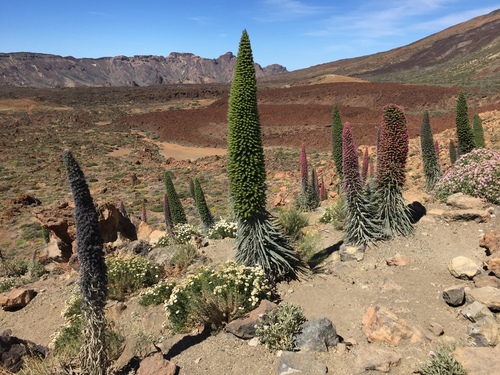
The Teide Violet (Viola cheiranthifolia) is an extraordinary, resilient perennial plant found exclusively on the high-altitude volcanic slopes of Mount Teide on Tenerife in the Canary Islands. Holding the record as the highest-flowering plant in Spain, it thrives in a harsh, alpine environment of volcanic ash and pumice, ranging from 2,000 meters to nearly the summit at 3,700 meters. This delicate-looking wildflower is a true survivor, enduring extreme temperature fluctuations, intense solar radiation, and severe drought.
Habitat: Found on high-altitude volcanic scree, pumice slopes, and rocky crevices of Mount Teide, often in barren, dry alpine conditions above 2,000 meters.
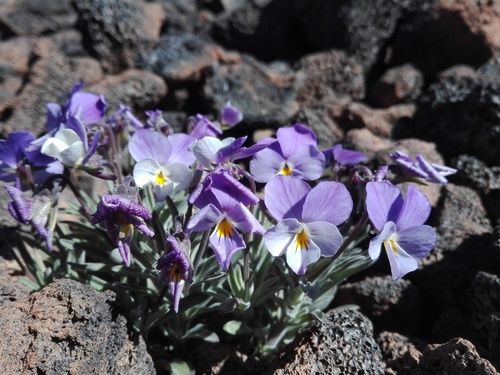
The Teide Violet is a small, low-growing herbaceous plant, typically reaching heights of only 5 to 15 cm. It forms a dense rosette of small, spade-to-oval shaped leaves covered in fine, velvety hairs that give them a silvery-grey-green appearance to protect against UV rays. Its striking, spurred flowers feature five petals in a lovely blend of violet, pale mauve, white, and a bright yellow center, making them stand out starkly against the dark, barren volcanic soils of its habitat.
Category
PlantsRarity
Common
Danger
1/5 · Very low
Snaps
Be the first to snap!
It is the highest-altitude flowering plant in Spain, thriving at elevations up to 3,700 meters on the slopes of Mount Teide.
Its scientific name, 'cheiranthifolia', means 'leaves like a wallflower', referring to the unique shape of its foliage.
The species was famously studied and documented by the legendary Prussian naturalist Alexander von Humboldt during his expedition to Tenerife in 1799.
Dense, fine hairs cover its leaves, reflecting intense high-altitude ultraviolet radiation and reducing water loss.
Produces natural antifreeze proteins and sugars within its cells to survive freezing nightly temperatures alternating with hot daytime sun.
Possesses a deep, robust taproot system that stabilizes the plant in shifting volcanic scree and accesses scarce moisture deep below.
As a photosynthetic plant, it synthesizes its own food using sunlight, carbon dioxide, and water while absorbing essential minerals from volcanic soils.
Gallotia galloti
The Canary Island lizard feeds on the flowers and fruits of the violet, occasionally assisting in seed dispersal.
Bombus canariensis
Pollinates the flowers of the Teide Violet, allowing the plant to reproduce in its harsh alpine environment.

Oryctolagus cuniculus
An introduced herbivore that heavily grazes on the Teide Violet, posing a major threat to its wild populations.
No trait badges are assigned for this object yet.
No aliases listed yet.
Collections for this object will appear here as more themes are added.
Danger
1/5 · Very low
No special safety notes yet.
Start with the whole plant, then compare leaf arrangement, leaf edges, stems and any flowers or fruit. Opposite leaves grow in pairs; alternate leaves come one at a time along the stem. These details tell you far more together than a single green leaf does. Plant Identifier: upload a photo and compare the visible details.
5-15 cm
2-5 years
As a photosynthetic plant, it synthesizes its own food using sunlight, carbon dioxide, and water while absorbing essential minerals from volcanic soils.
Found on high-altitude volcanic scree, pumice slopes, and rocky crevices of Mount Teide, often in barren, dry alpine conditions above 2,000 meters.
Zoom in to split clusters and explore where this object has been snapped.
Recent snaps will appear here as new observations are added.
Take the discovery with you
Snap it with Snappit to identify it, learn what makes it special, and add the discovery to your collection.