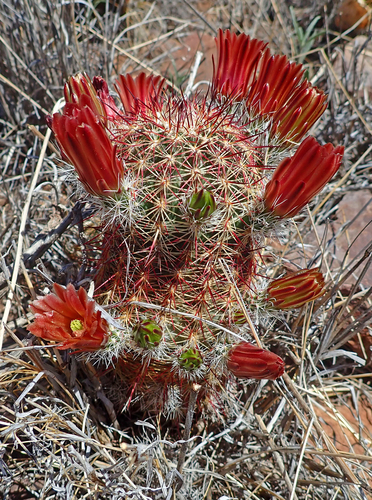


Texas Hedgehog Cactus
echinocereus chloranthus
The Texas Hedgehog Cactus (Echinocereus chloranthus) is a small, cylindrical cactus native to the arid desert regions of the southwestern United States and northern Mexico. Known for its dense, overlapping spines that range in color from yellow and brown to reddish-purple, this plant blends beautifully into its rocky surroundings. Despite its rugged exterior, it produces small, tubular, yellow-green to brownish flowers in the spring, which emerge from the sides of its stems. This charming succulent is a favorite among desert enthusiasts for its resilience and unique appearance.
Habitat: Found on dry, rocky limestone hillsides, gravelly slopes, and desert grasslands, often nestled among rocks or desert scrub.
This cactus typically grows as a single cylindrical stem, reaching heights of 5 to 25 cm. The stem is heavily covered in neat, comb-like clusters of spines that vary from translucent white and yellow to deep reddish-brown, often forming attractive bands of color along the body. Its flowers are relatively small, measuring about 2 to 3 cm wide, and exhibit a distinct greenish-yellow, bronze, or reddish hue, blooming from the sides of the stem rather than the crown.
Category
PlantsRarity
Common
Danger
1/5 · Very low
Snaps
1
During periods of extreme drought, the cactus can shrivel and pull itself closer to the ground to reduce exposure to drying winds.
Its species name 'chloranthus' translates to 'green flower', referring to its distinctly greenish blossoms.
The spines are so dense that they act like a built-in sunscreen, significantly reducing the amount of UV light reaching the plant's skin.
Opens its stomata at night to absorb carbon dioxide, minimizing water loss during hot desert days.
Thick layers of spines shade the stem from intense solar radiation and deter hungry herbivores.
Accordion-like ribs allow the stem to expand rapidly to store water after rare rainfall events.
As a photoautotrophic plant, it synthesizes its own food using sunlight, carbon dioxide, and water through photosynthesis.
Diadasia opuntiae
Pollinated by native desert bees while collecting nectar and pollen.

Neotoma albigula
Feeds on the succulent stems and fruits despite the protective spines.
No trait badges are assigned for this object yet.
No aliases listed yet.
Collections for this object will appear here as more themes are added.
Danger
1/5 · Very low
No special safety notes yet.
The easiest way to identify Texas Hedgehog Cactus is to use the Snappit nature identifier app.
5-25 cm
0.1-1.5 kg
10-30 years
As a photoautotrophic plant, it synthesizes its own food using sunlight, carbon dioxide, and water through photosynthesis.
Found on dry, rocky limestone hillsides, gravelly slopes, and desert grasslands, often nestled among rocks or desert scrub.
Zoom in to split clusters and explore where this object has been snapped.

Texas, US
You might spot Texas Hedgehog Cactus, Ornate Tree Lizard, and Cactus Wren.
View guide →
Texas, US
You might spot Texas Hedgehog Cactus, Cactus Wren, and Ornate Tree Lizard.
View guide →

New Mexico, US
You might spot Texas Rainbow Cactus, Giant Desert Centipede, and Ocotillo.
View guide →
Take the discovery with you
Snap it with Snappit to identify it, learn what makes it special, and add the discovery to your collection.











.jpg&width=800)



_001.jpg&width=800)




