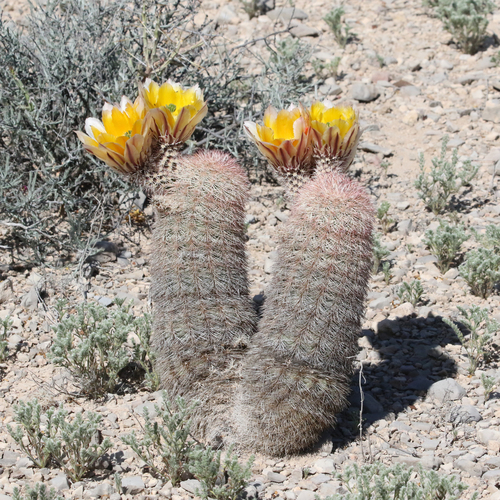


Texas Rainbow Cactus
echinocereus dasyacanthus
The Texas Rainbow Cactus (Echinocereus dasyacanthus) is a spectacular desert succulent renowned for its breathtaking, multi-colored floral displays. Native to the arid landscapes of the southwestern United States and northern Mexico, this cylindrical cactus gets its common name from the distinct, alternating bands of reddish, yellow, and grayish spines that wrap around its stem. When spring arrives, it produces massive, showy flowers that range in color from brilliant yellow and orange to dark pink, making it a favorite among desert hikers and succulent collectors alike. Extremely drought-tolerant, it thrives in rocky, well-draining soils where other plants struggle. Its compact size and remarkable resilience showcase the incredible adaptations of Chihuahuan Desert flora.
Habitat: Found on rocky limestone hillsides, gravelly slopes, and desert grasslands throughout the Chihuahuan Desert.
This cactus features a mostly unbranched, cylindrical stem that stands upright, growing between 10 to 35 centimeters tall and 5 to 10 centimeters in diameter. It is densely covered in short, comb-like spines that press close to the stem in overlapping layers; these spines display distinct, horizontal color bands of pink, yellow, rust, and gray, mimicking a rainbow. In late spring, giant funnel-shaped flowers, reaching up to 12 centimeters in diameter, erupt near the tip of the stem, exhibiting vibrant shades of yellow, gold, or dark pink with bright green stigmas at their centers.
Category
PlantsRarity
Common
Danger
1/5 · Very low
Snaps
3
Despite their intimidating spines, the ripe, greenish-purple fruits of this cactus are fleshy, edible, and historically consumed by indigenous peoples.
Its scientific name 'dasyacanthus' translates to 'shaggy spine' in Greek, referencing its densely covered stem.
The common name 'rainbow cactus' comes from the horizontal bands of differently colored spines that represent different seasons of growth.
Performs carbon dioxide uptake at night to minimize water loss through transpiration during the scorching desert day.
Dense, overlapping, multi-colored spines act as a physical sunscreen, reducing heat stress and reflecting harsh ultraviolet rays.
Possesses a shallow, wide-spreading root network that rapidly absorbs moisture from brief, light desert rain showers.
As a photosynthetic plant, the Texas Rainbow Cactus creates its own food by converting sunlight, carbon dioxide, and water into sugars.
Diadasia rinconis
Provides nectar and pollen to specialized native bees, securing pollination services in return.

Campylorhynchus brunneicapillus
Consumes the sweet, fleshy green fruits and helps disperse seeds across the desert landscape.

Sylvilagus audubonii
Occasionally gnaws on the fleshy stems for water during extreme, prolonged droughts.
No trait badges are assigned for this object yet.
No aliases listed yet.
Collections for this object will appear here as more themes are added.
Danger
1/5 · Very low
No special safety notes yet.
The easiest way to identify Texas Rainbow Cactus is to use the Snappit nature identifier app.
10+ cm
0.3+ kg
10+ years
As a photosynthetic plant, the Texas Rainbow Cactus creates its own food by converting sunlight, carbon dioxide, and water into sugars.
Found on rocky limestone hillsides, gravelly slopes, and desert grasslands throughout the Chihuahuan Desert.
14+ days
Zoom in to split clusters and explore where this object has been snapped.

Texas, US
You might spot Texas Rainbow Cactus, Ocotillo, and Greater Earless Lizard.
View guide →

Texas, US
You might spot Leonora's Dancer and Ornate Tree Lizard.
View guide →

New Mexico, US
You might spot Texas Rainbow Cactus, Giant Desert Centipede, and Ocotillo.
View guide →

New Mexico, US
You might spot Ocotillo, Texas Mountain Laurel, and Agarita.
View guide →
Take the discovery with you
Snap it with Snappit to identify it, learn what makes it special, and add the discovery to your collection.











.jpg&width=800)



_001.jpg&width=800)




