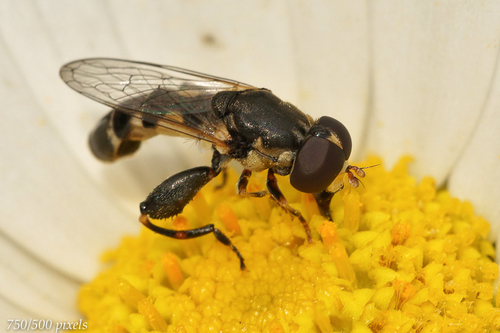


Thick-Legged Hover Fly
syritta pipiens
The Thick-Legged Hover Fly (Syritta pipiens) is a small, energetic, and highly common hoverfly species found globally. Often mistaken for a tiny wasp or bee due to its yellow-and-black coloration, this harmless insect is a fantastic garden helper. It spends its adult life darting between flowers, hovering in place with incredible precision, and feeding on pollen and nectar. Unlike many other hoverflies, it has noticeably swollen hind femora (thighs) lined with tiny spines, which give it its distinctive common name and unique silhouette.
Habitat: Found in a wide range of open environments, including suburban gardens, urban parks, meadows, and agricultural fields, typically near decaying organic material or flowering plants.
This small fly measures about 7 to 9 millimeters in length with a slender, elongated abdomen marked by orange-yellow spots or bars on a dark background. Its most defining physical trait is the dramatically swollen and thickened hind femur, which features a row of small black spines on the underside. Its face is covered in a silvery-white dust, and it possesses large, dark compound eyes that meet at the top of the head in males. Its wings are clear and lack complex patterning, extending straight along the body when at rest.
Category
InsectsRarity
Common
Danger
1/5 · Very low
Snaps
7
Despite their wasp-like appearance, they have only one pair of wings and are completely incapable of stinging or biting.
Males are highly territorial and will aggressively chase away other insects, including much larger flies, from their sunny backyard perches.
They are among the most globally widespread hoverfly species, having been accidentally introduced to many regions via soil and compost transport.
Using rapid wingbeats of up to 300 times per second, they can hover perfectly motionless in mid-air and instantly change direction.
They possess yellow-and-black abdominal markings resembling stinging wasps, deterring potential predators despite being completely harmless.
The swollen, spiny hind femora allow males to firmly grip females during mating flights, securing their partner in mid-air.
Adults feed on flower nectar and pollen for energy, while the larvae feed on bacteria found within decaying organic matter.
Age differences: Larvae are saprophagous detritivores feeding on bacteria in wet decomposing material, whereas adults are strictly nectar- and pollen-feeders.
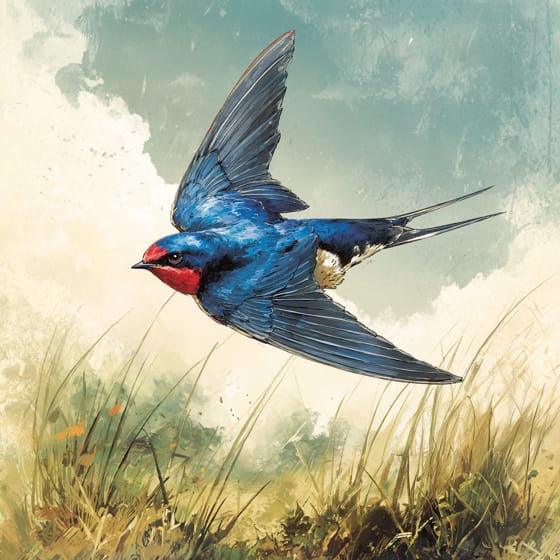
Hirundo rustica
Adult hover flies are caught in mid-air by insectivorous birds like swallows.
Daucus carota
Adult flies feed on nectar and pollen, transferring pollen between flowers in the process.
Musca domestica
Larvae compete for decaying organic matter and bacterial food sources in compost and manure piles.
No trait badges are assigned for this object yet.
No aliases listed yet.
Collections for this object will appear here as more themes are added.
Danger
1/5 · Very low
No special safety notes yet.
The easiest way to identify Thick-Legged Hover Fly is to use the Snappit nature identifier app.
1 cm
1-2 cm
0.00001-0.00003 kg
15 km/h
Adults feed on flower nectar and pollen for energy, while the larvae feed on bacteria found within decaying organic matter.
Found in a wide range of open environments, including suburban gardens, urban parks, meadows, and agricultural fields, typically near decaying organic material or flowering plants.
Foraging
Zoom in to split clusters and explore where this object has been snapped.

New York, US
You might spot Sundial Lupine, Spotted Horsemint, and New Jersey Tea.
View guide →
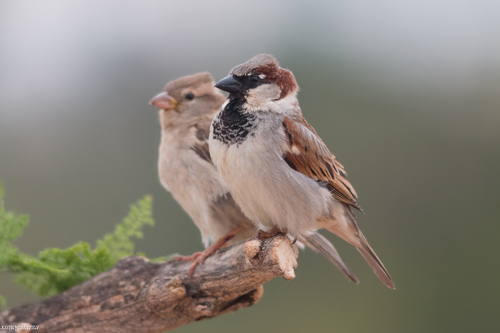
Pennsylvania, US
You might spot House Sparrow, Spotted Lanternfly, and American Robin.
View guide →

New Hampshire, US
You might spot Eastern Red-Backed Salamander and Eastern Newt.
View guide →

Virginia, US
You might spot Asian Lady Beetle, Spotted Lanternfly, and Christmas Fern.
View guide →

New York, US
You might spot Rock Pigeon, House Sparrow, and Eastern Gray Squirrel.
View guide →

US
You might spot Common Mugwort, Common Milkweed, and White Snakeroot.
View guide →
Take the discovery with you
Snap it with Snappit to identify it, learn what makes it special, and add the discovery to your collection.












.jpg&width=800)




