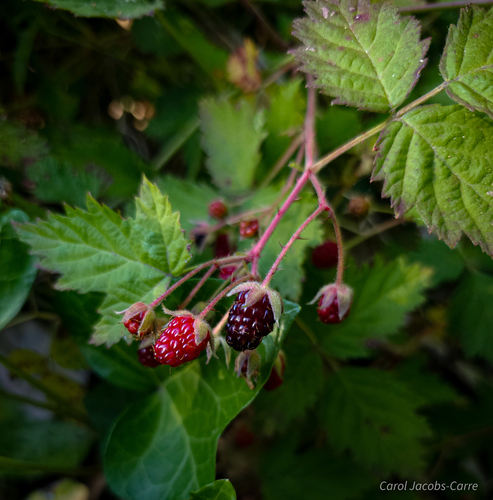


Trailing Blackberry
rubus ursinus
The Trailing Blackberry (Rubus ursinus) is a sprawling, native North American vine famous for producing some of the most deliciously tart and sweet wild blackberries in the Pacific Northwest. Unlike its invasive cousin, the Himalayan blackberry, which forms towering, impenetrable thickets, the Trailing Blackberry creeps low to the ground. It weaves through forest floors, along riverbanks, and over decaying logs, acting as a vital groundcover and an essential food source for a myriad of forest creatures. This resilient perennial has deep roots, both ecologically and culturally. Indigenous peoples of the Pacific Northwest have long harvested its succulent berries for fresh eating and drying, while its leaves are steeped for medicinal teas. Because of its exceptional flavor, Rubus ursinus has been widely used in hybridization, famously serving as a parent species for popular commercial berries like the loganberry, boysenberry, and marionberry. Spotting this delicate but prickly native vine in the wild is a true treat for nature lovers and foragers alike.
Habitat: Found in open woodlands and clearings, often trailing across the forest floor or over low vegetation.
The Trailing Blackberry is a low-growing, deciduous-to-evergreen vine with slender, trailing stems (canes) that can reach up to 6 meters in length. Its stems are heavily armed with small, fine, slightly hooked prickles that easily catch on clothing or skin. The leaves are typically compound, featuring three (sometimes five) toothed leaflets that are dark green above and paler beneath, often turning vibrant shades of red or deep burgundy in the fall and winter. In spring, it produces loose clusters of delicate, white to pale pink flowers with narrow, elongated petals. By mid-to-late summer, the female plants yield small, elongated, aggregate fruits that ripen from green to red, and finally to a deep, glossy purplish-black.
Category
PlantsRarity
Common
Danger
1/5 · Very low
Snaps
2
Because it is dioecious, foraging for wild trailing blackberries can be tricky; you might find a huge patch of vines that are entirely male and will never produce a single berry.
Indigenous peoples historically used the tough, flexible vines of the Trailing Blackberry as a binding material for making traditional tools and baskets.
The famous boysenberry, loganberry, and marionberry all trace their genetic roots back to the humble, wild Trailing Blackberry.
The scientific name 'ursinus' means 'bear-like' or 'belonging to bears', a nod to how much native bears love to gorge on these sweet summer fruits.
Unlike most other blackberry species, the Trailing Blackberry is typically dioecious, meaning individual plants are either strictly male or female and require cross-pollination to fruit.
The tips of its sprawling canes can root when they touch the soil, allowing the plant to rapidly clone itself and carpet the forest floor.
It possesses a robust root system and deep rhizomes that survive low-intensity wildfires, allowing it to quickly resprout and stabilize soil after a burn.
As a photosynthetic plant, the Trailing Blackberry generates its own food using sunlight, water, and carbon dioxide.
Ursus americanus
Bears heavily forage on the ripe blackberries during late summer to build essential fat reserves.
Bombus occidentalis
Bees are essential pollinators for this dioecious plant, carrying pollen from male to female flowers.
Rubus armeniacus
This introduced invasive species aggressively competes with the native Trailing Blackberry for light, water, and space.
.jpg&width=800)
Pipilo maculatus
These ground-foraging birds eat the berries and help disperse the seeds throughout the forest understory.
No trait badges are assigned for this object yet.
No aliases listed yet.
Collections for this object will appear here as more themes are added.
Danger
1/5 · Very low
No special safety notes yet.
The easiest way to identify Trailing Blackberry is to use the Snappit nature identifier app.
100-600 cm
5-25 years
As a photosynthetic plant, the Trailing Blackberry generates its own food using sunlight, water, and carbon dioxide.
Found in open woodlands and clearings, often trailing across the forest floor or over low vegetation.
Photosynthesis
Zoom in to split clusters and explore where this object has been snapped.

Oregon, US
You might spot Duck, Pacific Trillium, and Wood Duck.
View guide →

Washington, US
You might spot Pacific Banana Slug and Oregon Forestsnail.
View guide →

Oregon, US
You might spot Oregon Oak, Pacific Poison Oak, and American Bullfrog.
View guide →

Washington, US
You might spot Rock Pigeon, American Crow, and Pigeon Guillemot.
View guide →

Oregon, US
You might spot Rough-Skinned Newt and Isabella Tiger Moth.
View guide →

Washington, US
You might spot Pacific Tree Frog, Pacific Banana Slug, and Salal.
View guide →
Take the discovery with you
Snap it with Snappit to identify it, learn what makes it special, and add the discovery to your collection.












.jpg&width=800)



_001.jpg&width=800)




