.jpg&width=800)





Spotted Towhee
Pipilo maculatus
The Spotted Towhee is a colorful bird with black, white, and rusty orange feathers. They love to hop around on the ground looking for seeds and insects to eat.
Habitat: Forests
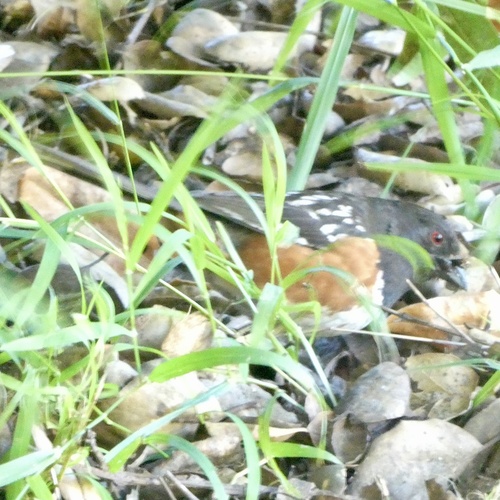
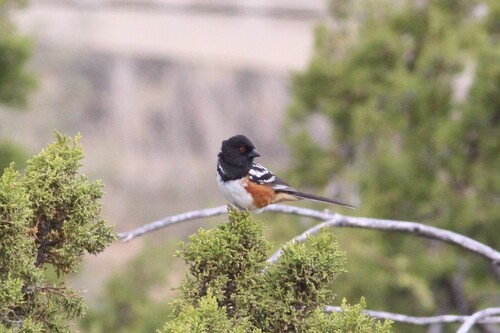
The Spotted Towhee is a chunky bird with a black head, throat, and back, marked with bright white spots on its wings and back. Its sides are a rich rufous-brown, and it has striking red eyes, making it distinctive from other ground-dwelling sparrows.
Category
BirdsRarity
Common
Danger
1/5 · Very low
Snaps
68
Despite their name, many don't migrate far, staying local year-round!
Their bright red eyes stand out, making them look extra sharp and alert!
They sing a cheerful 'drink-your-tea' song, often heard just before rain!
When foraging, they do a cute 'double-scratch' dance with both feet!
Spotted Towhee can find hidden insects by using a unique two-footed backward scratch, like a mini excavator, to uncover tasty treats.
Spotted Towhee has a loud 'chewink' call that helps them warn other birds about danger, keeping everyone safe in the brush.
Spotted Towhee can crack open tough seeds with its strong, cone-shaped beak, accessing nutritious food sources that others can't.
These omnivores primarily scratch for insects, spiders, and seeds on the ground.
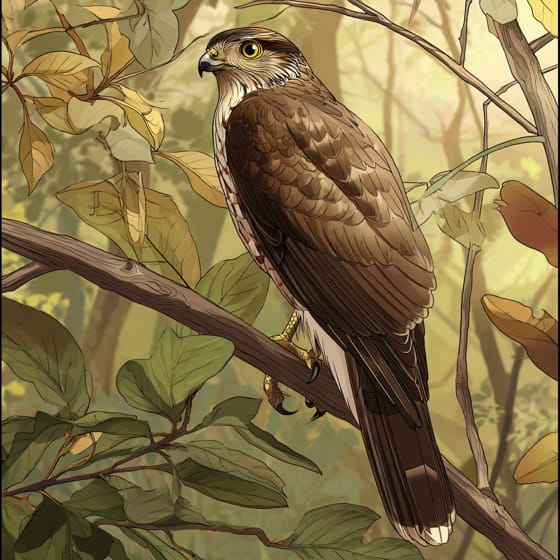
Accipiter cooperii
A common aerial predator that hunts small birds.
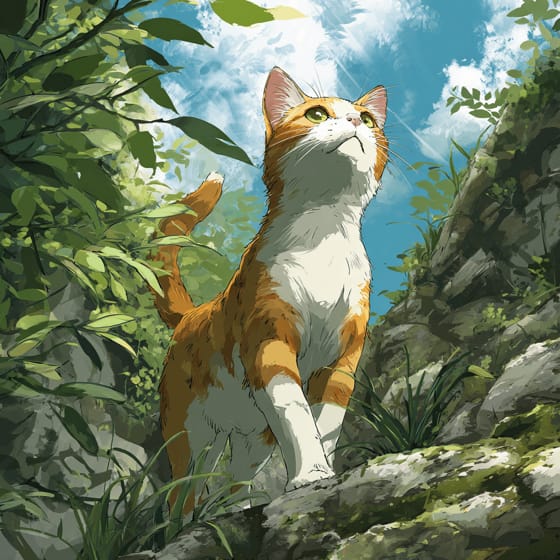
Felis catus
An introduced predator that captures ground-dwelling birds.
Formica fusca
Often foraged from leaf litter and undergrowth.

Toxicodendron diversilobum
Consumes the seeds, showing tolerance to the plant.
Symphoricarpos albus
Dense shrubs provide cover for nesting and hiding.
Feathered describes animals, primarily birds, possessing a covering of feathers.
Marked with spots or patches of a different color.
Social animals live in organized groups, cooperating for survival benefits such as foraging, defense, and raising offspring.
Colorful describes organisms or objects displaying a wide range of bright and distinct colors.

This trait identifies organisms whose diet primarily consists of insects and other small invertebrates.

Forest habitats are terrestrial environments dominated by dense tree cover, supporting a high diversity of plant and animal life.

Diurnal animals are primarily active during daylight hours, typically resting or sleeping at night.
No aliases listed yet.
Danger
1/5 · Very low
Enjoy watching birds from a distance and don't try to touch them.
The easiest way to identify Spotted Towhee is to use the Snappit nature identifier app.
17-21 cm
25-30 cm
0.03-0.049 kg
2-8 years
40 km/h
These omnivores primarily scratch for insects, spiders, and seeds on the ground.
Forests
Zoom in to split clusters and explore where this object has been snapped.
Jun 2, 2026
Atchison VillagePhoto attribution
(c) Karen Offereins, some rights reserved (CC BY)
License: CC BY 4.0 ↗
Image may be shown cropped inside the card frame.
May 4, 2026
Gallup Commercial Historic DistrictPhoto attribution
(c) William Harmon, some rights reserved (CC BY)
License: CC BY 4.0 ↗
Image may be shown cropped inside the card frame.

California, US
You might spot Acorn Woodpecker and Western Fence Lizard.
View guide →

California, US
You might spot Western Fence Lizard and California Brittlebush.
View guide →

California, US
You might spot Monarch, Canada Goose, and Western Gull.
View guide →

New Mexico, US
You might spot Tree Cholla, Colorado Pinyon, and House Finch.
View guide →

California, US
You might spot Redwood, Pacific Trillium, and Evergreen Huckleberry.
View guide →

Oregon, US
You might spot Duck, Pacific Trillium, and Wood Duck.
View guide →
Take the discovery with you
Snap it with Snappit to identify it, learn what makes it special, and add the discovery to your collection.




.jpg&width=800)







