

Twinleaf
jeffersonia diphylla
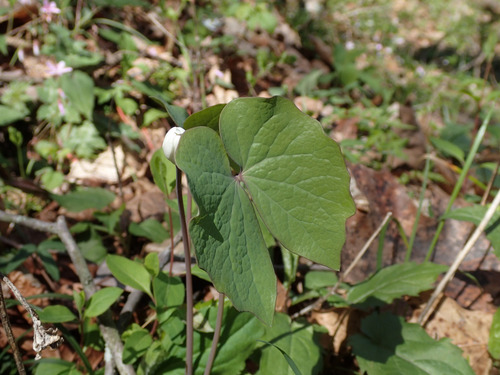
Twinleaf (Jeffersonia diphylla) is a charming spring ephemeral native to the moist, deciduous forests of eastern North America. Named in honor of Thomas Jefferson, this woodland perennial is highly regarded for its unique, paired leaves that perfectly mirror one another like butterfly wings. Emerging early in the spring, it quickly produces a delicate, star-like white flower that blooms for only a short time before shedding its petals. Following this brief display, the plant focuses its energy on developing an intriguing pear-shaped seed capsule with a hinged lid. Because it thrives in rich, undisturbed calcareous soils, the presence of Twinleaf is often a sign of a healthy, mature forest ecosystem, making it a favorite find among native plant enthusiasts.
Habitat: Found in rich, moist deciduous forests, damp woodlands, and rocky slopes with calcareous or limestone-rich soils.
Twinleaf is easily recognized by its distinctive leaves, which are deeply divided into two identical, wing-like lobes, giving the appearance of a pair of green butterfly wings atop a long, smooth petiole. The plant grows to a height of about 20 to 40 cm. In early spring, it produces a single, solitary white flower on a leafless stalk. The flower has 8 white petals and 8 prominent yellow stamens, measuring about 2.5 to 3 cm across. After blooming, the flower is replaced by a green, pear-shaped seed pod with a distinctive horizontal seam that pops open like a lid when mature.
Category
PlantsRarity
Common
Danger
1/5 · Very low
Snaps
Be the first to snap!
Its fruit is a capsule that opens via a horizontal slit, resembling a tiny jar or goblet with a pop-up lid.
The flower of the Twinleaf is notorious for its extremely brief lifespan, often blooming and losing its petals in a single day.
The genus name Jeffersonia was given to honor Thomas Jefferson by his friend and botanist Benjamin Smith Barton in 1792.
The seeds of the Twinleaf possess fleshy, lipid-rich appendages called elaiosomes that attract ants, which carry the seeds back to their underground nests to feed their larvae, effectively planting the seeds in optimal conditions.
It completes its leaf development and reproductive cycle early in the spring before the forest canopy closes, taking full advantage of the abundant sunlight reaching the forest floor.
Its fruit is an unusual pear-shaped capsule that opens along a horizontal seam near the top, forming a lid that opens to shake out seeds during windy or rainy weather.
As a photosynthetic plant, Twinleaf produces its own food by absorbing sunlight, water, and carbon dioxide, while pulling essential minerals from rich calcareous soils.
Aphaenogaster rudis
Disperses Twinleaf seeds by carrying them to underground nests to consume the nutrient-dense elaiosome.

Odocoileus virginianus
Occasionally browses the foliage of Twinleaf in early spring when other vegetation is scarce.
Carex radiata
Grows alongside Twinleaf in mature deciduous forests, competing for space and light on the forest floor.
No trait badges are assigned for this object yet.
No aliases listed yet.
Collections for this object will appear here as more themes are added.
Danger
1/5 · Very low
No special safety notes yet.
Start with the whole plant, then compare leaf arrangement, leaf edges, stems and any flowers or fruit. Opposite leaves grow in pairs; alternate leaves come one at a time along the stem. These details tell you far more together than a single green leaf does. Plant Identifier: upload a photo and compare the visible details.
20-40 cm
5-20 years
As a photosynthetic plant, Twinleaf produces its own food by absorbing sunlight, water, and carbon dioxide, while pulling essential minerals from rich calcareous soils.
Found in rich, moist deciduous forests, damp woodlands, and rocky slopes with calcareous or limestone-rich soils.
Foraging Or Grazing Equivalent Photosynthesis Absorption From Soil Water Air And Light Energy Harvesting Mechanisms In Plants And Algae Or Fungi As Applicable To The Taxonomic Group Listed Above In This Json Profile Data Structure Definition Schema Format Properties And Constraints Listed Above In This Prompt Or Query Instruction Set Provided By The User Or System Prompt Itself As Applicable To The Taxonomic Group Listed Above In This Json Profile Data Structure Definition Schema Format Properties And Constraints Listed Above In This Prompt Or Query Instruction Set Provided By The User Or System Prompt Itself As Applicable To The Taxonomic Group Listed Above In This Json Profile Data Structure Definition Schema Format Properties And Constraints Listed Above In This Prompt Or Query Instruction Set Provided By The User Or System Prompt Itself As Applicable To The Taxonomic Group Listed Above In This Json Profile Data Structure Definition Schema Format Properties And Constraints Listed Above In This Prompt Or Query Instruction Set Provided By The User Or System Prompt Itself As Applicable To The Taxonomic Group Listed Above In This Json Profile Data Structure Definition Schema Format Properties And Constraints Listed Above In This Prompt Or Query Instruction Set Provided By The User Or System Prompt Itself As Applicable To The Taxonomic Group Listed Above In This Json Profile Data Structure Definition Schema Format Properties And Constraints Listed Above In This Prompt Or Query Instruction Set Provided By The User Or System Prompt Itself As Applicable To The Taxonomic Group Listed Above In This Json Profile Data Structure Definition Schema Format Properties And Constraints Listed Above In This Prompt Or Query Instruction Set Provided By The User Or System Prompt Itself
Zoom in to split clusters and explore where this object has been snapped.
Recent snaps will appear here as new observations are added.
Take the discovery with you
Snap it with Snappit to identify it, learn what makes it special, and add the discovery to your collection.