
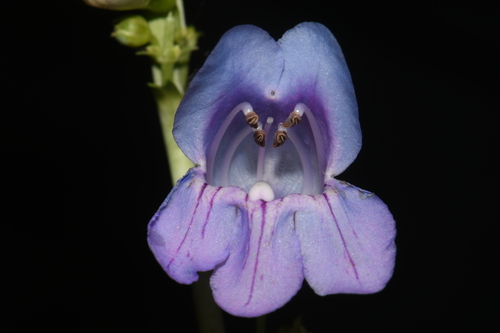


Upright Blue Beardtongue
penstemon virgatus
The Upright Blue Beardtongue (Penstemon virgatus) is a beautiful, hardy perennial wildflower native to the mountainous regions of the southwestern United States. Standing tall on slender, wand-like stems, this plant features striking spikes of tubular, two-lipped flowers ranging in color from pale lavender to deep blue-violet. It is a vital component of mid-to-high-elevation ecosystems, offering rich nectar rewards to local pollinators during the dry summer months.
Habitat: Typically found growing in open ponderosa pine forests, montane meadows, and rocky or gravelly slopes at elevations between 5,000 and 9,000 feet.
This plant is easily recognized by its erect, unbranched stems that reach heights between 20 and 80 centimeters. Its narrow, lance-shaped leaves are arranged oppositely along the stem. The flowers are tubular, about 2 to 3 centimeters long, with a distinct two-lipped opening. They exhibit light blue, lilac, or purple hues, often decorated with delicate magenta nectar guide lines running deep into the throat of the bloom.
Category
PlantsRarity
Common
Danger
1/5 · Very low
Snaps
Be the first to snap!
Because they bloom during the height of summer, these flowers provide a critical hydration and sugar resource for migrating hummingbirds.
The common name 'beardtongue' describes the sterile fifth stamen (staminode), which is heavily bearded with fine yellow or white hairs.
The species name 'virgatus' is Latin for 'wand-like' or 'made of twigs,' referring to the remarkably straight and slender habit of its stems.
Features dark purple lines inside the flower throat that act as visual guides, directing bumblebees and hummingbirds directly to the nectar.
Utilizes a deep taproot system to access sub-surface moisture, allowing it to thrive in dry, rocky, and nutrient-poor soils.
Possesses a sterile, fuzzy staminode (the beard) that physically forces foraging insects to brush against the fertile pollen-bearing anthers.
As a photosynthetic plant, it generates its own energy using sunlight, water, and carbon dioxide from the atmosphere.
Selasphorus platycercus
Visits the flowers for nectar, serving as a primary pollinator in high-altitude environments.

Bombus huntii
Crawls inside the tubular flowers to collect pollen, acting as an effective pollinator.

Odocoileus hemionus
Occasionally browses on the foliage and seed pods during the late summer months.
No trait badges are assigned for this object yet.
No aliases listed yet.
Collections for this object will appear here as more themes are added.
Danger
1/5 · Very low
No special safety notes yet.
Start with the whole plant, then compare leaf arrangement, leaf edges, stems and any flowers or fruit. Opposite leaves grow in pairs; alternate leaves come one at a time along the stem. These details tell you far more together than a single green leaf does. Plant Identifier: upload a photo and compare the visible details.
20-80 cm
3-10 years
As a photosynthetic plant, it generates its own energy using sunlight, water, and carbon dioxide from the atmosphere.
Typically found growing in open ponderosa pine forests, montane meadows, and rocky or gravelly slopes at elevations between 5,000 and 9,000 feet.
Zoom in to split clusters and explore where this object has been snapped.
Recent snaps will appear here as new observations are added.
Take the discovery with you
Snap it with Snappit to identify it, learn what makes it special, and add the discovery to your collection.


















