

VinháTico
persea indica
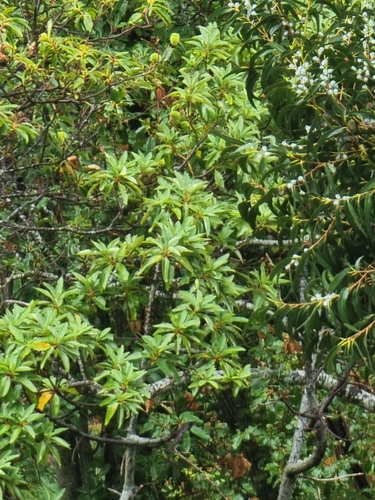
The Vinhático (Persea indica) is a majestic, evergreen tree endemic to the humid Laurisilva forests of Macaronesia, including Madeira, the Azores, and the Canary Islands. A close relative of the avocado, this tree can reach impressive heights of up to 30 meters. It is highly celebrated for its durable, reddish-toned wood, historically referred to as 'Madeira mahogany,' which was heavily utilized in traditional carpentry and shipbuilding. Beyond its timber value, the Vinhático is an ecological cornerstone of the cloud forest. Its dense canopy captures moisture from incoming sea fogs, playing a vital role in the hydrological cycle of these volcanic islands. Finding a mature Vinhático surrounded by ferns and mosses is a quintessential Macaronesian forest experience.
Habitat: Found in humid, subtropical laurel cloud forests (Laurisilva), typically on steep slopes, ravines, and cloud-swept ridges.
The Vinhático is easily recognized by its large, lance-shaped leaves that are bright green when young but turn a brilliant, fiery orange-red just before they fall, creating a striking mosaic of color in the canopy. It features pale, smooth grey bark that becomes fissured with age. In spring, it produces small, inconspicuous clusters of greenish-yellow flowers at the branch tips, which develop into small, fleshy, olive-like dark blue or black drupes.
Category
PlantsRarity
Common
Danger
1/5 · Very low
Snaps
Be the first to snap!
Its timber, known as 'Vinhático' or 'Madeira mahogany,' is highly sought after for its rich, lustrous reddish-brown color and resistance to decay.
The bright orange-red leaves that regularly dot its evergreen crown make it look as though it is constantly in a subtle, year-round state of autumn.
The species belongs to the same genus as the domestic avocado (Persea americana), though its small, dark blue fruits are not palatable to humans.
The tree's leaf structure and canopy density are perfectly adapted to capture atmospheric moisture from passing clouds, turning fog into water droplets.
Older leaves accumulate vibrant red and orange pigments before shedding, a metabolic process that efficiently recycles nutrients.
The tree possesses an excellent capacity to regenerate by sending up vigorous new shoots from its base or trunk after structural damage.
As a photoautotrophic plant, it produces its own food using sunlight, water, and carbon dioxide through the process of photosynthesis.
Columba trocaz
The pigeon feeds on the fleshy drupes and disperses the seeds throughout the forest.
Columba bollii
Eats the fruits of the tree, aiding in seed dispersal across the Canary Islands.
Laurus novocanariensis
Competes for canopy space, sunlight, and soil nutrients in the dense Laurisilva forest.
No trait badges are assigned for this object yet.
No aliases listed yet.
Collections for this object will appear here as more themes are added.
Danger
1/5 · Very low
No special safety notes yet.
Start with the whole plant, then compare leaf arrangement, leaf edges, stems and any flowers or fruit. Opposite leaves grow in pairs; alternate leaves come one at a time along the stem. These details tell you far more together than a single green leaf does. Plant Identifier: upload a photo and compare the visible details.
1500-3000 cm
100-400 years
As a photoautotrophic plant, it produces its own food using sunlight, water, and carbon dioxide through the process of photosynthesis.
Found in humid, subtropical laurel cloud forests (Laurisilva), typically on steep slopes, ravines, and cloud-swept ridges.
Zoom in to split clusters and explore where this object has been snapped.
Recent snaps will appear here as new observations are added.
Take the discovery with you
Snap it with Snappit to identify it, learn what makes it special, and add the discovery to your collection.