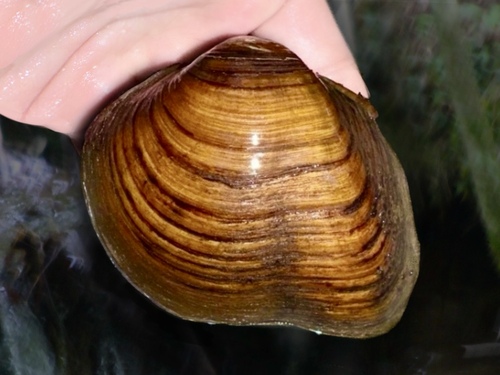


Wabash Pigtoe
fusconaia flava
The Wabash Pigtoe (Fusconaia flava) is a resilient freshwater mussel native to the rivers and streams of North America. As a member of the Unionidae family, this bivalve plays a vital role in maintaining aquatic health by constantly filtering water, improving clarity and quality for surrounding wildlife. Despite its humble appearance, the Wabash Pigtoe has an incredibly complex life cycle that relies on specific fish hosts to distribute its young. Over the years, these long-lived mussels have become key indicators of clean, stable river ecosystems, silently serving as the unsung heroes of our freshwater river basins.
Habitat: Typically found half-buried in the gravel, sand, or mixed mud substrates of medium-sized rivers and swift-flowing streams.
This medium-sized mussel features a solid, heavy, and somewhat triangular or squarish shell, which usually measures between 4 to 10 centimeters in length. The outer shell color varies from a light yellowish-brown to a darker reddish-brown, often exhibiting a smooth texture with a shallow, broad groove running down the side. Younger specimens may display faint greenish rays, while the interior of the shell showcases a beautiful, pearly white nacre, occasionally tinged with salmon or pink.
Category
InvertebrateRarity
Common
Danger
1/5 · Very low
Snaps
Be the first to snap!
Mussel biologists can determine the age of a Wabash Pigtoe by counting growth rings on its shell, much like counting rings on a tree trunk.
Their larval young, called glochidia, are harmless hitchhikers that ride on the gills of fish for several weeks before dropping to start life on the river bottom.
Wabash Pigtoes have incredibly thick, dense shells that were historically harvested for the manufacture of pearl buttons.
Capable of filtering gallons of water daily, extracting nutrients, organic particles, and bacteria while purifying its aquatic habitat.
Releases specialized larvae that attach harmlessly to the gills of host fish, utilizing them for transport and nutrients before dropping off.
Uses a powerful muscular foot to burrow deep into riverbeds, anchoring itself securely against strong currents.
As a filter feeder, it siphons river water to strain out microscopic organic material, nutrients, and tiny organisms.
Age differences: Juveniles primarily feed on interstitial organic matter in sediment, whereas adults filter suspended particles directly from the water column.

Semotilus atromaculatus
Serves as a temporary host for the Wabash Pigtoe's parasitic larvae during their development.

Ondatra zibethicus
Actively preys upon adult Wabash Pigtoes by crushing their shells or pulling them from the riverbed.

Lepomis macrochirus
Acts as another common host fish supporting the metamorphosis of Wabash Pigtoe larvae.
No trait badges are assigned for this object yet.
No aliases listed yet.
Collections for this object will appear here as more themes are added.
Danger
1/5 · Very low
No special safety notes yet.
Compare body symmetry, shells, segments, legs, tentacles and how the animal moves. Invertebrates span many unrelated groups, so start with body structure. Invertebrate Identifier: upload a photo and compare the visible details.
4-10 cm
0.05-0.25 kg
15-50 years
As a filter feeder, it siphons river water to strain out microscopic organic material, nutrients, and tiny organisms.
Typically found half-buried in the gravel, sand, or mixed mud substrates of medium-sized rivers and swift-flowing streams.
Filtering
10000+
Zoom in to split clusters and explore where this object has been snapped.
Recent snaps will appear here as new observations are added.
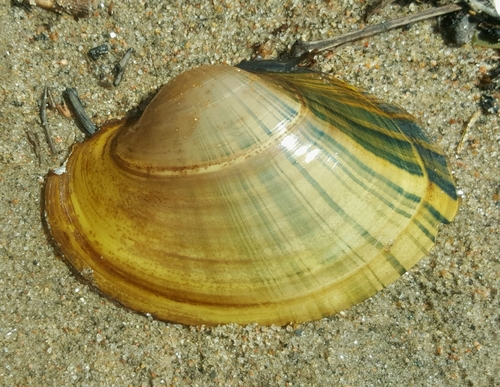
Iowa, US
You might spot Plain Pocketbook, Fatmucket, and Wabash Pigtoe.
View guide →

Nebraska, US
You might spot Wabash Pigtoe, Three-Ridge Mussel, and Creeper.
View guide →
Take the discovery with you
Snap it with Snappit to identify it, learn what makes it special, and add the discovery to your collection.