

West Canary Skink
chalcides viridanus
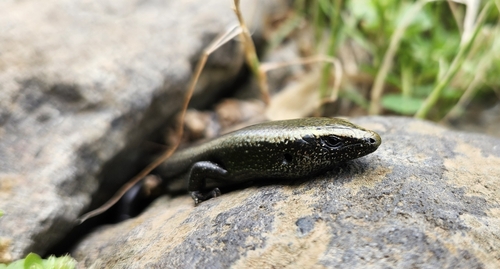
The West Canary Skink (Chalcides viridanus) is an enchanting, glossy reptile endemic to the western Canary Islands, including Tenerife, La Gomera, El Hierro, and La Palma. Known for its sleek, cylindrical body and metallic sheen, this small skink is a delightful sight for hikers and nature enthusiasts exploring the archipelago's diverse landscapes. Despite its short legs, it moves with surprising agility, slipping effortlessly beneath volcanic rocks and dense vegetation at the slightest hint of danger. Deeply integrated into the island ecosystems, the West Canary Skink plays a vital role as an insect controller. It has successfully adapted to a wide range of altitudes, thriving from sunny coastal shores to high-elevation pine forests. Its friendly presence in stone walls and gardens makes it one of the most commonly encountered and beloved reptiles of the western Canaries.
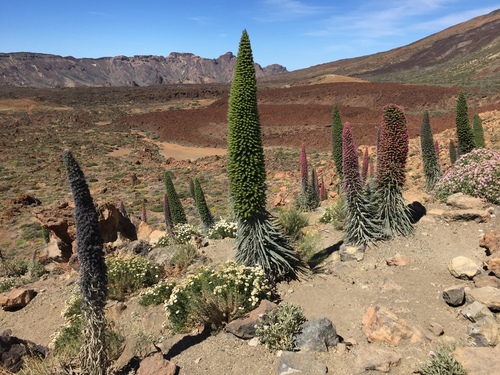
Habitat: Typically found in sun-exposed volcanic rock fields, traditional dry-stone walls, open scrublands, coastal dunes, and suburban gardens across the western Canary Islands.
This medium-sized skink features a highly polished, cylindrical body with short but fully developed five-toed limbs. Its coloration is striking and variable, ranging from a metallic olive-green or bronze-brown back to deep, dark brown or black flanks, often separated by a faint pale stripe. The underbelly can vary from bright yellow to a pale greenish-gray, and some individuals display magnificent golden flecks. Adults typically reach a total length of 15 to 18 centimeters, with their smooth, tightly overlapping scales giving them an exceptionally glossy, almost wet appearance.
Category
ReptilesRarity
Common
Danger
1/5 · Very low
Snaps
Be the first to snap!
Its species name 'viridanus' refers to its greenish sheen, which glistens brilliantly when hit by direct sunlight.
They are frequently found living in close proximity to humans, utilizing the crevices of traditional Spanish dry-stone walls as safe havens.
Unlike many lizards that lay eggs, the West Canary Skink is viviparous, giving birth to fully developed, live young.
When running at high speeds, they tuck their small limbs against their body and glide forward using a snake-like wriggling motion.
When threatened by a predator, the skink can discard its tail, which continues to wiggle and distract the attacker while the skink escapes.
With its elongated body and reduced limb size, it can fold its legs against its sides and swim through loose soil or dense leaf litter using serpentine movements.
It excels at rapidly absorbing heat from sun-baked volcanic rocks, allowing it to maintain peak agility even in cooler high-altitude environments.
Feeds opportunistically on a wide variety of small terrestrial invertebrates, hunting actively among leaf litter and rock crevices.

Falco tinnunculus
Preys on the skink, especially young or basking individuals.
Gallotia galloti
Competes for food resources like small insects and shares basking spots.
Felis catus
An invasive predator that heavily hunts skinks in suburban and rural areas.
No trait badges are assigned for this object yet.
No aliases listed yet.
Collections for this object will appear here as more themes are added.
Danger
1/5 · Very low
No special safety notes yet.
Compare toes, scales, head shape, crests and tail proportions. Many lizards can drop and regrow their tails, so a short tail isn't always a species trait. Lizard Identifier: upload a photo and compare the visible details.
12+ cm
0.01+ kg
5+ years
8 km/h
Feeds opportunistically on a wide variety of small terrestrial invertebrates, hunting actively among leaf litter and rock crevices.
Typically found in sun-exposed volcanic rock fields, traditional dry-stone walls, open scrublands, coastal dunes, and suburban gardens across the western Canary Islands.
Foraging Block Feeding Reptile Style, Searching Under Debris. Check On Common Behaviors. Primarily Foraging. Let's List It As Foraging. Foraging Is Standard. Let's Make It Foraging. See If Standard. Yes. Correct. Let's Clean Up Key Fields As Standard String. Let's Keep Huntingmethod As Foraging. Correct. Let's Write Foraging. Let's Check Dietchangeswithage: 'juveniles Feed Exclusively On Very Small Soft Bodied Insects, Whereas Adults Can Consume Harder Shelled Beetles And Small Terrestrial Snails.' Now We Output Json With No Control Tokens. Let's Keep Things Clean. Let's Do Foraging. Correct. Let's Provide Plain String For Huntingmethod. Correct. Let's Go Ahead. Let's Make Sure It's Valid. Let's Verify Value: 'foraging' Is A Valid Option. Valid Values: Huntingmethod Can Be 'foraging'.
Zoom in to split clusters and explore where this object has been snapped.
Recent snaps will appear here as new observations are added.
Take the discovery with you
Snap it with Snappit to identify it, learn what makes it special, and add the discovery to your collection.