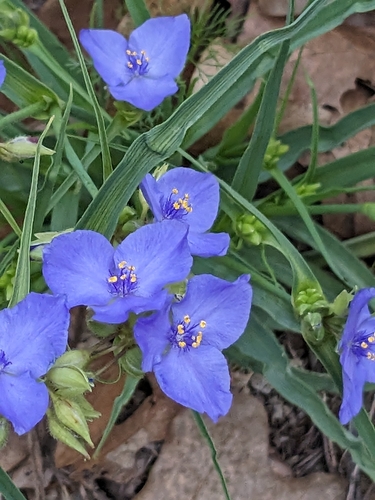


Western Spiderwort
tradescantia occidentalis
Western Spiderwort (Tradescantia occidentalis) is an eye-catching perennial wildflower native to the prairies, dry woodlands, and sandy soils of central and western North America. Renowned for its delicate, striking blue to purple three-petaled blooms, it is a favorite among wildflower enthusiasts and a vital pollen source for native insects. Interestingly, the plant's ephemeral flowers usually open in the early morning and melt into a soft jelly by midday under the hot sun, a fascinating process known as deliquescence. Beyond its aesthetic appeal, the Western Spiderwort has a unique scientific claim to fame: the microscopic hairs on its stamens are highly sensitive to radiation and can mutate from blue to pink in the presence of gamma rays or other ionizing radiation, making the plant a natural bioindicator.
Habitat: Found primarily in dry prairies, sandy or rocky meadows, roadside ditches, and open woodlands across central and western North America.
The Western Spiderwort features distinct, vibrant, three-petaled flowers that range in color from deep violet-blue to magenta or even pale pink, adorned with bright yellow, fluffy anthers in the center. Its stems are erect, jointed, and somewhat fleshy, growing up to 60 centimeters tall. The leaves are long, narrow, and grass-like, with a grayish-green tint, often folding lengthwise down the middle. When a stem or leaf is broken, it secretes a viscous, thread-like sap that resembles spider silk.
Category
PlantsRarity
Common
Danger
1/5 · Very low
Snaps
1
Because of its sensitivity to radiation, the plant has actually been planted near nuclear facilities in the past to act as a living radiation detector.
Despite attracting many bees and flies with bright colors, Western Spiderwort flowers don't produce any nectar; visitors come strictly for the rich pollen.
The name 'Spiderwort' likely comes from the plant's stringy, viscous sap that resembles a spider's web when you snap a stem in half.
Western Spiderwort flowers are 'ephemeral,' meaning each bloom lasts for only a single morning before turning into a jelly-like liquid.
The stamen hairs of the flower mutate from blue to pink when exposed to low levels of ionizing radiation.
The petals undergo autolysis and dissolve into a jelly-like fluid by midday under intense heat to conserve resources.
It produces a sticky, stringy sap when its stems or leaves are broken, which helps seal wounds and deter herbivores.
As a photosynthetic plant, the Western Spiderwort produces its own food using sunlight, water, and carbon dioxide.
Bombus occidentalis
Pollinates the flowers while gathering pollen, as spiderworts do not produce nectar.

Odocoileus hemionus
Grazes on the succulent foliage and stems of the plant.
.jpg&width=800)
Toxomerus marginatus
Hoverflies commonly visit the morning flowers to consume and distribute pollen.
No trait badges are assigned for this object yet.
No aliases listed yet.
Collections for this object will appear here as more themes are added.
Danger
1/5 · Very low
No special safety notes yet.
The easiest way to identify Western Spiderwort is to use the Snappit nature identifier app.
15-60 cm
3-10 years
As a photosynthetic plant, the Western Spiderwort produces its own food using sunlight, water, and carbon dioxide.
Found primarily in dry prairies, sandy or rocky meadows, roadside ditches, and open woodlands across central and western North America.
Photosynthesis
Zoom in to split clusters and explore where this object has been snapped.
Take the discovery with you
Snap it with Snappit to identify it, learn what makes it special, and add the discovery to your collection.













.jpg&width=800)



_001.jpg&width=800)




