.jpg&width=800)





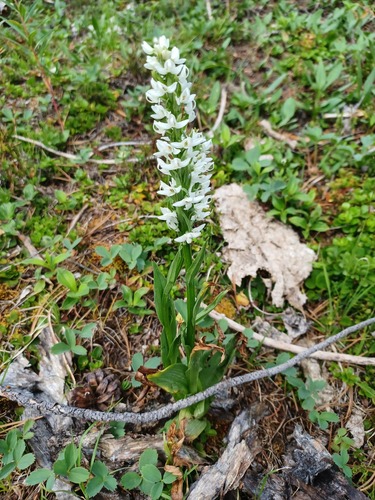
white bog orchid
Platanthera dilatata
The white bog orchid is a beautiful flower that grows in wet, marshy areas. Its delicate white petals look like tiny stars shining in the grass, making it a special sight in nature.
Habitat: Wetlands
The white bog orchid is an elegant plant with an erect stem bearing narrow, lance-shaped leaves. Its small, pure white, fragrant flowers are arranged in a dense, upright spike, often featuring a distinctive long, slender spur at the base of each bloom.
Category
PlantsRarity
Rare
Danger
1/5 · Very low
Snaps
6
Its tiny seeds are like dust, carried by the wind for miles to find new damp homes!
Some varieties of this orchid actually have green flowers, not always pure white!
The scientific name 'Platanthera' means 'broad anther,' referring to its wide pollen structures.
White bog orchids can live for many years, silently growing in their boggy homes.
White bog orchid releases a sweet, strong fragrance at night to attract specific moths for pollination in the dark.
White bog orchid thrives in waterlogged, acidic soils where few other plants can grow, thanks to specialized root adaptations.
White bog orchid has a long, slender spur on its flowers that perfectly holds nectar for long-tongued pollinators.
Hyles lineata
visits flowers for nectar, carrying pollen between them.
Bombus occidentalis
collects nectar and pollen, aiding in reproduction.
Tulasnella calospora
exchanges nutrients with the orchid, crucial for its growth.
Flowering plants are any plants that produce flowers as part of their reproductive cycle.
Ornamental plants are cultivated primarily for their aesthetic appeal, enhancing landscapes and gardens with their attractive foliage, flowers, or form.
Summer blooming plants produce their flowers during the summer season, often providing vibrant color when many other plants have finished.
Fragrant flowers emit a pleasant aroma, often to attract pollinators or for defense.

Describes plants that are particularly attractive and beneficial to a wide range of pollinating organisms.

This habitat trait identifies species found in wetlands, which are areas of land saturated with water, either permanently or seasonally, including marshes, swamps, and bogs.

Endangered status indicates a species is at a very high risk of extinction in the wild in the near future.
No aliases listed yet.
Danger
1/5 · Very low
Always look at flowers from a distance and don't pick them, so they can keep growing.
The easiest way to identify white bog orchid is to use the Snappit nature identifier app.
15-100 cm
1-2 cm
Summer
Yes
None
Perennial
Insect
Zoom in to split clusters and explore where this object has been snapped.
Jul 8, 2021
Pasayten WildernessPhoto attribution
(c) Gabriel Campbell-Martinez, some rights reserved (CC BY)
License: CC BY 4.0 ↗
Image may be shown cropped inside the card frame.

Colorado, US
You might spot Rocky Mountain Marsh-Marigold and American Bistort.
View guide →

Washington, US
You might spot Whitebark Pine, Subalpine Larch, and White Pasqueflower.
View guide →

British Columbia, CA
You might spot Green Comma, Mourning Cloak, and Hoary Comma.
View guide →

California, US
You might spot Black Bear, Western Fence Lizard, and Woodland Pinedrops.
View guide →

Wyoming, US
You might spot Lodgepole Pine, Flowery Phlox, and Moose.
View guide →
Take the discovery with you
Snap it with Snappit to identify it, learn what makes it special, and add the discovery to your collection.









.jpg&width=800)


_001.jpg&width=800)




