

White Leadtree
leucaena leucocephala
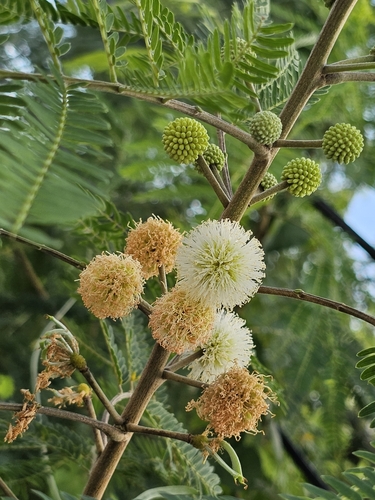
The White Leadtree (Leucaena leucocephala), also known as the river tamarind or jumbay, is a versatile and fast-growing miracle tree native to southern Mexico and Central America. Now naturalized throughout the global tropics, this resilient legume is widely cultivated for livestock fodder, firewood, and soil improvement. However, its high adaptability and rapid growth have also earned it a spot among the world's 100 worst invasive species. This dual nature makes the White Leadtree a fascinating subject of study, representing both a valuable agricultural asset and a significant ecological challenge in non-native habitats where it forms dense, monospecific thickets that displace native vegetation.
Habitat: Found in disturbed sites, coastal areas, riparian zones, and open woodlands across tropical and subtropical regions.
The White Leadtree typically grows as a small, shrubby tree reaching 5 to 20 meters in height. It is easily identified by its bipinnate, feathery green leaves that close up slightly at night. During the blooming season, it produces spherical, puffy white flower heads that resemble small pom-poms, about 2 centimeters in diameter. These flowers transition into clusters of long, flat, translucent brown seed pods, each measuring 10 to 15 centimeters in length, which dangle conspicuously from the branches and rattle softly in the wind.
Category
PlantsRarity
Common
Danger
1/5 · Very low
Snaps
5
It is nicknamed the 'Conflict Tree' because of its dual identity as a highly beneficial agroforestry species and a destructive invasive weed.
Its seeds contain an amino acid called mimosine, which can cause hair loss and health issues in non-ruminant animals if eaten in large quantities.
The puffy white flowers of the White Leadtree close up and sleep at night along with its sensitive, feathery leaflets.
Partners with symbiotic soil bacteria to convert atmospheric nitrogen into usable nutrients, allowing it to thrive in and enrich poor soils.
Sprouts vigorously from cut stumps and produces abundant seeds, enabling it to dominate disturbed landscapes quickly.
Utilizes a deep taproot system to access deep water tables, allowing it to survive prolonged dry seasons.
As a photosynthetic plant, the White Leadtree produces its own food using sunlight, water, carbon dioxide, and soil nutrients.
Acanthoscelides macrophthalmus
The larvae of this seed beetle feed exclusively on the seeds of the White Leadtree, acting as a natural biological control agent.
Rhizobium leguminosarum
Forms a symbiotic relationship in the root nodules to fix nitrogen, benefiting both the plant and the soil microbiology.
Capra hircus
Goats readily graze on the high-protein leaves and shoots of the tree, although excessive intake can cause mimosine toxicity.
No trait badges are assigned for this object yet.
No aliases listed yet.
Collections for this object will appear here as more themes are added.
Danger
1/5 · Very low
No special safety notes yet.
The easiest way to identify White Leadtree is to use the Snappit nature identifier app.
500-2000 cm
20-40 years
As a photosynthetic plant, the White Leadtree produces its own food using sunlight, water, carbon dioxide, and soil nutrients.
Found in disturbed sites, coastal areas, riparian zones, and open woodlands across tropical and subtropical regions.
6-15 days
Zoom in to split clusters and explore where this object has been snapped.

Hawaii, US
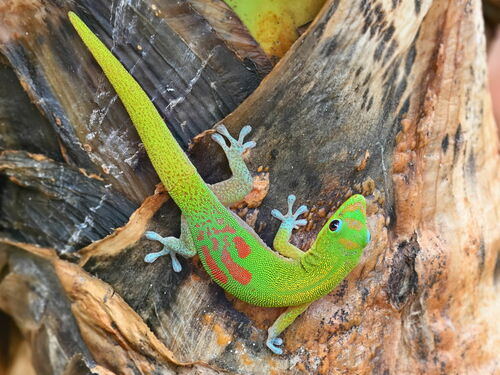
You might spot Brown Anole, Gold Dust Day Gecko, and Red-Crested Cardinal.
View guide →

US
You might spot Pond Slider, Black-Bellied Whistling-Duck, and Brown Anole.
View guide →
Hawaii, US
You might spot Gold Dust Day Gecko, Sea Turtle, and Brown Anole.
View guide →

Hawaii, US
You might spot ʻōhiʻa Lehua and Stinking Passionflower.
View guide →
Hawaii, US
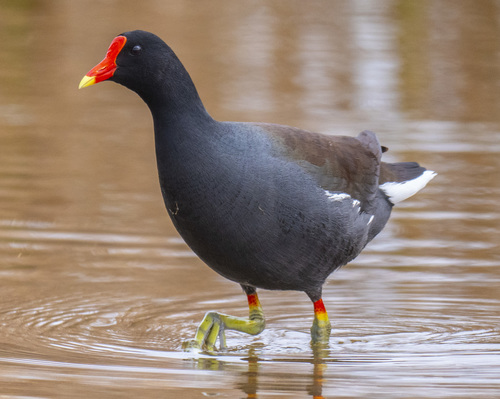
You might spot Common Gallinule and Red-Crested Cardinal.
View guide →

Hawaii, US
You might spot Yellow ʻilima, Red-Tailed Tropicbird, and White Leadtree.
View guide →
Take the discovery with you
Snap it with Snappit to identify it, learn what makes it special, and add the discovery to your collection.











.jpg&width=800)



_001.jpg&width=800)




