





wild parsnip
Pastinaca sativa
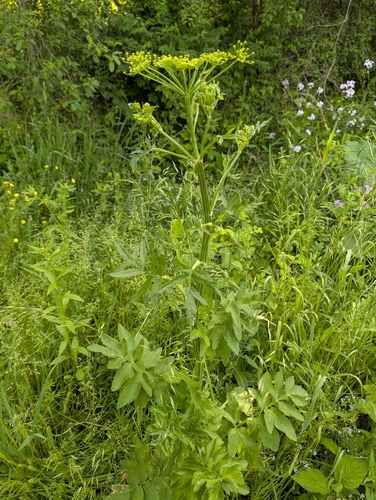
Wild parsnip is a tall plant with bright yellow flowers that bloom in the summer. It grows in fields and along roadsides, and its leaves look like big green hands reaching out.
Habitat: Grasslands
The wild parsnip is a tall plant with sturdy, grooved stems that can sometimes have reddish-purple patches. It has clusters of small, five-petaled yellow flowers arranged in flat-topped, umbrella-like formations. Its compound leaves have saw-toothed edges, making it distinct from the white flowers of similar plants like Queen Anne's Lace.
Category
PlantsRarity
Common
Danger
3/5 · Moderate
Snaps
10
Its wild ancestor is the very same plant species as the parsnips you can eat!
Some specialized insects, like the parsnip webworm, can munch on it without getting sick!
The cooked root of a wild parsnip tastes sweet, like a mix of carrot and potato!
The plant was brought from Europe to North America by early European settlers centuries ago.
Wild parsnip has sap that reacts with sunlight, causing skin irritation to protect itself from predators.
Wild parsnip has a long, thick taproot that stores energy, helping it survive and regrow.
Wild parsnip produces thousands of lightweight seeds that can travel far on the wind to find new homes.
Apis mellifera
Bees collect nectar and pollen from its flowers.
Vespula vulgaris
Wasps visit the flowers to feed on nectar.
Depressaria pastinacella
Larvae feed on its flowers and developing seeds.
Flowering plants are any plants that produce flowers as part of their reproductive cycle.
Biennial plants complete their life cycle over two growing seasons, typically forming foliage in the first year and flowering/seeding in the second.
Summer blooming plants produce their flowers during the summer season, often providing vibrant color when many other plants have finished.
Edible plants are those parts of a plant that are considered safe for human consumption.

Grassland habitats are terrestrial biomes dominated by grasses and herbaceous plants, supporting a variety of grazing animals.

Describes plants that are particularly attractive and beneficial to a wide range of pollinating organisms.

Toxic organisms contain substances that are poisonous and can cause adverse effects upon exposure.
No aliases listed yet.
Danger
3/5 · Moderate
Avoid touching wild parsnip, as its sap can cause skin irritation.
The easiest way to identify wild parsnip is to use the Snappit nature identifier app.
50-150 cm
30-60 cm
0.2-0.5 cm
Summer
Yes
High
Biennial
Zoom in to split clusters and explore where this object has been snapped.
Jun 6, 2026
Cornell Botanic GardensPhoto attribution
no rights reserved
License: CC0 1.0 ↗
Image may be shown cropped inside the card frame.
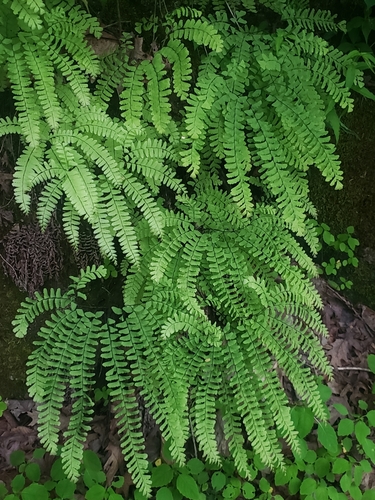
Iowa, US
You might spot Northern Maidenhair Fern and Wood Nettle.
View guide →

Vermont, US
You might spot Japanese Knotweed and Red-Bellied Woodpecker.
View guide →

Ohio, US
You might spot Wild Bergamot, Rattlesnake Master, and Eastern Pondhawk.
View guide →

Illinois, US
You might spot Osage-Orange, Cutleaf Teasel, and Red Clover.
View guide →

Pennsylvania, US
You might spot Solomon's Plume, Moonseed, and Virginia Waterleaf.
View guide →

Pennsylvania, US
You might spot Orange Hawkweed and Hickory Tussock Moth.
View guide →
Take the discovery with you
Snap it with Snappit to identify it, learn what makes it special, and add the discovery to your collection.








.jpg&width=800)



_001.jpg&width=800)



