
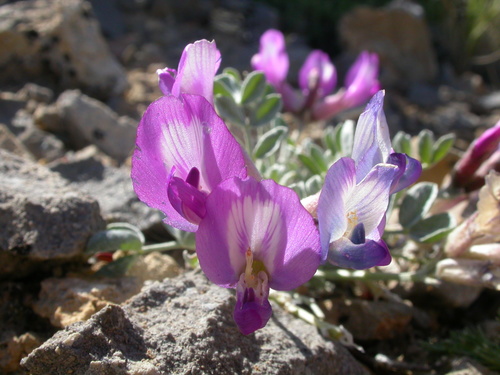


Woollypod Milkvetch
astragalus purshii
The Woollypod Milkvetch (Astragalus purshii) is a fascinating, low-growing perennial plant native to the arid and semi-arid regions of western North America. Resembling a soft, silver cushion hugging the dusty earth, this resilient wildflower is celebrated for its remarkable adaptation to harsh, dry environments. It is a member of the Fabaceae (pea) family, and it immediately captures the eye with its extremely fuzzy, wool-covered seed pods that look like tiny tufts of cotton or sheep's wool scattered across the desert floor. Throughout spring, it produces beautiful clusters of pea-like flowers ranging in color from cream and pale yellow to vibrant purple, providing vital nourishment for native pollinators.
Habitat: Typically found in open, arid environments such as sagebrush steppes, grasslands, and rocky slopes of western North America.
Woollypod Milkvetch forms low, dense mats or tufts that rarely exceed 15 centimeters in height. The entire plant is heavily blanketed in dense, soft, white or grayish hairs, giving it a distinct velvety, silver-green appearance. The leaves are pinnately compound, divided into small, oval leaflets. The flowers are classic pea-like blossoms, typically cream, yellowish, or violet-purple, arranged in tight clusters. The most striking visual identifier is the seed pod: a short, plump, curved legume that is so densely covered in thick, woolly white hairs that it resembles a miniature cotton ball.
Category
PlantsRarity
Common
Danger
1/5 · Very low
Snaps
Be the first to snap!
Indigenous peoples of the Great Basin historically used infusions of various milkvetch species for medicinal purposes, though many Astragalus species can accumulate toxic levels of selenium.
The incredibly fluffy white seed pods of the Woollypod Milkvetch look so much like miniature sheep that some locals refer to them as 'ground-kittens' or 'lambs-wool'.
The thick coat of wool on its seed pods functions like insulation, protecting the developing seeds from late-spring frosts and the scorching desert heat.
The dense coating of white hairs reflecting intense sunlight and reducing moisture loss from drying desert winds.
Partners with symbiotic rhizobia bacteria in its root system to convert atmospheric nitrogen into usable soil nutrients.
Enters a dormant state during extremely hot, dry summer months to conserve water and survive severe droughts.
As a photoautotrophic plant, the Woollypod Milkvetch synthesizes its own organic compounds using sunlight, carbon dioxide, and water through photosynthesis.
Bombus huntii
Provides nectar and pollen to native bumblebees, which act as primary pollinators.

Plebejus melissa
Serves as a larval host plant for caterpillars of the Melissa Blue butterfly.

Thomomys talpoides
Roots and seed pods are sometimes consumed by foraging pocket gophers.
No trait badges are assigned for this object yet.
No aliases listed yet.
Collections for this object will appear here as more themes are added.
Danger
1/5 · Very low
No special safety notes yet.
Start with the whole plant, then compare leaf arrangement, leaf edges, stems and any flowers or fruit. Opposite leaves grow in pairs; alternate leaves come one at a time along the stem. These details tell you far more together than a single green leaf does. Plant Identifier: upload a photo and compare the visible details.
5-15 cm
3-10 years
As a photoautotrophic plant, the Woollypod Milkvetch synthesizes its own organic compounds using sunlight, carbon dioxide, and water through photosynthesis.
Typically found in open, arid environments such as sagebrush steppes, grasslands, and rocky slopes of western North America.
Zoom in to split clusters and explore where this object has been snapped.
Recent snaps will appear here as new observations are added.

Washington, US
You might spot Red-Tailed Hawk and Colorado Checkered Whiptail.
View guide →

Washington, US
You might spot Ring-Billed Gull, Cackling Goose, and Black-Bellied Plover.
View guide →
Take the discovery with you
Snap it with Snappit to identify it, learn what makes it special, and add the discovery to your collection.

















