





yellow passionflower
Passiflora lutea
The yellow passionflower is a beautiful flower with bright yellow petals and unique shapes. It attracts butterflies and bees, making gardens lively and colorful!
Habitat: Woodlands
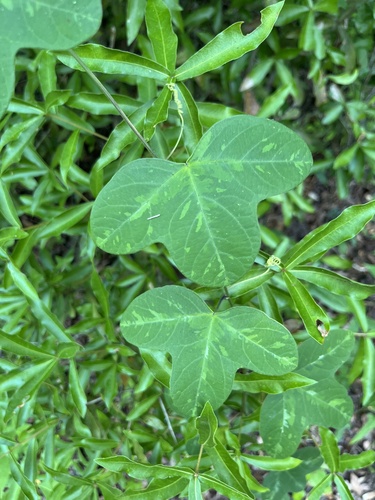
The yellow passionflower is a slender vine with ivy-shaped leaves, deeply lobed and dark green. Its small, star-like flowers feature greenish-yellow petals and a striking central corona of wavy yellow and purple filaments. It produces small, spherical yellow-green fruits.
Category
PlantsRarity
Common
Danger
1/5 · Very low
Snaps
21
Guess what? Tiny ants act as bodyguards, protecting its leaves from hungry bugs!
Its fruits, though small, burst with a tangy, sweet flavor that's super refreshing!
Its name, 'passionflower,' comes from symbols found in its amazing flower shape!
The Gulf Fritillary butterfly loves laying its eggs on this plant, a perfect nursery!
Yellow passionflower has special leaf glands that produce nectar, attracting ants to defend against hungry pests.
This vine can grow twisting tendrils that grab onto anything, helping it climb high towards the sun.
Its small, sweet-tart fruits are eaten by animals, which then help scatter the plant's tiny seeds far and wide.
Agraulis vanillae
Its caterpillars feed on the leaves, maturing into beautiful butterflies.
Apis mellifera
Visits the flowers to collect nectar and pollen, aiding in reproduction.
Crematogaster lineolata
Attracted to the leaf nectar, these ants protect the plant from pests.
Climbing or vine plants are characterized by a growth habit that allows them to ascend upwards by twining, tendrils, or adhesive roots.
Flowering plants are any plants that produce flowers as part of their reproductive cycle.
Summer blooming plants produce their flowers during the summer season, often providing vibrant color when many other plants have finished.
Fruit-bearing plants produce fruits, which are the mature ovaries of flowering plants containing seeds.

Colorful describes organisms or objects displaying a wide range of bright and distinct colors.

Edible plants are those parts of a plant that are considered safe for human consumption.

Describes plants that are particularly attractive and beneficial to a wide range of pollinating organisms.

Forest habitats are terrestrial environments dominated by dense tree cover, supporting a high diversity of plant and animal life.
No aliases listed yet.
Danger
1/5 · Very low
Always look but don't touch wild flowers, as some may not be safe.
The easiest way to identify yellow passionflower is to use the Snappit nature identifier app.
200-600 cm
100-300 cm
2-4 cm
Summer to Fall
Yes
Mild
Perennial
Zoom in to split clusters and explore where this object has been snapped.
May 19, 2026
Bainbridge Commercial Historic DistrictPhoto attribution
(c) Megan Herrmann, some rights reserved (CC BY)
License: CC BY 4.0 ↗
Image may be shown cropped inside the card frame.

Florida, US
You might spot Anole, Eastern Box Turtle, and Golden Silk Spider.
View guide →

Alabama, US
You might spot Anole, Eastern Gray Squirrel, and Asian Lady Beetle.
View guide →

Georgia, US
You might spot Gulf Fritillary, Anole, and American Beautyberry.
View guide →

District of Columbia, US
You might spot Spotted Lanternfly and Eastern Gray Squirrel.
View guide →

South Carolina, US
You might spot Anole, Asian Lady Beetle, and Gulf Fritillary.
View guide →

Tennessee, US
You might spot American Robin, Northern Cardinal, and Eastern Chipmunk.
View guide →
Take the discovery with you
Snap it with Snappit to identify it, learn what makes it special, and add the discovery to your collection.







.jpg&width=800)



_001.jpg&width=800)



