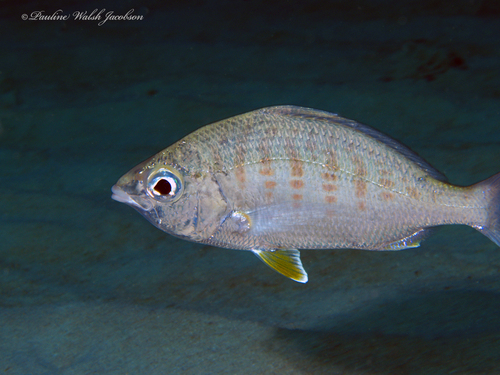


Yellowfin Mojarra
gerres cinereus
The Yellowfin Mojarra (Gerres cinereus) is a common but fascinating coastal fish known for its unmistakable silvery sheen and unique feeding habits. Widespread across the tropical and subtropical waters of the Americas, this species forms an integral part of shallow marine and estuarine ecosystems. Often seen schooling over sandy bottoms and seagrass beds, they are primarily bottom-feeders that play a critical role in controlling benthic invertebrate populations while serving as a vital food source for larger predators. What truly makes the Yellowfin Mojarra stand out is its remarkable, highly protrusible jaw. This specialized adaptation allows the fish to rapidly extend its mouth downward into a vacuum-like tube, plunging into the sand to suck up buried prey. By efficiently separating food from the sediment, they continually churn the substrate, acting as minor ecological engineers of their shallow-water habitats.
Habitat: Found primarily in shallow coastal waters, estuaries, mangrove roots, and sandy shores across tropical and subtropical regions of the Americas.
The Yellowfin Mojarra features a deep, laterally compressed body covered in prominent, highly reflective silver scales that provide excellent camouflage in sunlit, shallow waters. Faint, dark vertical bars often mark its sides, though these can fade or intensify depending on the fish's mood and environment. Its most distinctive identifiers are its pelvic and anal fins, which boast a striking yellowish hue. The fish has a sharply forked caudal (tail) fin and a steeply sloped facial profile with a uniquely structured mouth that points distinctly downward, hinting at its bottom-feeding lifestyle.
Category
FishRarity
Common
Danger
1/5 · Very low
Snaps
Be the first to snap!
Despite being relatively small, they are an incredibly important energy bridge in coastal food webs, transferring nutrients from tiny buried sand-creatures up to apex predators.
They are remarkably hardy travelers, sometimes swimming so far up coastal estuaries that they end up foraging in almost entirely freshwater environments.
They don't chew their sandy meals. Instead, they use a built-in biological sieve inside their throats to capture the meat and puff out clouds of sand from their gills.
When a Yellowfin Mojarra goes in for a bite, its face transforms instantly; its jaws swing forward and lock into a downward tube, resembling a tiny telescope.
Its mouth extends remarkably far forward and downward, forming a tubular vacuum that allows it to suck prey directly out of the sandy sea floor.
It takes in large mouthfuls of sand, uses specialized internal gill rakers to filter out small edible invertebrates, and safely expels the clean sand out through its gill covers.
This species can adapt to extreme shifts in water salinity, allowing it to move seamlessly between full ocean saltwater, brackish estuaries, and even freshwater rivers.
The Yellowfin Mojarra is a benthic invertivore, foraging along the sea floor for small organisms buried in the sediment.
Age differences: Juveniles feed mostly on microscopic zooplankton and copepods in the safety of mangroves, shifting to larger hard-shelled benthic invertebrates as they mature.
Centropomus undecimalis
Preyed upon by large estuarine game fish.

Ardea herodias
Hunted by coastal wading birds in shallow waters.

Lagodon rhomboides
Competes for benthic invertebrate food resources in seagrass beds.
Donax variabilis
Excavates and consumes small sand-dwelling bivalves.
No trait badges are assigned for this object yet.
No aliases listed yet.
Collections for this object will appear here as more themes are added.
Danger
1/5 · Very low
No special safety notes yet.
Look at body shape, where the fins sit and their outline, mouth position, stripes and spots. Young fish and breeding adults can wear different patterns, and aquarium color varieties can look nothing like wild fish. Fish Identifier: upload a photo and compare the visible details.
15-41 cm
0.1-1 kg
4-8 years
25 km/h
The Yellowfin Mojarra is a benthic invertivore, foraging along the sea floor for small organisms buried in the sediment.
Found primarily in shallow coastal waters, estuaries, mangrove roots, and sandy shores across tropical and subtropical regions of the Americas.
Foraging
Zoom in to split clusters and explore where this object has been snapped.
Recent snaps will appear here as new observations are added.

US
You might spot Great Barracuda, Gray Snapper, and Red Mangrove.
View guide →

US
You might spot Great Barracuda, Gray Snapper, and Atlantic Sergeant Major.
View guide →
Take the discovery with you
Snap it with Snappit to identify it, learn what makes it special, and add the discovery to your collection.