

Zelus Renardii
zelus renardii
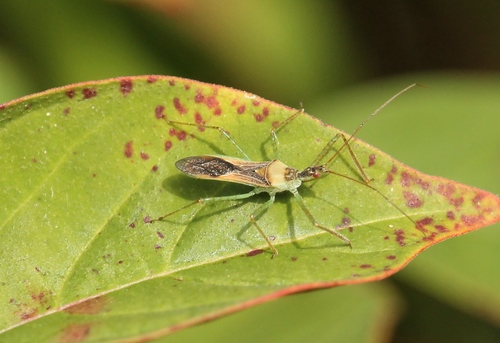
Zelus renardii, commonly known as the leafhopper assassin bug, is a fascinating predatory insect native to North and Central America, and introduced to parts of Europe and South America. As an accomplished generalist predator, it plays a vital role in regulating pest populations in both agricultural fields and home gardens. It is highly valued by gardeners and farmers alike for its voracious appetite for common pests like aphids, thrips, and leafhoppers. Using its sharp rostrum, it pierces its prey and injects lethal digestive enzymes. While helpful for biocontrol, they should be handled with care, as they can deliver a painful (though harmless) bite to humans if provoked.
Habitat: Found in agricultural fields, orchards, home gardens, and suburban parks, typically resting on leaves or flowers waiting for prey.
This slender bug ranges from 1.0 to 1.5 cm in length, boasting a distinctive elongated head, narrow body, and prominent, thread-like antennae. Its coloration is typically a mixture of bright yellowish-green on the legs and underside, with reddish-brown or brownish-orange on its back and thorax. They possess a curved, needle-like beak tucked beneath the head. Their front legs are covered in tiny, sticky hairs used to capture prey, and they have clear wings that lie flat on their back when resting.
Category
InsectsRarity
Common
Danger
1/5 · Very low
Snaps
2
Despite their beneficial role, they can inflict a surprisingly painful bite on humans if handled carelessly, though it is not medically significant.
They coat their legs with a sticky resin they scrape from plants or secrete themselves to better grab slippery insects.
Zelus renardii has been observed feeding on honey bees, making it a minor nuisance for beekeepers.
They secrete a sticky substance from glands on their forelegs, allowing them to ensnare prey with a simple touch.
They inject digestive enzymes that rapidly paralyze the prey and liquefy its internal tissues for easy consumption.
They can remain motionless for hours among foliage before launching quick, precise strikes at passing insects.
An opportunistic generalist predator that feeds primarily on small herbivorous insects found on vegetation.
Age differences: Nymphs hunt smaller soft-bodied insects like aphids, while adults target larger, more active prey.

Homalodisca vitripennis
Preys on the glassy-winged sharpshooter, a major agricultural pest.
Gryon pennsylvanicum
Parasitized by tiny wasps that lay their eggs inside the assassin bug's egg masses.
Troglodytes aedon
Preyed upon by insectivorous birds looking for active insects on foliage.
No trait badges are assigned for this object yet.
No aliases listed yet.
Collections for this object will appear here as more themes are added.
Danger
1/5 · Very low
No special safety notes yet.
The easiest way to identify Zelus Renardii is to use the Snappit nature identifier app.
An opportunistic generalist predator that feeds primarily on small herbivorous insects found on vegetation.
Found in agricultural fields, orchards, home gardens, and suburban parks, typically resting on leaves or flowers waiting for prey.
Ambush
Zoom in to split clusters and explore where this object has been snapped.

Oklahoma, US
You might spot Western Ratsnake and Spotted Chorus Frog.
View guide →

Valencian Community, ES
You might spot African Lion, Giraffes, and African Elephant.
View guide →
California, US
You might spot Eastern Fox Squirrel, Common Raven, and Mourning Dove.
View guide →
Spain, ES
You might spot Vestal, Eurasian Collared-Dove, and Common Blackbird.
View guide →
Take the discovery with you
Snap it with Snappit to identify it, learn what makes it special, and add the discovery to your collection.












.jpg&width=800)




