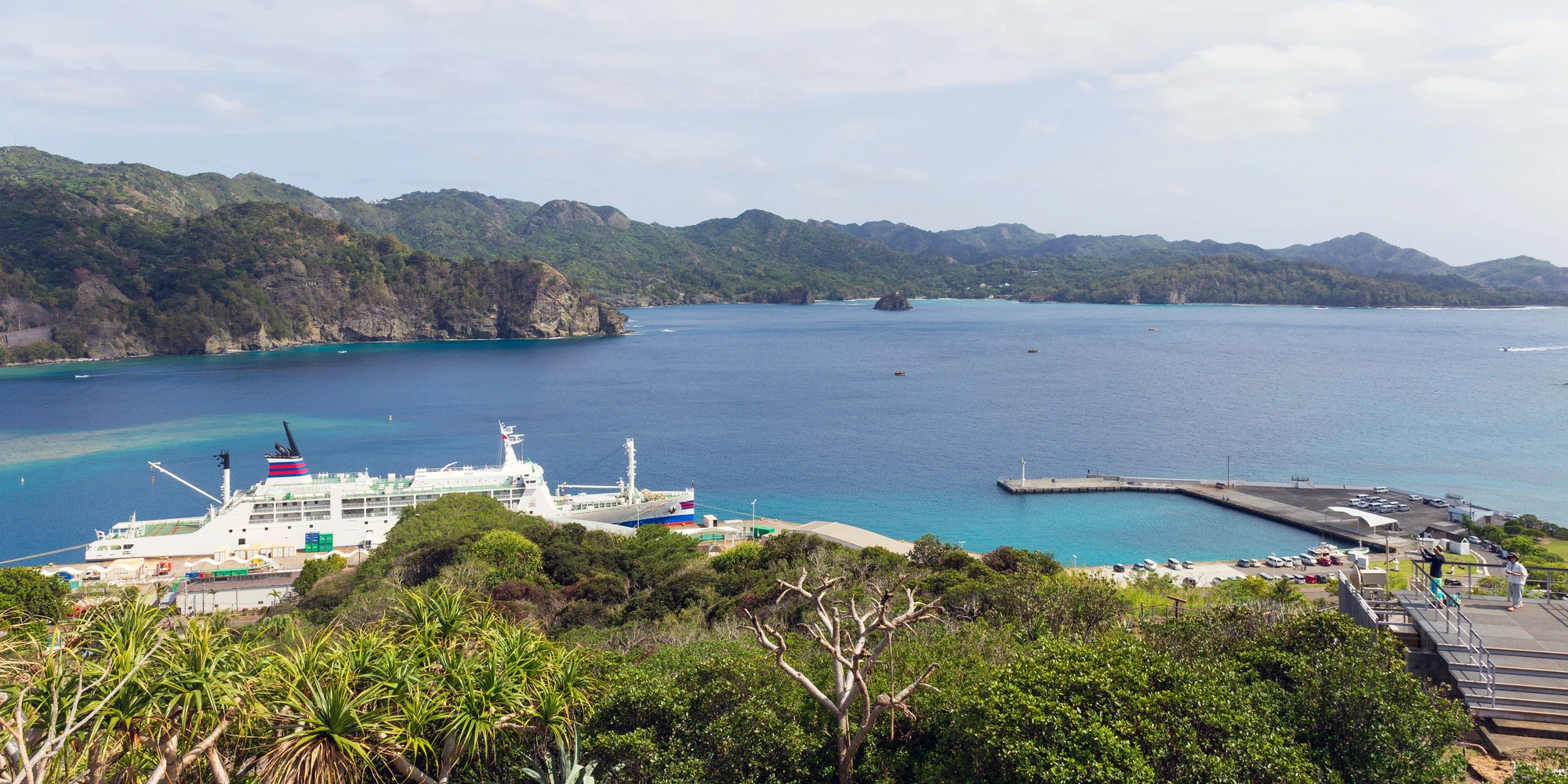
The first thing to make room for in an Ogasawara visit is the journey. Chichijima lies about 1,000 km south of central Tokyo, reached by the Ogasawara Maru from Takeshiba. After roughly a day at sea, the hills around Futami Bay give the arrival a real sense of scale. This is Tokyo administratively, but the national park is a scattered oceanic archipelago. A typical ferry-based holiday takes six days, with three nights ashore and two aboard ship. Build the visit around those sailing dates.
For a rewarding first outing on Chichijima, start at the Ogasawara World Heritage Centre in Nishimachi. Its displays make a small snail shell feel as important as the surrounding sea. The islands were never connected to a continent; the organisms that reached them became the starting points for distinctive island communities. Plants and land snails are especially revealing examples of evolution. Understanding that story makes the paths, cleaning mats and protected areas outside much more meaningful.
The centre is also a working conservation facility. From the public exhibition hall, a window looks into a breeding laboratory for endemic land snails and tiger beetles. These are animals in a conservation-breeding setting, not a promise that you will find them on a walk. Look at the shell models, wildlife displays and replica barrier used to explain the effects of introduced green anoles. The laboratory work is best viewed quietly; take questions to the ranger-office staff rather than interrupting people caring for the animals.
When the weather and trail conditions suit, follow that indoor introduction with Asahiyama. Arrange transport to the trail entrance beside Yoake Road, then take the signed path to the 267 m summit and return the same way. Woodland gives way to a brighter ridge and a view across the curves of Futami Bay. This is a good place to slow down and notice how an island forest can be low and compact, with vegetation adapted to comparatively dry, rocky ground. It is still a mountain path: uneven footing, heat and exposed sections deserve respect, even on a short outing.
The ocean offers another way to appreciate the park. On a different part of your stay, a local boat guide can introduce the marine wildlife, while the Weather Station Observatory offers a land-based chance of seeing humpback whales in season. Green sea turtles, spinner dolphins and humpbacks are part of Ogasawara’s wild marine life, but they are not endemic to these islands. The Bonin flying fox, red-headed wood pigeon and endemic land snails tell a different, more geographically restricted story on land. Enjoy learning about both without treating any animal as a guaranteed encounter.
Leave some unplanned time. A rough-sea day may change a boat trip, and wind or rain may make the hill walk a poor choice. The centre and a quiet look across the bay can be enough for an arrival day after the crossing. A good Ogasawara visit is built from a few well-chosen outings, clean equipment and time to look closely. Turn your visit into a safari! Use the Snappit app to scan and log wildlife sightings here.
Ogasawara National Park was designated on 16 October 1972, following the islands’ return to Japanese administration in 1968. The Ogasawara Islands were inscribed on UNESCO’s World Heritage List in 2011 for their ecological and evolutionary significance. The World Heritage Centre opened in May 2017, bringing public interpretation and practical conservation work together. The national park and World Heritage property have different boundaries; neither designation makes every island or forest area freely accessible.