Snappit logo
Snappit
Get App
Generic illustration, not a photograph of this venueIllustration
ParkCastilla y León, Spain

Montaña Palentina Natural Park

Montaña Palentina rewards a slower approach.

About

Montaña Palentina rewards a slower approach. In the west, the Carrión valley opens towards a skyline of steep rock; farther east, the Pisuerga country is more wooded. Between them are villages, grazing land and forests that make the mountains feel lived in. This is a large natural park, so a good first day needs a focus rather than a long list of distant stops.

Make that focus the Casa del Parque in Cervera de Pisuerga. Its Zona Oso exhibition explains the park through the brown bear, while the relief model helps turn unfamiliar place names into a workable plan. Follow it with either the woodland circuit to the Roblón de Estalaya or the shorter Bosque Fósil walk from Verdeña. The latter is especially good for curious children: the attraction is the marks of an ancient forest in rock, rather than a collection of standing petrified trees.

Save the long walk to Tosande’s yews or a trip to the western pine woods for a separate outing. Curavacas and Espigüete belong to the park’s mountain story, but their summits require a different level of preparation. You can enjoy this landscape without climbing either one. Planning to visit? Download the Snappit app to identify the wildlife you spot in real-time.

The natural park was declared in 2000 under the longer name Fuentes Carrionas y Fuente Cobre-Montaña Palentina. Older maps and leaflets still use that name for the same protected area. Its landscape also records much older stories: grazing helped shape open ground, while coal mining changed the region’s settlements and economy. At Verdeña, a former opencast mine exposed the fossil traces now interpreted along the public walk. A visit can connect those human histories with the living woodland without treating the mountains as empty wilderness.

What to do here

Spend 45–60 minutes at the visitor centre, ask which paths are suitable that day, and choose one of the two eastern woodland walks below. Carry a picnic or return to Cervera for a break. If your group wants a more ambitious day, choose Tosande only after checking its seasonal route restrictions and hunt closures; do not bolt it onto a short family outing.

Seasonal info

Autumn and winter bring hunting-related trail restrictions as well as shorter days. The 16 October 2026 notice lists Tejeda de Tosande closures on 31 October and 12 December 2026, and 28 February 2027. The operator updates the list weekly and dates can change. In summer, carry water and start longer walks early; in poor weather, keep to a modest plan or stay indoors.

Accessibility

The Casa del Parque has a lift and toilets described in its official audio guide; call to check step-free entry, the lift and the toilet arrangement for your needs. The outdoor walks have uneven paths and climbs; ask staff which options suit your wheelchair or walking aid. Bosque Fósil includes village steps in the published description, and Tosande has a sustained, uneven climb. A low difficulty rating describes walking effort, not step-free access.

Don't miss

1

Zona Oso at Cervera’s Casa del Parque, a useful introduction to the bears and their landscape.

2

The Roblón de Estalaya, an old sessile oak reached through mixed deciduous woodland.

3

Bosque Fósil de Verdeña, where rock preserves the traces of a forest from about 300 million years ago.

4

A choice of very different forests

eastern beech and oak woods, Tosande’s yews and the native pine woods near Velilla.

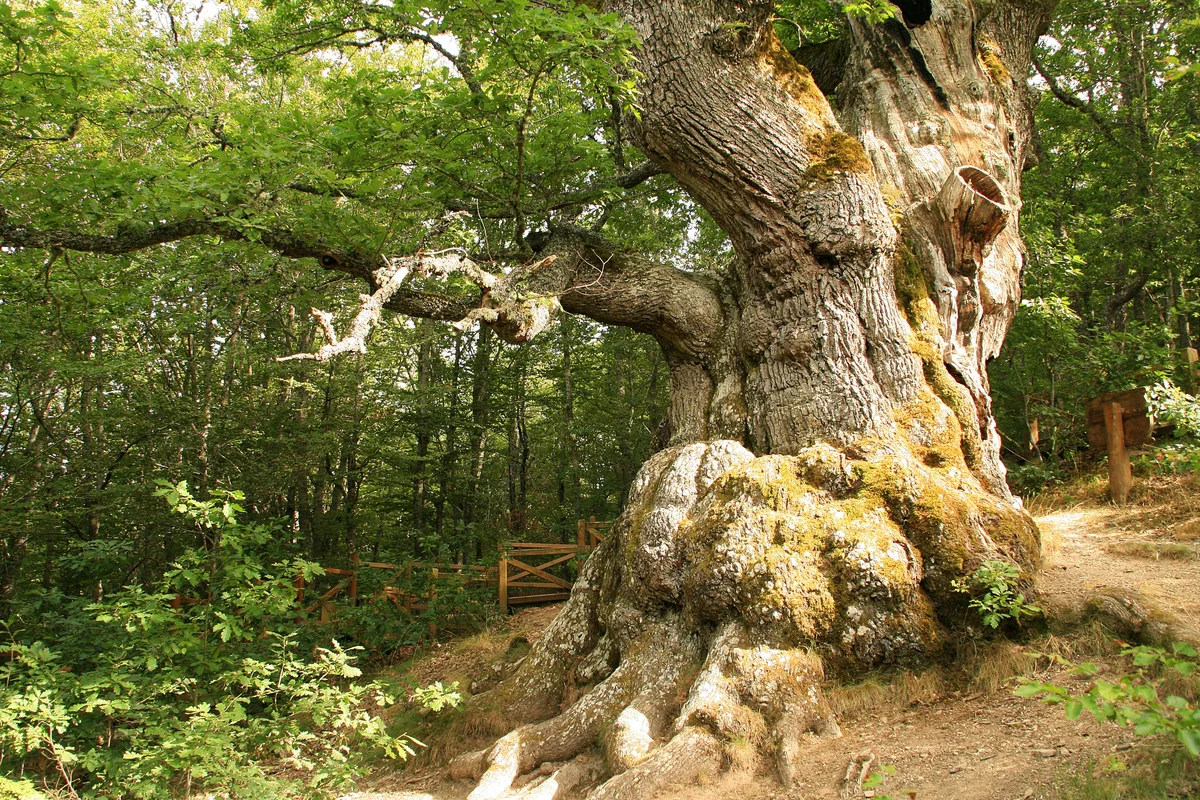
A massive, knotted tree trunk with exposed roots and moss stands among green woodland, beside a wooden fence and an earth path.

The Roblón de Estalaya in August 2012: an old oak whose broad, weathered trunk is a reason to linger on the woodland outing.

Roblon de Estalaya.Palencia. (7901800714).jpg — Miguel Ángel García. / Wikimedia Commons / CC BY 2.0 Generic · Creative Commons 1 · Creative Commons 2

Walks and routes

Bosque Fósil de Verdeña: a short walk into deep time

The official circuit is 3 km from the parking area by Verdeña, with a one-hour walking estimate and 120 m of stated height difference. Allow 1½–2 hours for the village, oak woodland and interpretation stops. At the rock face, look for patterns left by ancient tree bases and trunks. The marked route returns through the surrounding landscape; let the signs lead rather than trying to climb closer to the fossils.

The leaflet describes stairs and a passage through the village, followed by tracks, paths and an uphill woodland section. The steps interrupt step-free travel, so choose a different outing if your group needs a wheelchair or pushchair route.


Bosque Fósil de Verdeña: a short walk into deep time

Roblón de Estalaya: an old oak worth taking time over

The signed woodland loop starts at the designated trail parking reached from the road beyond Vañes towards Estalaya. It is about 4.6 km; the older official leaflet gives 1½ hours and 125 m of height difference. Allow 2–3 hours with a relaxed group. Oak and beech woodland are as much a part of the visit as the great sessile oak at the centre of it. Admire the tree from outside its protective fence.

Tracks and woodland paths include a climb, a bridge and a livestock-gate area in the published route. The official low difficulty rating does not establish step-free access. Check the current condition before choosing it for anyone with limited mobility.

Roblón de Estalaya: an old oak worth taking time over

Pinar de Velilla: a separate western woodland day

On the Carrión side of the park, this official circular route begins at the parking area beside Ciudad del Brezo. The operator gives 4 km, two hours and 150 m of height difference. Native Scots pines change the feel of the walk, and the upper part offers views towards Compuerto reservoir and Espigüete. Keep this as an alternative to the eastern walks, with time for the road journey.

Rated low walking difficulty, but the circuit climbs on a woodland route. Ask staff about the surface, width and gradients before choosing it for a wheelchair or walking aid.

Pinar de Velilla: a separate western woodland day

Tejeda de Tosande: the longer forest outing

This is the more demanding choice, reached from the signed parking by Dehesa de Montejo on the CL-626. Official descriptions give 10.5–11 km for the full route and roughly 3–3½ hours walking. Allow 4–5 hours with stops. The approach leads towards an uphill beech wood and the yews. The uneven climb and return deserve a full walking plan, not a spare afternoon squeezed between other stops.

The leaflet describes a steep, uneven ascent. Keep strictly to the path through the yew wood to protect roots and regeneration. It is not presented as an accessible or pushchair route.

Tejeda de Tosande: the longer forest outing

First visit: Cervera and one eastern walk

Start at the Casa del Parque during its morning opening and allow 45–60 minutes. Ask about conditions, then choose either Bosque Fósil for the shorter circuit or Roblón de Estalaya for a longer woodland visit. Make time for lunch and the road transfer. If anyone is tired or the weather worsens, the exhibition can be the whole visit.

Two days, with the driving kept sensible

Use the first day for Cervera and one Pisuerga-side walk. On the second, either stay east for Tosande when its route is permitted and your group is ready for a longer climb, or explore the western side with Pinar de Velilla. Avoid turning the itinerary into a race between all four trailheads.

Things to try

Give the centre a real place in the day

Use the relief model to find the two main river basins, then choose a walk together. In Zona Oso, give children one question to follow through the exhibition, such as how a bear’s food changes with the seasons. Allow time to ask staff about the day’s trail choices before leaving.

Make a small woodland notebook

Choose a few fallen leaves to examine where they lie, sketch a trunk or compare the shapes of the canopy. Photographs and drawings make better souvenirs than collected plants. Keep the activity on the path so that a quiet observation stop does not become a search through sensitive habitat.

Look for a forest inside the rock

At Bosque Fósil, start with the interpretation panels and then see which marks you can recognise in the rock face. Ask everyone to describe what they see before deciding it resembles a tree base or trunk. Stay behind the protective boundary; the site is for looking, not collecting.

Let the exhibition carry the visit

If the forecast is poor, check that the Casa del Parque is open and spend longer with Zona Oso and the park film. There is no need to justify the journey with a slippery woodland circuit. In strong wind or a storm, leave forest and exposed-viewpoint plans for another day.

Wildlife and habitats

Sessile oak

The Roblón gives this tree a memorable face. Look at the surrounding woodland as well as the veteran tree, and respect its fence and roots. Comparing leaf shapes from the path is more useful than trying to guess a precise age.

European beech

On the Roblón walk, compare the beech canopy with the oaks around it. Notice how the light changes beneath different trees and how fallen leaves alter the woodland floor through the seasons.

Scots pine

The western pine wood offers a useful contrast with the eastern broadleaved forests. Notice the needle canopy and the different pattern of light beneath it; use the signed route rather than stepping into the undergrowth for a closer specimen.

Common yew

Tosande’s yews are a reason to slow down, if the route is open and suitable for your group. Keep to the path to protect the trees and young growth. The view from the route is enough; do not step around trunks for a better angle.

Brown bear

Make the exhibition your starting point for understanding this animal. In the countryside, stay on marked paths and never follow tracks. If a bear appears, keep calm, give it room and withdraw from its path; keep dogs on a lead. Wildlife sightings are a bonus, never the basis of the day.

Griffon vulture

From an open permitted stopping place, use binoculars to scan the wider sky. Enjoy any large soaring birds at a distance and check the identification carefully. Do not seek cliff nests or walk towards roosting birds.

Black woodpecker

A quiet pause on a woodland path can be more interesting than constant walking. Listen for natural sounds and watch from where you are; do not play calls or investigate cavities to draw birds into view.

Stories and discoveries

Two rivers make a useful mental map

The Carrión and Pisuerga both begin in these mountains. Their valleys offer a helpful contrast when planning: more exposed rock and steep slopes on the Carrión side, more extensive woodland in the Pisuerga landscape. These are broad patterns, not a guarantee that every eastern walk is easy.

A fossil forest is a trace of a vanished world

Verdeña’s rock face records an ancient forest exposed by mining. Expect impressions and structures in the rock rather than upright stone trees. The living woodland on the way makes the contrast especially engaging.

Old trees need room

The Roblón’s age is estimated rather than precisely known. What matters on a visit is its extraordinary survival and the woodland around it. Its protective fence is part of caring for the tree, so a photograph from outside is the right way to take it home.

When to visit

Spring: choose the height carefully

Enjoy the return of leaves in the lower woodland and let the forecast set the day’s ambition. Mud, lingering snow and swollen watercourses can make a route less straightforward than its distance suggests. Save exposed mountain objectives for suitable conditions and experience.

Summer: leave space for breaks

Use the centre’s longer weekly opening season, but note the 14:00–17:00 break. Begin a longer walk with enough daylight and drinking water, and reduce your plan in heat or thunderstorms. Shade on part of a route does not make the entire day sheltered.

Autumn: colour with a closure check

The deciduous woods are a rewarding focus. Check the weekly hunting notice before every walk, and ask about Tosande’s autumn/winter out-and-back restriction. Shorter daylight is a good reason to choose one route and leave plenty of return time.

Winter: the centre or another day

Regular centre opening in the 2026 schedule ends on 13 December; groups can enquire about an arranged visit. Snow, ice or severe weather may make even a low-rated woodland route unsuitable. Choose an indoor plan or postpone rather than treating a summer walking time as a winter promise.

Getting there and practical advice

Casa del Parque: where to start

Find the centre at Calle El Plantío, s/n, 34840 Cervera de Pisuerga. It has visitor information, the Zona Oso exhibition and an audiovisual presentation. Contact +34 979 139 401 or +34 676 210 231, or [email protected], for group visits and specific access questions.

2026 opening calendar

From 12 February–30 June and 1 September–13 December 2026, the centre opens Thursday–Saturday 10:00–14:00 and 17:00–20:00, and Sunday 10:00–14:00. In July and August, the same morning/afternoon hours apply Tuesday–Saturday, with Sunday mornings only. It also opens 8 December 10:00–14:00 and 17:00–20:00. Ask about winter group visits and check the new calendar for travel beyond 2026.

Centre admission and reservations

The regional sheet updated 15 October 2026 lists general admission at €1, reduced admission at €0.50 for over-65s and youth-card holders, and free entry for under-7s and people with disabilities. Check proof requirements, group arrangements and any separate guided-activity price directly. The sheet warns that prices and hours can change.

Toilets, water and food

The centre’s audio guide identifies toilets near reception. Check their layout and availability for your group. Carry drinking water and snacks for the walks and plan food in a village before heading to a trailhead. Bring what you need for the full walk rather than relying on a café or fountain along the way.

Arriving in Cervera

The centre’s directions include the CL-626 from Aguilar de Campoo and the CA-184/CL-627 route from Potes. Choose a route for the weather and road conditions, particularly across the mountain approaches. Use the centre’s street address to plan your arrival.

Getting from the town to a trail

The recommended woodland walks have separate starting points. Arrange your onward and return transport before leaving Cervera, and use the signed trail parking. Bosque Fósil starts by Verdeña; the Roblón has its own parking near Estalaya; western Pinar de Velilla is a different outing.

If you are travelling without a car

Plan the journey to Cervera and the last connection to your chosen trailhead separately. Ask the tourism office or accommodation about current bus services and prebookable local transport; do not assume a bus runs to these woodland starts or that a taxi will be waiting at the end. Confirm the return before committing to a walk.

Mountain tracks and private access

Use ordinary permitted roads and designated parking. Restricted tracks have their own rules: the park website, for example, highlights a separate vehicle-permit process for Puertos de Pineda. Do not treat a route displayed on a map as a drivable scenic road.

Start with the indoor visit

The official audio-guide transcript describes an upper-floor lift and toilets near reception. This makes the centre a useful place to discuss a mobility-led visit, but call first about the entrance, lift availability, toilet dimensions and any assistance. The presence of a lift alone does not answer every access question.

Choose a path for the people using it

At Bosque Fósil, village steps are a specific barrier; at Roblón, the route includes a bridge, gates and a woodland climb; Tosande is steeper and uneven. Ask staff to match an open route or shorter stop to your equipment and stamina. Do not assume an off-path shortcut makes a route accessible.

Sources and useful links

Wildlife you might spot

7

Each card links to a full Explore page with photos, traits, and fun facts.

Snap map for this place

Start with the big picture, then zoom in to explore individual wildlife observations around this place.

Loading map…

Good to know before you go

Check the Casa del Parque’s current “Cierre sendas” notice before setting out, especially for Tosande. Respect closure signs even if an older leaflet shows a complete circuit.

Choose one valley for a first day. The visitor centre and a woodland walk make a satisfying visit without trying to fit in distant trailheads.

Wear shoes with grip, take a waterproof and warm layer, and carry drinking water and food. Fill your bottles before leaving town; do not drink from streams.

Use the marked paths and close livestock gates after passing through. Keep fossil fragments, plants and fallen natural objects where they are.

Keep dogs on a lead in bear country. Never follow bear tracks or approach wildlife; if a bear appears, stay calm, give it space and withdraw from its path without threatening gestures.

Park only in designated places and keep access clear for residents, farms and emergency vehicles. A map showing a track is not permission to drive along it.

Arrange group visits with the centre in advance. The 2026 calendar has a midday closure and fewer opening days outside summer.

Do not light fires or camp freely in the protected area. Take all litter away, tell someone your walking plan, and call 112 in an emergency.

Frequently asked questions

Yes. That longer name appears on older official material for the park now presented as Montaña Palentina. This guide covers the natural park in Palencia, with Cervera de Pisuerga as the recommended first-visit base.
Bosque Fósil is the shorter option at 3 km, with some climbing and village steps. Roblón de Estalaya is about 4.6 km and gives you a memorable old tree as a destination. Choose for your group’s ability and the day’s conditions; neither is presented here as a pushchair route.
No. Brown bears are part of the park’s wild fauna, but build your visit around the landscape and the exhibition. Use binoculars for any distant wildlife, stay on marked paths and never pursue an animal or its tracks.
The regional tourism sheet updated 15 October 2026 lists €1 general admission, €0.50 for over-65s and youth-card holders, and free entry for children under 7 and people with disabilities. Confirm eligibility and any separate activity charge with the centre before visiting.
Ask the centre whether any booking or access restriction applies to your chosen walk. Arrange group visits to the Casa del Parque directly; guided activities and vehicle access can have separate conditions. Always check trail closures before setting out.
Yes: make the Casa del Parque the main event, using the exhibition, model and film to understand the landscape. Confirm the lift and toilet facilities if needed. Ask staff for a suitable open outdoor stop rather than assuming that a named viewpoint has step-free access.
Tosande is a substantial walk, with about 10.5–11 km published for the full route and seasonal changes to the permitted circuit. Curavacas and Espigüete are separate mountain objectives. Choose either kind of outing deliberately, with suitable experience, equipment and weather.

Recent snaps at this place

Recent snaps will appear here as new observations are added.

View all ›

Take the discovery with you

Exploring Montaña Palentina Natural Park?

Identify the wildlife you spot, learn as you go, and keep a collection of the adventure.

  1. 1Spot it
  2. 2Snap it
  3. 3Keep the discovery