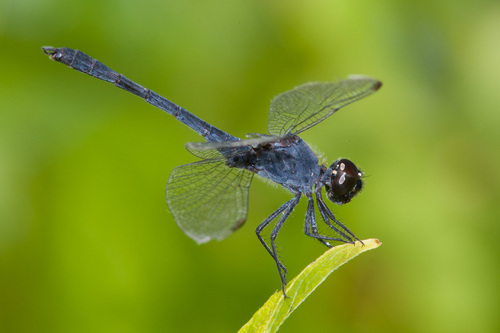
Blue Dasher
Snap a dragonfly or damselfly and Snappit reads its wings, eyes, body shape and markings to suggest a match. Then learn with your kid how age and sex change its colors.
Identify and collect animals with your phone.


Drag a photo here, or choose one below.
JPG, PNG or WebP · Up to 10 MB

Wait for the insect to perch, then keep all four wings and the abdomen in frame. A side view and a top view show different markings.


Compare the suggested name with what you see in your photo. Then open its field-guide entry for fun facts and look-alikes to rule out.

Browse the field guide here, or save your finds as collectible cards in the Snappit app. Build collections and learn something new together.
From the Snappit field guide: the darting, glittering hunters your kid spots over the pond. Open a card to see their colors and how they start life underwater.
A slender insect by a pond could be a damselfly or a dragonfly, and color alone won't tell you which. Check the eyes, body proportions, wing shape and resting position. Young adults change color as they mature, and males and females of the same species can look quite different.

Look at the wings before the color. Dragonflies have broader hindwing bases and rest with their wings held out to the sides. Damselflies are slimmer, with four similar narrow wings, and most fold them over the back. Spreadwing damselflies hold their wings partly open, though, so posture works best paired with wing shape.

Many dragonflies have huge eyes that touch or nearly meet on top of the head. Damselflies have widely separated eyes, but so do some dragonflies, including clubtails. Use eye spacing alongside body build and wing shape; separated eyes alone don't prove you've got a damselfly.

The long rear section is the abdomen. Instead of just asking whether it's blue or red, look for rings, dark lines, pale spots, a clubbed tip, or a narrow waist near the base. Markings that repeat segment by segment are often more useful than overall color, especially on worn adults.

Many species change as they mature. Males of some dragonflies develop a powdery blue or whitish coating called pruinescence, while females and young adults stay yellow, brown, green or patterned. So a bright adult male can look completely different from a female or youngster of the same species.
Compare real field-guide examples: Blue Dasher · Emperor Dragonfly · Common Green Darner

If the insect looks stout, with a broad chest, wide hindwing bases and huge eyes that meet or nearly meet, it's most likely a dragonfly. If it's needle-slim with separated eyes and narrow, matching wings, think damselfly first. Resting posture helps, but don't rely on it alone.

A bright blue or red individual is often a mature male, but color can mislead. Females and young males may share the same brownish or yellowish markings, and males take days to weeks to reach full adult color. Compare stripe placement, abdomen shape and any powdery bloom instead of the shade.

Adults have fully expanded wings. Aquatic nymphs don't, though you may see developing wing pads. Dragonfly nymphs are usually stocky and breathe through gills hidden inside the abdomen, while damselfly nymphs are slimmer with three leaf-like gills at the tail end. An empty shed skin keeps the same features.

With one still image, start with the silhouette. Is the insect stout or threadlike? Are the wings open or folded? Do the hindwings widen where they meet the body? Then zoom in on the head. Eyes that meet or nearly meet point to a dragonfly; separated eyes show up in damselflies and some dragonflies, so check the wings too.
Next, work along the abdomen from base to tip. Look for a widened end, a pinched middle, rings on each segment, or contrasting side stripes. These details often survive even in average photos. If the image is a bit soft, structure still counts: a heavy thorax and broad wing bases tell you more than a blue or red cast from sunlight.

Blue dragonflies aren't one kind of insect. Often blue points to an adult male, especially when it looks dusty rather than glossy. Red turns up in several unrelated groups too. For both colors, body proportions, thorax stripes, wing patches and the shape of the last few abdominal segments separate candidates better than the headline color.
Open wings don't automatically mean dragonfly, either. Spreadwing damselflies rest with their wings half open, so a slim insect with angled wings can fall between the usual categories. Nymph photos cause a different kind of confusion: they look nothing like the elegant flying adults people expect, so many kids don't realize that chunky underwater bug is a dragonfly in the making.
A side or slightly-from-above view shows the wing bases, abdomen shape and resting posture at once, which beats a straight head-on shot.

If you took several photos, upload the clearest one. A perched insect with all four wings visible is much easier to read than a blurred flight shot.

The end of the abdomen and the exact wing outline carry useful clues. Try not to crop off the tail tip, the wing tips, or where the wings attach.
It depends on more than the blue. The color can come from maturity, sex or a powdery coating rather than one unique species. A photo helps most when it also shows the thorax stripes, the abdomen shape, and whether the blue is solid, patchy or dusty.
Look past the red, which narrows things less than you'd expect. Some red dragonflies are slim, others stocky, and sunlight can make orange look red. Check the body build, any dark lines on the abdomen, the face color, and whether the wings are clear or marked near the base.
Quite likely, especially if it has a thin body and wings folded over its back. Don't go by slimness alone, though. Some dragonflies are fairly slim, and spreadwing damselflies rest with their wings half open. Check the eye spacing and whether all four wings are similarly narrow.
Because it's probably a damselfly. Most damselflies fold their wings together above the body at rest, while dragonflies hold theirs spread out flat. The main exception runs the other way: spreadwing damselflies rest with wings partly open. Check the wing bases and eye spacing to confirm.
Often, at least to dragonfly or damselfly nymph. Look at the body, legs, developing wing pads, and any leaf-like gills at the tail end. Empty shed skins on reeds look almost the same. Species details are tiny, so a broad result is often more honest than an exact name.
Sometimes. Even a soft image can show whether the insect is stout or slender, whether the wings are spread, and whether the abdomen ends in a club. If you have several shots, pick the one that's sharpest around the head and wing bases, not the brightest.
Go by structure and markings more than color. This one's tricky, because females and young males often share yellow, brown or green patterns, and mature males of some species later turn much bluer or redder. Young adults can look fresh and shiny, without the powdery bloom older males get.
Yes. Snappit is a free iPhone and Android app for kids exploring with a grown-up. Snap a dragonfly at the pond and it suggests a match with short, kid-friendly facts, then saves it as a collectible card with a rarity tier in your family's private collection. No ads, no chat, free IDs every day, and an optional subscription for unlimited snaps.
The Snappit appAges 4+ · No ads
Take what you learn here into Snappit and turn your next walk or day out into a shared adventure.
Save your discoveries as collectible cards in the app, with rarity tiers and themed collections to explore.
Short, friendly facts give young readers something to notice, ask about, and remember. The app is made for ages 4 and up, without ads.
Discover new collection themes, try the daily discovery, and earn badges as you keep exploring together.


Open a place guide to see its species checklist and plan what to look for on your next visit.
New York, US
You might spot Seaside Dragonlet and Double-Ringed Pennant.
View guide →

Ohio, US
You might spot Eastern Pondhawk, Double-Striped Bluet, and Skimming Bluet.
View guide →

Ohio, US
You might spot Spotted Spreadwing and Eastern Pondhawk.
View guide →