Snappit logo
Snappit
Get App
Generic illustration, not a photograph of this venueIllustration
ParkComunidad de Madrid, Spain

Casa de Campo Park

Casa de Campo is a good place to let a city day slow down.

About

Casa de Campo is a good place to let a city day slow down. Begin beside the lake, where you can watch the water, notice the trees and take a break without committing to a long walk. Beyond this busy meeting place, the park opens into wooded hills and stream valleys. You do not need to cover that whole landscape to enjoy it.

The Centro de Información y Educación Ambiental, beside the lake’s boating area, is a useful first stop. Its park model and displays put the woodland, water and history in context. Outside, a small themed garden and pond invite a closer look at the life around the building. Ask which parts of the garden and botanical path are suitable that day, especially if you are visiting with young children or need a step-free route.

Afterwards, choose between a lake-edge wander and a short section of the Senda Botánica, the established path following the Meaques stream towards Zarzón. The first keeps refreshments close at hand; the second gives you more reason to slow down beside individual trees. A full botanical walk is a bigger undertaking than its simple line on a map might suggest, because you still need to get back.

There is a rewarding contrast here between a landscape that supports wild birds and native oak woodland, and one shaped for centuries by people. The lake is artificial, the pinewoods include replanting, and ornamental trees add another layer to the story. Keep those distinctions in mind and an ordinary leaf, acorn or bird on the water becomes a clue to how this park works. Unlock an interactive field guide for this spot: get the Snappit app to identify nature on the go.

The name recalls the Vargas family’s country estate, which Philip II acquired in 1562. Successive rulers expanded and reshaped the property for hunting, leisure and practical uses. Its ponds, gardens, walls and wooded ground belong to that long history of a working royal landscape. Casa de Campo became a public park in 1931. The Civil War brought fighting and damage, and later decades added major leisure facilities. In 2010 it was declared a Bien de Interés Cultural in the category of Historic Site. That designation recognises the whole layered place, rather than treating it simply as a formal garden. The historic Casa de los Vargas and its Renaissance garden are part of a separate restoration project, with a public opening announced for 2027. Check an actual opening announcement before planning an interior or garden visit there; the lakeside environmental centre is a different building.

What to do here

Start at the lakeside environmental centre when it is open, look at the garden, then pick one outdoor focus: a relaxed circuit or partial circuit of the lake, or a short out-and-back on the botanical path. Pause for waterbirds and compare the trees you pass. Add a café stop or a prebooked environmental activity if that suits the day.

Seasonal info

July–September brings morning-only opening at the environmental centre. In autumn and winter, build the day around daylight and warm layers rather than expecting a long late-afternoon wander. Strong winds and other adverse weather can bring restrictions in parts of Casa de Campo; check the municipal park-alert page before setting out.

Accessibility

The city lists the environmental centre as accessible for people with reduced mobility, while the park as a whole is only partly accessible. The exhibition occupies two floors, so ask about access to the particular rooms and garden you want to use. The lake is the practical area to discuss for a shorter outing; the botanical path’s description as flat is not a guarantee that every surface or crossing will suit a wheelchair or pushchair.

Don't miss

1

The lake’s open water and views back towards Madrid

2

The environmental centre’s park model, displays and small themed garden

3

A short, attentive walk on the established botanical path beside the Meaques

4

Native oak woodland, planted trees and seasonal waterbirds in one urban park

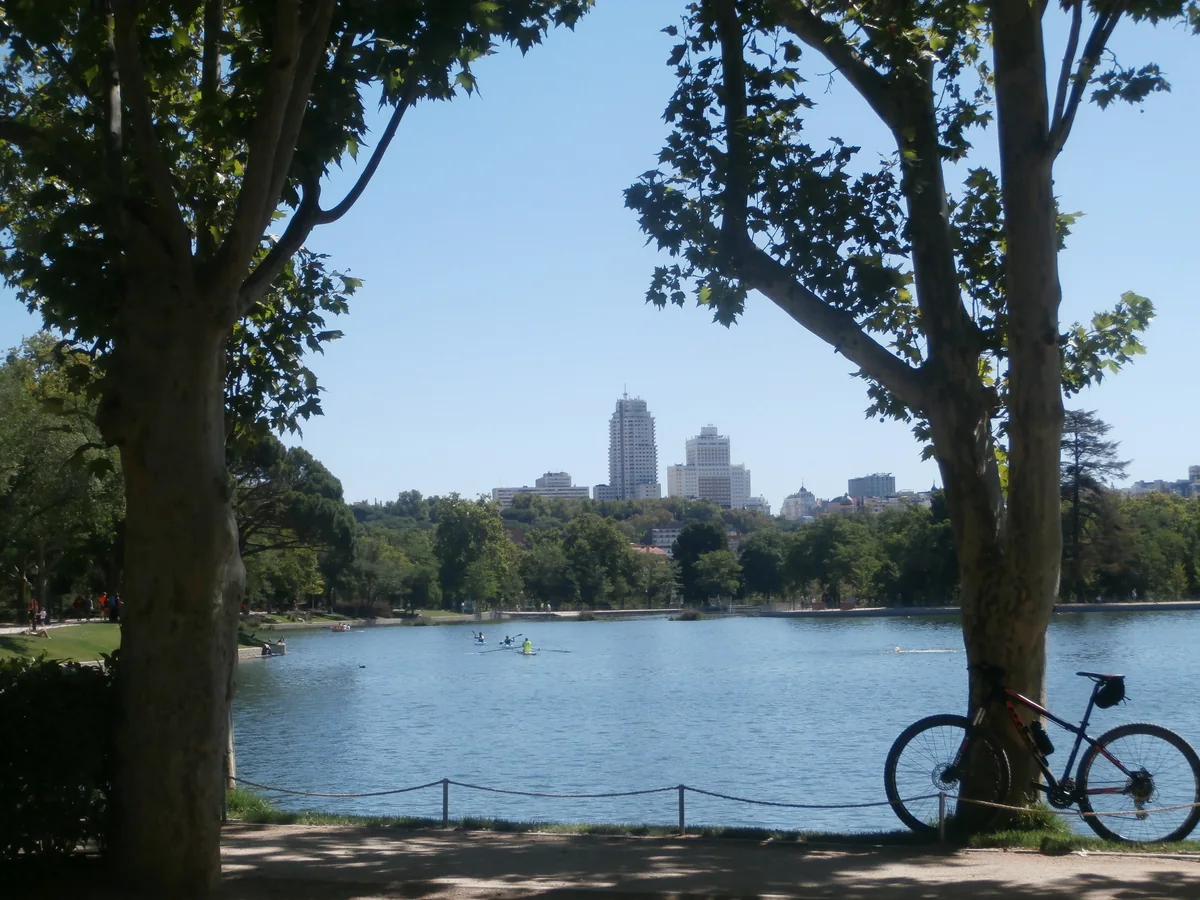
Two trees frame a blue lake and distant city buildings; a bicycle rests beside the near bank while small boats cross the water.

Casa de Campo’s lake in summer 2019, framed by shade trees with Madrid’s skyline beyond.

Vista parcial del Lago de la Casa de Campo, Madrid, España.jpg — siestecita / Wikimedia Commons / CC BY-SA 4.0 International · Creative Commons

Walks and routes

Lake edge: a circuit or a shorter wander

Begin at the environmental centre beside the boating area and explore the public shoreline paths. The lake’s published perimeter is 1,370 m, which gives a useful sense of scale; your actual walking distance depends on the paths and detours you choose. Allow 35–60 minutes for a leisurely circuit with stops, or turn back sooner. Take in the water, the city-facing view and the contrast between busy terraces and quieter pauses.

Ask the centre which section offers the smoothest approach, suitable rest points and toilets for your needs. You can enjoy a stretch of the shore without completing a loop. Watch for wet surfaces and movement around the boating area; a broad park accessibility label does not verify every lakeside connection.


Lake edge: a circuit or a shorter wander

Senda Botánica: a short out-and-back

Ask for the current botanical-path information at the centre, then follow an initial part of the established route from the lake towards Zarzón beside the Meaques. Choose a turning point together and return the same way. Allow 45–75 minutes for your chosen short section, with time to compare leaves, bark and the planted and streamside vegetation. The complete published path is 4 km one way, so a full out-and-back would be about 8 km before any extra approach. The old leaflet is useful background, but follow present signs and staff advice rather than relying on every historic numbered panel still being there.

Official tourism describes the full botanical path as level. Confirm the surface, crossings and suitable turning point before taking a wheelchair or pushchair; a level route can still have uneven or muddy sections. Shorten the outing if the ground or the return journey would be difficult.

Senda Botánica: a short out-and-back

A gentle 60–90-minute introduction

Choose a centre-opening day. Spend roughly half an hour looking at the displays and asking a question, then explore the garden if available and a short stretch of the lake. Pause to watch birds before returning. This is enough for an enjoyable first visit with a small child or anyone keeping walking modest.

A relaxed half day

Begin with the centre and garden, take a slow lake walk, then stop for a drink or lunch. If everyone wants more, ask about an initial section of the botanical path and make it a short out-and-back. Skip that extra walk if the weather is hot or the first part of the day has already filled your group’s attention.

A winter birdwatching visit

Arrive in daylight with binoculars and a warm layer. Start with a quiet shoreline watch, then use the centre’s interpretation to help with the birds you have seen. A café break can finish the outing. Keep it flexible if the weather turns; a winter lake visit does not need a long forest walk.

Things to try

Make a three-tree comparison

Choose three trees visible from the path. Compare the outline of the canopy, the bark and whether the leaves are broad or needle-like. Read a label before naming a species, and photograph what you notice rather than picking a sample. The botanical leaflet distinguishes native woodland, riverside trees and ornamental planting, which makes a useful theme for the game.

Spend ten minutes watching one patch of water

Find a safe place to pause without blocking the path. Ask which birds swim, dive, stand at the edge or fly overhead, then compare their shapes. A small notebook works as well as a camera. Let the birds decide how near they come, and leave their resting places undisturbed.

Look closely in the centre’s garden

When the outdoor area is open, use the garden’s interpretation to connect small plants and pond life with the much larger park. Ask staff about the current flowering beds and biodiversity projects. Watch insects where they settle, without touching plants, lifting covers or stepping into unmown plots.

Choose a booked activity for a deeper visit

The centre offers family sessions, interpreted walks and visits to environmental facilities. Check the current programme for the right age range and mobility needs, then book by email. The insect centre, nursery and bird observatory should be treated as arranged visits when offered, rather than assumed drop-in attractions.

Use the exhibition when it is open

On a wet day, the centre can become the main visit rather than just the introduction. Look at the model together, choose one landscape feature and connect it with what you can see outside. Check the timetable first; Mondays, Tuesdays and the midday break are not reliable indoor fallbacks.

Postpone the wooded walk in strong wind

Check the city’s park-alert information and obey any closed or taped-off area. Casa de Campo can have restrictions in particular zones without every entrance being shut. Do not use that as a reason to walk beneath trees during an adverse-weather warning; leave the forest and return when conditions are suitable.

Wildlife and habitats

Holm oak

Compare the broad leaves and acorns of an oak with the needles and cones of nearby conifers. Holm oak belongs to the park’s native woodland story, although people have also planted and managed it. Leave acorns in place for the ecosystem.

Mallard

The familiar duck is a useful first identification: adult males in breeding plumage have a green head, while females are mottled brown. The centre’s lake guide treats mallards as resident birds. Watch their behaviour from the path without offering food.

Great cormorant

In the cooler months, look for a large dark waterbird that sits low on the water or rests with wings spread. Great cormorants are described as winter visitors to the lake. Binoculars make a quiet shoreline stop more rewarding.

Black-headed gull

The name can mislead in winter: look for a small dark mark behind the eye rather than a full dark hood. These gulls are among the lake’s winter visitors, offering a good reason to return in a different season.

Deodar cedar

The park’s tree collection also includes ornamental species from elsewhere. Its documented Himalayan, or deodar, cedar is an example, with needle clusters and drooping branch tips. It belongs to the wider Reservado landscape; ask staff about opportunities to learn about it rather than entering restricted gardens.

Stories and discoveries

The lake has a designed history

The lake began within the royal landscape’s system of ponds. The present lake developed from the joining of two older ponds, so its apparently simple outline contains several centuries of change. Today it is both a leisure setting and habitat for free-living birds.

A tree worth slowing down for

The lakeside Plátano Gordo is one of the park’s notable trees. The centre identifies it as an introduced hybrid plane, with broad, hand-shaped leaves and patchy bark. Enjoy its canopy from the path and leave its bark and roots undisturbed.

Woodland with several origins

Casa de Campo’s oaks, pine plantations and streamside trees do not all tell the same story. The native oak community has survived alongside clearance, grazing and replanting, while ornamental species reflect the estate and public park’s designed spaces. Notice the changes as you move away from the shore.

When to visit

Spring: make the garden part of the visit

Use a mild day to compare new growth and spend time watching flower visitors around the centre. Do not disturb nesting birds or collect flowers. If pollen is a problem, remember that the lakeside plane trees flower in spring and choose your timing accordingly.

Summer: an early, compact outing

Carry water and keep the outdoor section modest. The centre’s July–September timetable is morning-only, so an afternoon arrival should not depend on the exhibition being open. If the forecast is very hot, choose another day rather than trying to make the woodland provide all the cooling you need.

Autumn: leaves and acorns

Compare falling broad leaves with the evergreen canopy and look for acorns without collecting them. A notebook or a set of photographs makes a good record. After rain, watch your footing on leaves and soft ground, and ask whether the botanical-path section you want is in good condition.

Winter: give the lake a second look

The centre’s bird guide describes winter visitors such as gulls and cormorants, alongside resident ducks. Wrap up, allow a quiet watch and leave time to return before dark. Cold wind or park restrictions are good reasons to move the outdoor part to another day.

Getting there and practical advice

Environmental centre: location and contact

The Centro de Información y Educación Ambiental Casa de Campo stands beside the lake’s embarkation area. Ask for a map, current path advice or help choosing an activity. Contact: +34 91 480 19 57 or [email protected]. Its location and purpose make it a better starting point for this nature visit than an attraction’s ticket office.

Environmental centre: published hours

October–June: Wednesday, Thursday and public holidays 10:00–14:30; Friday–Sunday 10:00–14:30 and 16:00–18:30. July–September: Wednesday–Sunday and public holidays 10:00–14:30. It closes every Monday and Tuesday, including holidays. The municipal record also lists closures on 24, 25 and 31 December and 1 and 6 January. Check the current calendar before travelling.

Exhibitions and outdoor learning

Inside are permanent displays, a large park model and space for temporary exhibitions. Outside are a themed garden and pond. Ask what is available during your visit. The biodiversity planters described near the Centro Entomológico are a separate project; do not assume they are all beside the environmental-centre entrance.

Food and drinking water

The lake has a cluster of restaurants and terraces, useful for building a proper pause into the day. Check an individual venue’s opening if you depend on it. Bring your own drinking water, especially before extending the visit along the botanical path; do not rely on an unchecked fountain or the stream.

Toilets

Municipal information identifies public toilets near the lake esplanade on Calle de María Teresa, opposite the restaurants. Ask which are open and whether the facilities meet your needs. Accessible toilets, baby-changing provision and opening hours should be confirmed rather than assumed.

Boat hire is optional

The lake’s official tourism page directs visitors to Madrid Móvil or the municipal sports booking website for rowing boats. Check the latest price, booking window, weather decision and age rules there. Ask specifically about boarding assistance if needed. Boat hire adds a separate paid activity; it is not part of the walking plan.

Public park access and overnight restrictions

The park is open to pedestrians year-round. Municipal guidance restricts private traffic and states that the access points serving the zoo, amusement park, Paseo de Extremadura and lake area close from 01:00 to 06:00. Plan this nature outing in daylight and follow the signs at the entrance you use. Attraction and centre hours remain separate.

Arrive at Lago on Line 10

For the lake and environmental centre, use Lago Metro station. CRTM lists its El Lago access on Paseo de la Puerta del Ángel and marks the station as accessible with a lift. Check service and lift status for the day, then follow signs towards the lake; allow extra time if you need to find the easiest onward path.

Choose the entrance, not just the park name

Batán and Casa de Campo stations are also on Line 10, with Line 5 connecting at Casa de Campo. Príncipe Pío is another approach to the wider park. These serve different arrival points, so use Lago for the simple plan here unless your journey planner or access needs suggest otherwise.

Keep a car plan outside the woodland walk

The municipal park information says private through-traffic is restricted. If you need to arrive by car, check the permitted approach and designated parking for your exact destination. Do not plan to drive between the lake and an arbitrary point on the botanical path or assume an old map’s parking symbols guarantee current access.

Cable car: closed at the latest check

The official tourism page still lists the Teleférico as closed for refurbishment on 17 October 2026. Its suggested reopening in the first quarter of 2027 is a forecast. Plan to arrive by ground transport and recheck the operator before treating the cable car as an option.

Match the centre visit to the rooms you need

The city’s accessibility label is encouraging, but the resources page describes an exhibition on two floors. Before travelling, ask how you reach both levels, the garden and a suitable toilet, and whether any assistance is needed. A short visit can focus on whichever displays and outdoor areas work for your group.

Choose a short, confirmed section

Discuss the lake approach and the beginning of the botanical path with staff. Ask about the actual surface, any steps or crossings, resting places and a comfortable turnaround. The published botanical route is flat, but its length and condition still matter; neither the whole forest nor every connection should be treated as universally accessible.

Make room for a quieter pace

The lake also serves diners, walkers and sports users. If bustle is tiring, keep the plan short and choose a place to pause before continuing. Ask the centre about adapting an organised activity to your group; it offers tailored work for organised groups, but support should be arranged in advance.

Sources and useful links

Wildlife you might spot

5

Each card links to a full Explore page with photos, traits, and fun facts.

Snap map for this place

Start with the big picture, then zoom in to explore individual wildlife observations around this place.

Loading map…

Good to know before you go

Start from Lago Metro station on Line 10 for this lake-focused visit. Check transport notices and any lift you need before travelling.

Check the centre’s hours and the city’s park-weather alerts on the day. The centre closes every Monday and Tuesday, including public holidays.

Carry drinking water, sun protection and shoes with grip. Keep the walk short in hot weather and allow time for breaks.

The botanical path is linear. Decide when to turn back while everyone still has energy; reaching Zarzón does not bring you back to the lake.

Keep children close beside open water. Stay on the paths and use the lake for watching, not paddling or swimming.

Watch wildlife without feeding, chasing or playing calls to attract it. Keep dogs close to you, away from birds and planted beds.

Leave acorns, cones, flowers and other natural material where they are. Photograph or sketch them instead; do not light fires or barbecues.

Book organised environmental activities in advance and wait for confirmation. The zoo, amusement park and boat hire have their own arrangements; none is needed for the public-park outing described here.

Frequently asked questions

No. Zoo Aquarium Madrid and Parque de Atracciones are independently managed attractions inside the wider park, with their own tickets and opening arrangements. This guide concentrates on the public lake area, environmental centre and botanical path.
Lago on Line 10 is the starting point for this guide. Casa de Campo and Batán stations serve other parts of the park; choosing the station with the park’s name can leave you with a different approach. Check the route to the lake before travelling.
The published route is 4 km one way, from the lake towards Puerta del Zarzón. Walking back along it roughly doubles that distance. For a gentle family visit, choose only an initial section and turn back together; ask the centre about current signs and conditions.
The centre’s organised activities are free but require advance email booking. Check the particular activity’s age requirements and wait for the centre to confirm your place. A request alone is not a confirmed booking.
As checked on 17 October 2026, the official tourism page says the Teleférico is closed for refurbishment. It gives a projected reopening in the first quarter of 2027. Use a ground-transport plan until the operator confirms it has reopened.
There are restaurants around the lake, and municipal information places public toilets by the lake esplanade on Calle de María Teresa. Check which facilities are open when you arrive, particularly if you need an accessible toilet or a baby-changing space.
Recreational rowing boats are a separate paid option. Check the current municipal booking service, weather, age rules and boarding arrangements before committing. You can have the full nature visit from the shore.
No wildlife sighting is guaranteed. The lake changes with the season, weather and disturbance. Bring binoculars if you have them, take a quiet pause, and enjoy identifying whatever is there.

Recent snaps at this place

Recent snaps will appear here as new observations are added.

View all ›

Take the discovery with you

Exploring Casa de Campo Park?

Identify the wildlife you spot, learn as you go, and keep a collection of the adventure.

  1. 1Spot it
  2. 2Snap it
  3. 3Keep the discovery