
Snappit logo
Snappit
Get App
Generic illustration, not a photograph of this venueIllustration
ParkProvence-Alpes-Côte d’Azur, FR

Mercantour National Park

The journey up the Vésubie changes the scenery quickly: olive-growing country gives way to mountain woodland, then to the larch valleys and rocky heights of the Boréon, the Madone de Fenestre and the Gordolasque.

About

The journey up the Vésubie changes the scenery quickly: olive-growing country gives way to mountain woodland, then to the larch valleys and rocky heights of the Boréon, the Madone de Fenestre and the Gordolasque. Glaciers shaped the upper valleys; the torrents continue to reshape their beds. The forest is worth a visit in its own right, especially if your group would enjoy comparing trees more than climbing to a pass.

This is one introduction to a much larger national park. The Mercantour spans the Alpes-Maritimes and Alpes-de-Haute-Provence in Provence-Alpes-Côte d’Azur, beside Italy. The Vésubie is only one sector. Allos, the Ubaye, the Tinée, the Var-Cians and the Roya-Bévéra each call for their own journey and route planning; they are not extra stops along the Boréon walk. Eager to name that creature? Identify any animal you find during your visit using the Snappit app.

The Boréon has a place in the park’s origins: a hunting reserve was established here in 1947, followed by a larger Mercantour reserve in 1950. National-park designation arrived on 18 August 1979 after decades of proposals and debate. Today the landscape includes both protected habitats and continuing pastoral activity. The vacherie makes that relationship tangible: these mountains are also places where people work.

What to do here

Use Saint-Martin-Vésubie for orientation, then spend your walking time in the Boréon forest. Follow the official vacherie circuit with its current route sheet available offline. Treat the dairy as a possible seasonal stop, and bring your own food so the day still works if it is closed.

Seasonal info

Summer thunderstorms and autumn heavy rain can change the plan. Snow or ice turns a summer forest circuit into a different undertaking. There is no reliable calendar date on which every route becomes safe, and high trails can retain snow into summer.

Accessibility

The official family route is described as suitable for a joëlette, an assisted all-terrain chair. This does not establish independent wheelchair or pushchair access. Arrange equipment, trained helpers and a check of the whole route before committing.

Don't miss

1

A manageable forest-focused introduction to the Vésubie sector

2

Larches and spruces with visibly different needles and cones

3

A summer pastoral landscape around the vacherie

4

A national park that crosses two French departments

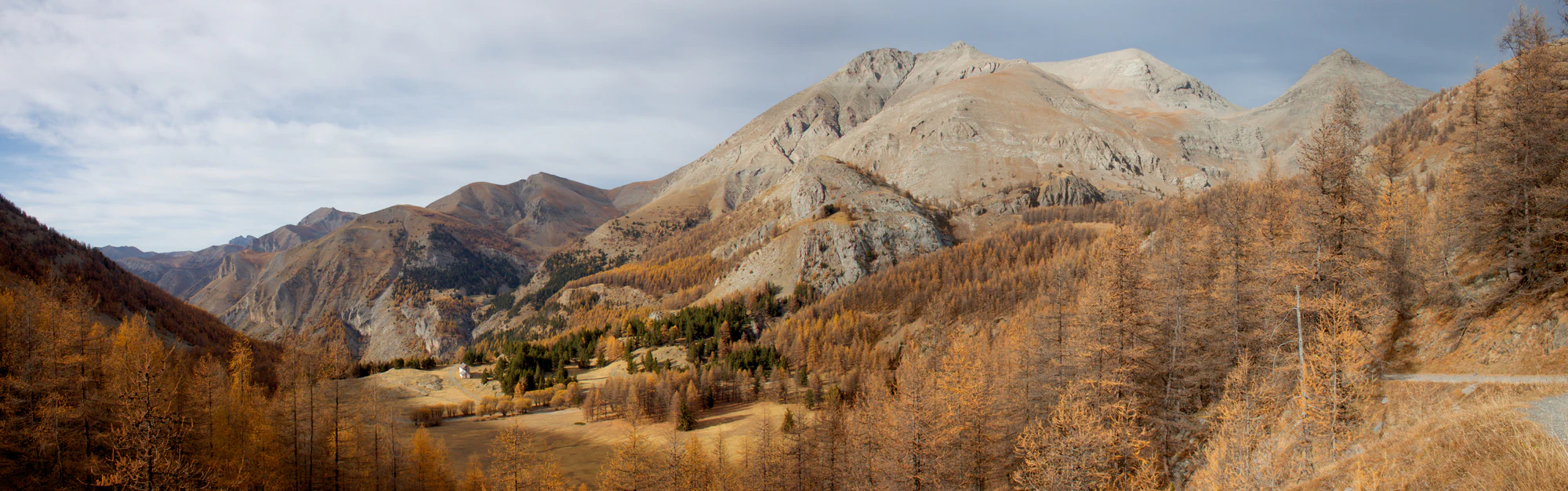
Golden-orange trees frame a grassy mountain basin beneath pale rocky ridges, with a narrow track at the right edge.

Autumn woodland and mountains near the Lac d’Allos trail, photographed by Toni Barros on 28 October 2017. This is the Haut-Verdon sector, a different valley from the Boréon walk; no lake is visible.

“Allos trail Panorama” — Toni Barros, CC BY 2.0. Source: https://www.flickr.com/photos/tonibarros/37994350686/. License: https://creativecommons.org/licenses/by/2.0/. Original photograph, unchanged. · Creative Commons

Walks and routes

Balade familiale vers la vacherie du Boréon

The published loop starts and finishes at the chalet d’accueil du Boréon: 5.8 km, 193 m of ascent and 195 m of descent, with a 3-hour walking time and a “very easy” official grade. It follows forest tracks towards the vacherie and returns through woodland. The description includes road crossings and about 100 m along the road. Use the linked official directions at each junction; this summary is not turn-by-turn navigation.

The joëlette recommendation concerns assisted travel. Track gradients, crossings and changing surfaces still matter. Do not interpret the grade as a guarantee for a standard wheelchair, pushchair or a child unused to mountain walking.


Balade familiale vers la vacherie du Boréon

A half-day built around the forest

Before leaving Saint-Martin-Vésubie, check the day’s forecast, access and return transport, and buy whatever food you need. At the Boréon, look at the signs and decide whether the whole group is comfortable with the published circuit. Spend the outward walk comparing the woodland, then take a proper food break without crowding working areas or water margins. Leave time for an unhurried return. Avoid adding a lake ascent simply because everyone feels energetic halfway through: the remaining descent and journey home still count.

Things to try

Make a two-tree sketchbook

Give each person one page for larch and one for spruce. Record the outline of the tree, how the needles are arranged and whether the cones hang down. A child can work with shapes and colours rather than names. Compare the pages later; the aim is to notice a difference carefully, not to finish a species checklist.

Read a working landscape

Around the vacherie, look from the public route at how woodland gives way to open ground. Keep access clear for the people working there and give livestock room. If produce is being sold, it can be a pleasant addition to the visit, but do not enter barns or assume animals are there for petting.

Keep the village option simple

If rain, thunderstorms, flood warnings or ice rule out the forest, postpone the hike. Use the tourist office when open to choose an available indoor visit or spend time in the village once conditions permit. Do not promise yourself a substitute exhibition at the former park house, and do not use the torrent as a bad-weather viewing attraction.

Wildlife and habitats

European larch · Larix decidua

Larch is a particularly satisfying tree to recognise here. Its needles grow in small tufts and turn yellow-orange before falling in autumn. A golden conifer is therefore not necessarily a dying tree. Compare its lighter canopy with the darker evergreen shapes nearby, and try drawing one twig without breaking it off. The park’s atlas records this species in Saint-Martin-Vésubie, and the official Boréon walk specifically includes larch woodland.

Norway spruce · Picea abies

Look for a conical outline and narrow cones hanging beneath the branches. Spruce cones can fall whole, unlike fir cones, which break apart on the tree. These are clues to examine from the track rather than reasons to pull a branch down. Spruce is documented on the Boréon route; the park’s atlas supplies the precise species identification and records it in the commune.

Chamois · Rupicapra rupicapra

Chamois belong to the wild Mercantour fauna, using rocky slopes, grassland and sometimes forest. Look with binoculars from an existing stopping place, and accept that a forest family walk may produce no sighting. In cold weather, avoiding disturbance matters particularly because animals must conserve energy. The horns are short and hooked, rather than the long sweeping horns associated with an adult male ibex.

Alpine marmot · Marmota marmota

Marmots are a wider-park discovery, most closely associated with open mountain grassland and sunny slopes, though they also use suitable clearings. A sharp alarm call may announce an animal you never see. Autumn brings hibernation, so the golden-tree season is not a promise of marmot encounters. Keep food to yourself and stay away from burrow entrances; do not turn a possible observation into a search through the habitat.

Stories and discoveries

The same park, a different valley

The panorama below was taken near the Lac d’Allos trail, in the Haut-Verdon sector, in October 2017. It shows the broader Mercantour landscape rather than the Boréon itinerary. Allos needs separate access planning; neither the visible track nor the autumn colour is evidence of conditions for your trip.

Restoration does not freeze a mountain in place

Storm Alex struck in October 2020, and Aline brought further damage in 2023. The park announced completion of its storm-damaged core-route restoration programme in October 2026. That is a major rebuilding milestone, but bridges, slopes and paths still need route-by-route checks after fresh weather. The current warning list remains the practical reference.

When to visit

Spring and early summer

Let local snow conditions decide how far into the mountains you go. The valley may feel warm while shaded ground remains icy, and meltwater changes crossings. Start with current advice for the forest circuit; save high passes for a separately prepared trip.

Summer

Start with time in hand, carry layers as well as sun protection, and watch the forecast for afternoon storms. Forest shade can make walking pleasant, but it does not remove the need to abandon an outing when conditions deteriorate. Confirm seasonal services rather than planning lunch around an assumed opening.

Autumn and winter

Autumn can bring the larches’ colour and much colder conditions within the same week. Allow for shorter daylight and early snow. In winter, use current local winter-activity advice and suitable professional support where needed; this summer walking description is not a snowshoe route. Wildlife also needs more space when food and energy are limited.

Getting there and practical advice

Where to ask in Saint-Martin-Vésubie

Use the tourist office at 5 avenue Kellerman, 06450 Saint-Martin-Vésubie for local orientation. Its published schedule for 1 October 2026–31 May 2027 is Monday–Saturday, 09:00–12:30 and 13:30–17:00, closed Sundays and public holidays. Check for exceptional closures before making a special journey. The summer timetable is different.

Do not rely on the old park-house address

For park-specific advice in Saint-Martin-Vésubie, ask the tourist office where the park is currently receiving visitors. Confirm the public address and hours before going. Do not plan a stop using old Vésubia Mountain Park listings or a reopening date described only as a plan.

Food, water and comfort stops

Sort out toilets and water before setting off and ask at the chalet about facilities available that day. Do not rely on a tap, toilet or shop being open farther along the walk. The route’s seasonal dairy stop is optional, so carry enough for the whole outing and take all picnic waste back with you.

Driving to the chosen start

From Nice, the park’s access guidance sends Vésubie visitors via the M6202 and M2565. Continue from Saint-Martin-Vésubie towards Le Boréon and the chalet d’accueil; use the designated parking for the published walk. Check road restrictions separately from trail conditions. A restored bridge or an old estimated driving time cannot tell you whether temporary works, weather or traffic will affect your journey.

Public transport is seasonal beyond the village

Check the current Lignes d’Azur journey planner for Saint-Martin-Vésubie, then verify the separate last leg to the Boréon. The published 2026 summer Boréon shuttle ran between 4 July and 20 September, on Fridays and weekends in July–August and weekends in September. That service has finished for an October visit. Do not arrive expecting an all-year shuttle, and arrange your return before you start walking. Future seasons require a new timetable check.

Plan assisted access as a whole day

Ask about the route surface, the road crossings, available equipment, suitable helpers, accessible parking and toilets together. A joëlette needs an organised team; a chair alone does not solve the outing. The park’s Aventure Mercantour pour Tous programme has run adapted excursions, but a past event is not a standing bookable service. Request a current, individually suitable option in advance.

Know which protection zone you are in

Green hexagons mark the national-park core. Its specific rules differ from those of the surrounding aire d’adhésion, where ordinary national and local law still applies. Within the core, do not bring a pet dog, light a fire, fly a recreational drone, disturb animals or leave litter. Picking is generally prohibited, with limited regulated exceptions for specified plants; this visit is for looking, not gathering. Check current rules for any different activity.

A practical go-or-no-go check

Take walking shoes, warm and waterproof clothing, water, food and an offline route reference. Tell someone where you are going. Fresh damage, rising water, ice, poor visibility or a tired child are good reasons to turn around. Phone reception is uneven; 112 is the emergency number, but a phone is not a guarantee that you can summon help from every point.

Read the exact Boréon alert

The 1 October 2026 park bulletin says the Boréon GR52/GTM has reopened via the vacherie des Erps, markers 377–378–379. It separately flags an unbridged ford on the Cavalet path and a closure at Tavels. These are distinct itineraries. Do not use the GR reopening to approve an improvised variation on your forest circuit.

Sources and useful links

Wildlife you might spot

4

Each card links to a full Explore page with photos, traits, and fun facts.

Snap map for this place

Start with the big picture, then zoom in to explore individual wildlife observations around this place.

Loading map…

Good to know before you go

Bring a picnic and drinking water before leaving the village; a working dairy is not a guaranteed café stop.

Download the official route sheet. Several forest-track junctions make a remembered sketch an inadequate substitute.

Keep children close at road crossings and away from torrent edges.

Choose the outing for the youngest or least confident walker, including the return journey.

Take photographs of plants and cones in place; leave collecting and tasting out of the activity.

Use binoculars for any wildlife you encounter. A useful view never requires making an animal move.

Frequently asked questions

It is an easier mountain outing, but it still means nearly six kilometres and uphill walking. Plan a proper half-day. If that is too much for your group, ask locally for a currently suitable shorter option rather than assuming that a high-lake route will be easy.
Plan them as separate visits. They belong to the same national park, but neither is an extension of this forest circuit. The Merveilles rock-engraving area also has additional protection rules.
Alpha is a separate managed wildlife attraction at the Boréon. Passing its access area does not include a visit. If you want to add it, check its own opening arrangements, admission and accessibility beforehand; captive animal viewing is different from watching wild animals in the national park.
Pet dogs are prohibited in the national-park core even on a lead or carried. Assistance dogs are among the specified exceptions. For any proposed outing outside the core, confirm the exact boundary and local rules first; a village or car-park name does not tell you where the legal boundary lies.
Turn back while the return is still straightforward. Do not move from a cancelled high walk into the forest during a thunderstorm warning: trees do not make an outdoor route a storm shelter. Keep a village-based alternative available.

Recent snaps at this place

Recent snaps will appear here as new observations are added.

View all ›

Take the discovery with you

Exploring Mercantour National Park?

Identify the wildlife you spot, learn as you go, and keep a collection of the adventure.

  1. 1Spot it
  2. 2Snap it
  3. 3Keep the discovery










