Snappit logo
Snappit
Get App
Generic illustration, not a photograph of this venueIllustration
ParkÎle-de-France, FR

Fontainebleau Forest Massif

Fontainebleau is a forest of contrasting ground: loose sand, hard sandstone shelves known as platières, rocky slopes and patches of limestone.

About

Fontainebleau is a forest of contrasting ground: loose sand, hard sandstone shelves known as platières, rocky slopes and patches of limestone. Those changes help explain why the canopy and plants beneath it can look so different within one outing. The boulder piles are part of that landscape, formed as sandstone shelves broke down above eroding sand. You can appreciate the shapes from a path without turning the visit into a climbing session.

Arbor&Sens gives a first visit a clear centre. This former arboretum has an enclosed tree collection and interpretation designed around the senses. Treat it as a place to compare trees and discover what wood is used for, rather than trying to collect every famous viewpoint in a morning. It is one small visitor site within the much larger Fontainebleau, Trois-Pignons and Commanderie forest complex. Turn your visit into a safari! Use the Snappit app to scan and log wildlife sightings here.

The forest was once a royal hunting landscape, but its modern identity also owes much to artists and walkers. In the nineteenth century, painters associated with Barbizon pressed for the trees and landscapes they painted to be spared from logging. The artistic reserves established in 1861 became part of the story behind later biological reserves. Claude-François Denecourt also made the forest more approachable through his blue-marked walking paths, a tradition continued by Charles Colinet. Those markings are a historical wayfinding system, not a promise that every path is easy or currently open.

What to do here

Choose the short sensory section at Arbor&Sens. Read or explore the interpretation at your own pace, compare the trees around each stop and leave time simply to listen. If you want sandstone scrambling or a longer blue-marked walk, plan that as a separate outing with its own route and current access check.

Seasonal info

Summer heat and fire restrictions can change a visit at short notice. In autumn and winter, allow for shorter days, slippery ground and hunting. The July 2026 fire has left continuing closures, so the season alone never establishes whether a particular path is available.

Accessibility

Arbor&Sens is specifically designed to assist blind and partially sighted visitors, with a guide rope, tactile interpretation and Braille. That is a route-specific provision. It does not make the surrounding rocky forest universally accessible, and present surface conditions and mobility requirements still need checking.

Don't miss

1

A 1.5 km sensory section shown on the official Arbor&Sens plan

2

Trees explored through texture, sound and their everyday uses

3

Sand, sandstone and woodland forming a distinctive lowland landscape

4

A forest whose artistic history helped shape early nature protection

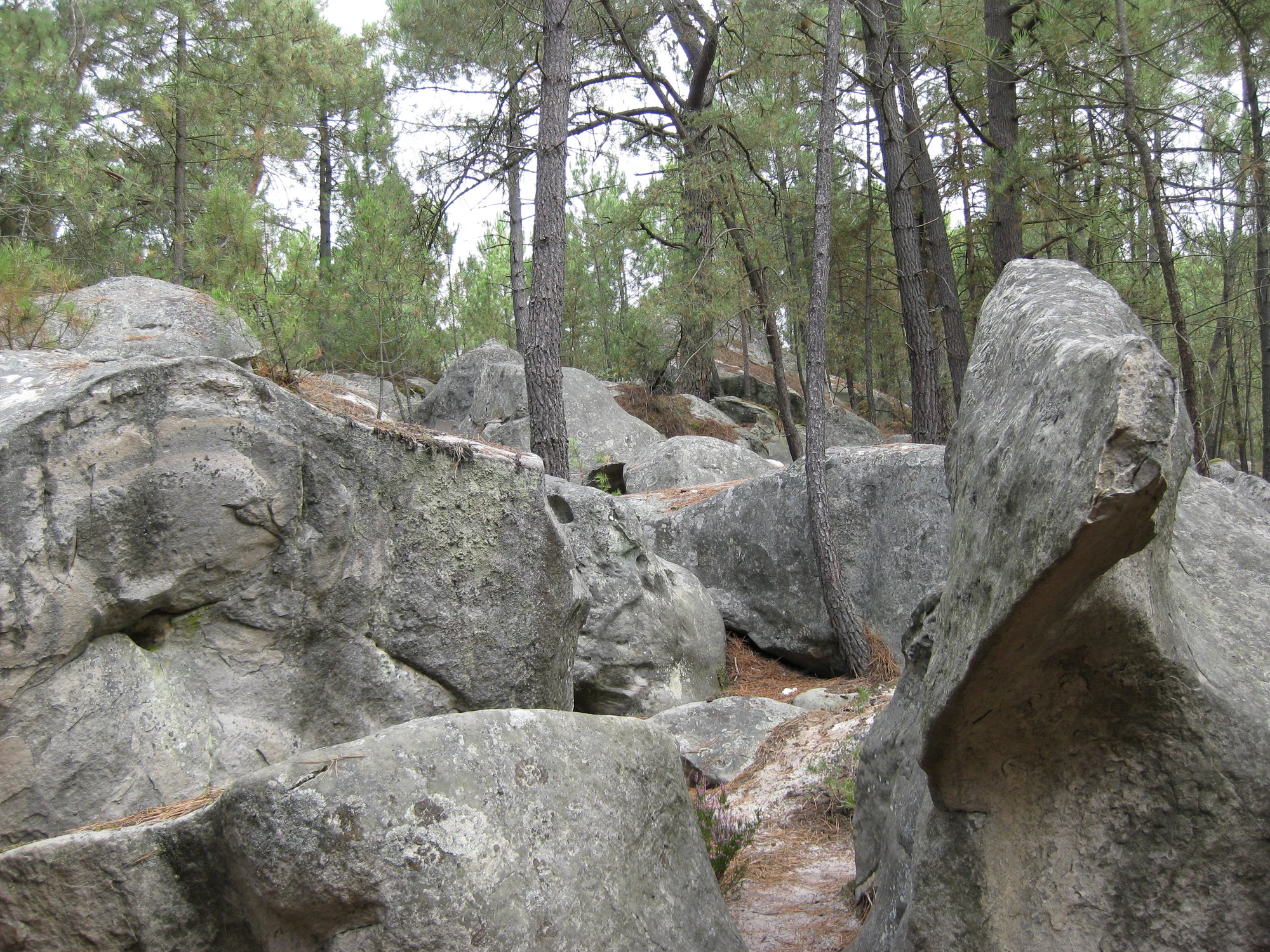
Large, textured grey sandstone boulders among green pine trees, with sandy ground between the rocks.

Sandstone boulders among the trees of Trois-Pignons at Noisy-sur-École, photographed on 31 August 2012. This view of the wider massif predates the July 2026 fires. It is not Arbor&Sens and does not show current forest conditions or establish which routes are open.

“Chaos de Grès, Forêt des Trois Pignons” — Lionel DUCHOISELLE, CC BY-SA 3.0. Source: https://www.geodiversite.net/media1727. License: https://creativecommons.org/licenses/by-sa/3.0/. Original photograph unchanged. · Creative Commons 1 · Creative Commons 2

Walks and routes

Arbor&Sens: the short sensory section

Start from the Arboretum de Franchard car park beside the D301, also called the Route Ronde, at the Long Boyau side of the site. Use the entrance plan to select the sensory section with its guide rope and tactile cues. The official plan distinguishes this 1.5 km section from the wider 2.5 km discovery network; they are different extents of the same site. Follow the on-site guidance rather than adding whichever woodland path looks inviting. Allow 1–1½ hours, with pauses at the interpretation stops. The aim is a complete, comfortable small outing, not a hurried circuit plus an unplanned rocky extension.

The guide rope, sandstone ground cues, raised interpretation and Braille are intended especially for blind and partially sighted visitors. If you need step-free access or use a wheelchair, ask about the current gate, surface, slopes and turning space before travelling. The sensory designation alone does not settle those questions.


Arbor&Sens: the short sensory section

A manageable half-day

Make travel and Arbor&Sens your two main parts. At the trailhead, read the plan together and agree how much walking suits everyone. Spend the first part on tree interpretation, then allow an unhurried return and snack break. If energy is low or the ground uncomfortable, shorten the visit. Save the rocky walks for another day.

Things to try

A tree detective walk

Choose a tree beside an interpretation stop. Notice its trunk pattern and crown before reading the panel, then compare it with a neighbour. Which features would help a child recognise it again in winter? Remember that this is a former arboretum: a label identifies a collection specimen, not necessarily a species growing wild throughout Fontainebleau.

Sketch the forest’s shapes

Frame a trunk, branching pattern or contrast between light and shade in a sketchbook or photograph. The artistic history gives this simple exercise a local connection. You do not need a dramatic viewpoint or an exact painter’s location to notice what makes a tree an interesting subject.

Keep climbing as a separate plan

Fontainebleau’s sandstone is famous for bouldering, but the sensory trail is not a climbing circuit. If climbing is the main aim, select an officially permitted sector, check its post-fire status and arrange suitable instruction for beginners. Wet conditions can harm the rock as well as worsen footing. Looking at a boulder from an open path is a good family activity in itself; there is no need to scramble onto it to appreciate its form.

Change the day’s emphasis

In light rain without wind or closure warnings, a short section may be enough for a well-equipped group. For sustained rain or strong wind, switch to an indoor visit in Fontainebleau and check its opening and tickets. Do not substitute a wet rocky circuit just to keep a forest day on the calendar.

Wildlife and habitats

Scots pine

Scots pine helps give many Fontainebleau scenes their character. ONF documents it across the massif and explains its historical introduction at Béorlots. Think of it as part of a managed forest with a long history. Compare evergreen crowns with nearby broadleaved trees from an open path; do not assume every conifer in the arboretum is this species.

European beech

Beech is among the established trees that ONF identifies in the massif. It also appears in the forest’s drought story: shallow, sandy soils do not store water well, and some trees struggle during repeated dry summers. A canopy with gaps is a prompt to look and ask questions, not to diagnose a tree from one visit.

Common heather

Common heather is documented in the massif’s heathland, including Béorlots. Its presence helps explain why open ground is an ecological feature worth preserving rather than an empty place awaiting trees. Enjoy heath from authorized paths elsewhere in the massif; this is not a reason to enter a reserve or expect a flower display at Arbor&Sens.

Black woodpecker

The black woodpecker is documented in ONF’s account of Béorlots, where its excavated cavities can later benefit other species. This belongs to the wider forest story, not a promised sensory-trail sighting. Listen without playback, and leave any cavity tree undisturbed. The reserve records do not establish today’s bird numbers after the fire.

Eurasian nightjar

The Eurasian nightjar is one of the birds ONF associates with the massif’s heathlands. Its ground-nesting habits make undisturbed open habitat particularly important. This is background for understanding the forest, rather than a suggestion to seek birds after dark or wander off-path. The short Arbor&Sens visit works best as a daylight outing.

Stories and discoveries

A pine forest with a human history

Scots pine is a familiar part of the massif, but its presence also reflects forestry choices. ONF’s history of the Béorlots reserve records nineteenth-century introductions. The scene is therefore a mixture of geology, natural growth and past management, rather than an untouched woodland that has always looked the same.

Open ground can be valuable habitat

More trees are not always the right outcome for every patch of land. At Haute-Borne, ONF has removed young pines to retain heathland and the wildlife that depends on it. This is one reason managed biological reserves can require active work, while integral reserves allow ecological processes to proceed with very limited intervention. Never enter a prohibited biological reserve. Where a marked public path is specifically authorized, stay on it and obey local restrictions; an old trail line does not override a closure.

Recovery takes more than reopening a path

After the July 2026 fire, ONF’s work includes making routes safe and watching how the forest regenerates. Seeds, surviving roots and shoots can contribute to recovery. A reopened visitor route does not mean the surrounding ecosystem has recovered, and a closed parcel is not an invitation to help by planting or clearing it yourself.

When to visit

Spring: make room for young wildlife

Fresh growth makes the tree collection rewarding, while breeding birds need quiet. Keep to the path, keep dogs close and do not use recorded calls to draw birds out. A bird heard from the trail is an encounter in its own right; there is no need to find its nest.

Summer: a morning-sized outing

Take enough water and make the visit shorter during hot weather. Shade does not remove fire danger. Check restrictions before travelling and postpone if the authorities close the sector. The dry, sandy soils also help explain why the massif can be sensitive to repeated drought.

Autumn: check the day, not just the season

Leaf colour and fungi can be absorbing, but shorter daylight and hunting require planning. The ONF’s 2026–2027 Fontainebleau calendar warns that information is still partial. Consult it again close to the visit; a blank date is not a safety guarantee. Follow posted hunting and forestry-work exclusions.

Winter: choose settled weather

Bare branches make tree shapes easier to compare. Choose a calm spell, dress for standing still at interpretation stops and keep the outing within daylight. In strong wind, postpone the woodland visit. Rain, leaf litter and frost can change the practicality of a route that felt straightforward in summer.

Getting there and practical advice

Be self-sufficient

The official tourism listing identifies free parking and a botanical trail. Bring your own water and plan toilet stops before entering the forest. If you need accessible toilets, refreshments or assistance on arrival, confirm arrangements with Fontainebleau Tourisme before leaving rather than relying on services at this woodland site.

By car: choose the exact car park

Look for Arboretum de Franchard on the ONF access map. The D301 approach lies between the Touring Club and Croix de Souvray junctions. Do not park at a closed neighbouring entrance or on a road verge because a familiar name appears on an older guide.

By train: plan the last stretch first

Transilien line R links Paris Gare de Lyon with Fontainebleau-Avon and other forest gateways. Arbor&Sens is an interior-forest destination: arrange the onward transfer before committing to this short-walk plan. Check live train information and the return journey. If the last stretch does not work for your group, choose an official station-based forest walk instead of assuming this trail starts near the platform.

Ask about the whole journey

For a visitor with access needs, include the car park or drop-off in your planning. Ask about surface damage, seating and toilet provision as well as the trail itself. Audio interpretation has been advertised in French and English, but app names differ between older official pages. Test downloads beforehand and keep another means of orientation.

Visitor information

Plan around the closures

Access checked on 18 October 2026: the ONF-linked live map lists the Arboretum de Franchard car park as accessible. The Arbor&Sens site plan places the trail west of the D301, outside the hatched Faisanderie closure on the ONF sector map dated 1 September. This is a workable starting choice, subject to any newer notice at the entrance. The same map still marks extensive Trois-Pignons closures; Vallée Chaude is not included in this visit. Do not cross barriers or step into a burned parcel that appears undamaged: weakened roots can leave standing trees unstable.

Sources and useful links

Wildlife you might spot

5

Each card links to a full Explore page with photos, traits, and fun facts.

Snap map for this place

Start with the big picture, then zoom in to explore individual wildlife observations around this place.

Loading map…

Good to know before you go

Use the ONF map before leaving and check the signs at your chosen entrance. A saved walking route cannot override a closure.

Bring drinking water, a snack and footwear with grip. Do not rely on a water point, café or toilet at Arbor&Sens.

Save the official site plan before travelling and keep your phone charged. Physical interpretation is useful even without a working audio app.

Keep the guide rope and tactile stops clear for visitors who rely on them. Step aside considerately when stopping to talk or take a photograph.

Carry rubbish home. Keep your picnic cold and flame-free; do not bring a barbecue into the forest.

Leave plants, fungi, dead wood and rocks where they are. Photograph interesting details without disturbing the ground around them.

Frequently asked questions

No. The ONF’s latest access material checked on 18 October 2026 still shows closed sectors following the July fire. Do not use a general reopening announcement to plan a trip into Trois-Pignons or Vallée Chaude.
Fontainebleau Tourisme lists the self-guided trail as free, with free parking. That does not establish access during an emergency closure. Paid guiding or other independently booked activities are separate.
Only after choosing a currently authorized sector and planning the activity properly. Walking among rocks, scrambling and climbing are different commitments. For a first climbing session, use a professional instructor and appropriate equipment rather than improvising on the way back.
For this sensory walk, keeping your dog on a lead is the considerate choice. Follow any stricter local signs. National forest rules also require leads away from forest paths from 15 April to 30 June, when young wildlife is particularly vulnerable.
They illustrate the wider massif’s documented wildlife, not a sighting list for the arboretum. Some evidence comes from protected reserves and surveys before the 2026 fire. A successful visit can be about trees and landscape without seeing a rare animal.

Recent snaps at this place

Recent snaps will appear here as new observations are added.

View all ›

Take the discovery with you

Exploring Fontainebleau Forest Massif?

Identify the wildlife you spot, learn as you go, and keep a collection of the adventure.

  1. 1Spot it
  2. 2Snap it
  3. 3Keep the discovery