Snappit logo
Snappit
Get App
Generic illustration, not a photograph of this venueIllustration
ParkKanto, Japan

Shinjuku Gyoen National Garden

Shinjuku Gyoen is a good place to give Tokyo a slower afternoon.

About

Shinjuku Gyoen is a good place to give Tokyo a slower afternoon. Its 58.3 hectares spread across Shinjuku and Shibuya, with enough room to move from a broad lawn to a pond-side garden and then into trees. This is a carefully managed national garden with an admission gate and closing time. For a first visit, choose a few contrasting areas rather than trying to tick off every corner.

The change in design is part of the pleasure. In the Formal Garden, London-plane avenues frame symmetrical rose beds; in the Landscape Garden, open grass lets individual trees dominate the view. The Japanese Traditional Garden draws you around the Upper Pond, where the scene changes as you walk. Pause at the edge of the Formal Garden and look back across the lawn: the long view, known as the Main Vista, was deliberately built into the garden design. It is worth noticing even when nothing dramatic is in flower.

Trees make this a rewarding visit outside blossom season. Tulip trees planted here in the late nineteenth century produce yellow-green, tulip-shaped flowers, usually from late April into mid-May. Near the Mother and Child Woods, bald cypresses have woody root projections rising above the ground. The planes, tulip trees and cypresses reflect generations of garden planting. A useful small challenge is to compare three things without picking anything: the outline of a leaf, the texture of a trunk and the shape of a whole tree.

For children, the Mother and Child Woods give the day a different focus. Start with the nature displays in the West Rest House, also called Mori-no-Ie, then make a short observation walk rather than a race to another landmark. Ask everyone to find movement at three levels: on the ground, in the shrubs and overhead. The garden documents wild birds including long-tailed tits, Eurasian tree sparrows and grey herons. Wildlife sightings are never guaranteed, so enjoy the listening and looking too. Keep to open paths, leave nests alone and let birds keep their distance.

The greenhouse adds another kind of plant discovery. Its displays move through environments including tropical lowlands, mountain habitats, Okinawan flora and dry regions. These are cultivated collections, with conservation work behind the scenes. Compare the display labels and leaf forms rather than trying to identify everything from appearance. Allow time to reach the building before its own last-entry time, which is earlier than the garden's.

Cherry blossom and chrysanthemum season reward slightly different plans. The garden's many cherry varieties flower in succession, so missing the main Somei Yoshino peak does not necessarily mean missing all blossom. November's chrysanthemum exhibition is more about skilled cultivation: displays sit beneath temporary wooden shelters along the Japanese Garden's paths. Look for the Ozukuri display, in which hundreds of blooms form a dome grown from a single root without grafting. At either busy season, a few unhurried stops will be more enjoyable than forcing a full circuit. On an ordinary day, keep space for a bench, a sketch or a quiet look across the water. Wondering what that bird or insect is? Find out on your visit using the Snappit nature app.

The grounds began as part of the Naito family estate. A government agricultural experimental station opened here in 1872, followed by an imperial botanical garden. Hayato Fukuba commissioned the French designer Henri Martinet, and the major redesign completed in 1906 underlies much of today’s layout. Wartime air raids devastated the site in 1945; after reconstruction it opened to the public as a national garden on May 21, 1949. Its history helps explain why Japanese garden traditions, Western landscape design and horticultural research share one place.


What to do here

For a balanced first visit, combine the Japanese Traditional Garden with the Landscape Garden and the plane avenues of the Formal Garden. Add either the Mother and Child Woods for a nature-focused family outing or the greenhouse for cultivated plant collections. With less time, pick two areas and linger. Use the suggested walks below as flexible ideas for your day.

Seasonal info

Early Kanzakura may flower in February to early March, Somei Yoshino usually follows in late March, and many double-flowered cherries peak around mid-April. Rose displays generally suit late April–late May and late October–late November. The 2026 Chrysanthemum Exhibition is scheduled for November 1–15. Flowering and leaf colour vary with conditions. Summer calls for water, shade and shorter outdoor sections; do not plan the greenhouse as a cooling refuge. In winter, the garden closes substantially earlier.

Accessibility

Plan with the official Universal Design Map rather than assuming every garden path is step-free. The Japanese Traditional Garden and Formal Garden include gravel, and the map marks rough surfaces, slopes and steps. Wheelchair-accessible toilets and diaper-changing facilities are provided. The greenhouse map warns that wheelchair users require assistance. Ask staff to suggest a suitable route and check current diversions; the ordinary nearest-station exit is not always the step-free exit.

Don't miss

1

See the garden change style

Compare the pond-side Japanese Garden, the open Landscape Garden and the precise lines of the Formal Garden. Looking for curves, symmetry and long views gives even a short visit a clear focus.

2

Meet the planted giants

Look for tulip trees, the Formal Garden’s London planes and bald cypresses near the Mother and Child Woods. Follow labels and compare shapes from the paths; no climbing or collecting is needed.

3

Make a small wildlife walk

Use the Mother and Child Woods and West Rest House for an observation-led outing. Watch the branches for long-tailed tits and tree sparrows, and scan pond edges for grey herons.

4

Choose a seasonal collection

Spring brings a sequence of cherry varieties, autumn adds carefully trained chrysanthemums, and the greenhouse offers cultivated plants across the year. Check current displays before choosing your priority.

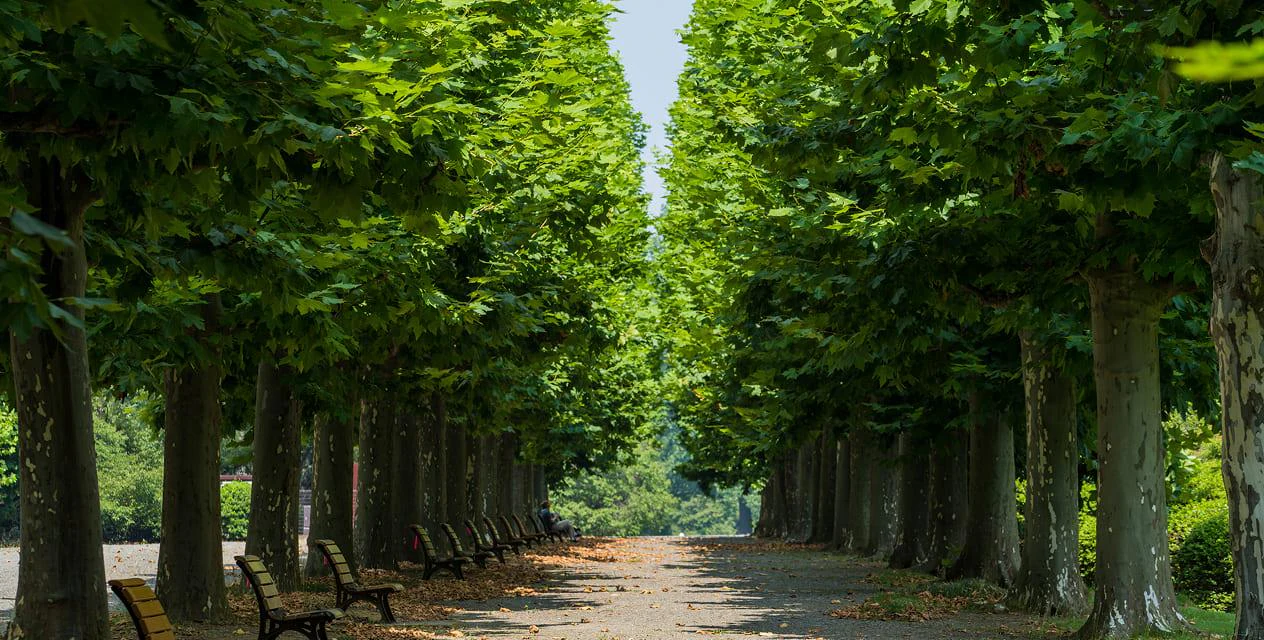
Two orderly rows of leafy plane trees frame a straight garden path, with mottled trunks and benches beneath the canopy.

London planes line the Formal Garden in regular rows, creating a shaded avenue with benches. Photograph supplied by Shinjuku Gyoen National Garden Office; capture date not stated.

©Shinjuku Gyoen National Garden Office. Source: Ministry of the Environment, Giant Trees / London Planes (https://policies.env.go.jp/national-garden/shinjukugyoen/english/highlights/tree/). PDL 1.0 and Shinjuku Gyoen website-photo conditions. Unaltered. · www.env.go.jp

Walks and routes

Pond, lawn and plane avenues

Enter at the gate that best fits your journey, then combine the Japanese Traditional Garden, Landscape Garden and Formal Garden using the official visitor map. At the pond, spend a few minutes watching before moving on; on the lawn, look at the silhouette of a large tree; at the Formal Garden, compare the rose-bed symmetry with the less regimented landscape you have just crossed. Finish at a convenient gate rather than adding distance merely to make a loop.

Gravel affects the Japanese and Formal Gardens. Use the Universal Design Map and ask staff for suitable paths between areas.

A slower woods-and-trees family visit

Use Shinjuku Gate as a practical starting point and focus on the Mother and Child Woods, the bald-cypress area and the West Rest House. Look at the cypress root projections from the path, use the indoor nature exhibits, and try a short listening stop. Turn back whenever attention or energy fades; adding a whole-garden circuit is optional.

Woodland path surfaces vary. Ask staff to suggest paths that suit your group’s mobility needs.

A selective half-day

Budget 3–4 hours if you want a relaxed garden walk, a break and one indoor stop. Choose the woods or greenhouse as the additional focus, then use the remaining time for two contrasting garden areas. Keep a margin before last entry at indoor facilities and before the grounds close.

Things to try

Three garden-design clues

Choose one curve beside the pond, one repeated shape in the Formal Garden and one long view across the Landscape Garden. Sketch the three clues, then decide which space makes you want to sit down. Try this as a simple self-guided observation game.

Watch without collecting

Give everyone a few quiet minutes to notice one sound, one movement and one plant shape. Compare what you found at the West Rest House displays. Leave animals, fallen material and growing plants in place; the supervised programme’s rules do not give ordinary visitors permission to collect.

Greenhouse habitat comparison

Choose two labelled greenhouse sections, such as tropical lowlands and dry regions. Compare leaf sizes and forms, and read how each plant is displayed. The cultivated collections bring together plants from different native environments.

Join a family nature programme

The garden offers organized nature observation and a bird nest-box programme for children with guardians. Check the current dates, age range, application window and language arrangements well in advance. The published nature-class system uses advance applications and lotteries; a normal entry ticket does not reserve a place.

A shorter visit with indoor stops

If conditions are suitable for travel, the greenhouse, Shinjuku Gyoen Museum and Information Center can give a damp-day visit a purpose. Outdoor walking is still required, and opening hours differ. In severe weather, check official notices before leaving rather than treating indoor facilities as guaranteed shelter.

Wildlife and habitats

Look for a tulip tree’s broad crown and distinctive leaf outline; compare the leaf with a plane leaf using labels. Yellow-green flowers are usually a late-April to mid-May possibility, not a year-round feature.

Cultivated tulip trees.

Along the Formal Garden avenues, compare repeated tree shapes, hand-like leaves and patchy bark. In season, round seed clusters may help you recognize the group.

Cultivated London planes in the Formal Garden avenues.

Look from the path at the bald cypresses’ woody projections above the soil. Treat the roots as living tree structures, not stepping stones.

Cultivated bald cypresses near the Mother and Child Woods.

Use a tree label to find a ginkgo, then compare its outline and autumn colour with nearby trees. Make a sketch or photograph instead of collecting a leaf.

Cultivated ginkgos contribute autumn colour to the Landscape Garden.

At the November exhibition, compare the way whole chrysanthemum plants have been trained, as well as flower colour and petal shape. These are horticultural displays that take planning and care.

Cultivated chrysanthemums displayed seasonally in the Japanese Garden.

Pause beside an open path and scan the branches for small birds with very long tails. Use binoculars if you have them, and let moving birds lead your eyes rather than following them off the path.

Wild resident bird.

Notice how a tree sparrow moves and feeds, then compare it with the operator’s bird sheet. A familiar-looking bird is still worth a careful identification.

Scan the pond margins from a public path for a large, long-legged grey heron. If one is present, watch its stillness before trying for a photograph; give it room and never bait it.

Wild waterbird.

Stories and discoveries

The Main Vista is a designed view across the Landscape Garden from the Formal Garden, rather than an accidental gap between trees.

The greenhouse’s first predecessor opened in 1875; the present greenhouse was comprehensively rebuilt in 2012.

The Mother and Child Woods was established in 1985 for nature education.

Yaezakura means double-flowered cherries; it does not identify a single cherry variety.

When to visit

spring

Use the current blossom report to choose between early cherries, Somei Yoshino and later double-flowered varieties. Check year-specific reservation requirements before travelling.

summer

Shorten the outdoor plan in heat, drink regularly and use shaded or indoor rest stops. Stay out of shrubs, keep drinks attended and avoid swatting at wasps or hornets.

autumn

Choose the November chrysanthemum exhibition or late-autumn trees and roses as the main focus. Shelter construction and removal may temporarily interrupt Japanese Garden paths around the exhibition.

winter

A shorter day can still suit tree outlines, birdwatching and a greenhouse stop. Work backward from the 16:30 garden closing time and the greenhouse’s earlier last entry.

Getting there and practical advice

Information Center and National Parks Discovery Center

Outside Shinjuku Gate, with garden information, exhibits and information about national parks across Japan. Useful before choosing your route.

West Rest House / Mori-no-Ie

Nature exhibits, picture books and interactive material support a visit to the Mother and Child Woods.

Toilets and changing facilities

Wheelchair-accessible public toilets and diaper-changing facilities are identified on the Universal Design Map. Use the map for locations and the exact equipment needed.

Wheelchair loans

The live admission guide lists free wheelchairs at all entrances and the Service Center, without reservations. Ask staff about availability on arrival.

Food and rest stops

Cafés and rest areas are spread around the garden. Check individual operating hours and ordering cutoffs; bringing a simple alcohol-free lunch lets you keep the day flexible.

Shinjuku Gate

Official walking estimates: 10 minutes from Shinjuku Station South Exit, or 5 minutes from Shinjuku-gyoemmae Station Exit 1. Use the separate barrier-free guide if you need lifts.

Okido Gate

The official access page gives a 5-minute walk from Shinjuku-gyoemmae Station Exit 2. This gate suits a greenhouse-first visit. The barrier-free approach guide uses different exits; do not assume Exit 2 is step-free.

Sendagaya Gate

Official estimates are 5 minutes on foot from JR Sendagaya Station or Kokuritsu-kyogijo Station Exit A5. Check station accessibility separately.

Grounds and station approaches

Consult the official Universal Design Map and linked station-specific access guides. Gravel in the Formal and Japanese Gardens, uneven paths, slopes and steps mean that one broad accessible/not-accessible label would be misleading.

Greenhouse

The Universal Design Map specifically says wheelchair users require assistance in the greenhouse. Ask staff about assistance needs and current conditions before committing to a greenhouse-first visit.

Disability concessions and assistance dogs

The admission page specifies free entry for holders of listed disability certificates issued in Japan plus one caregiver. Overseas documentation is not stated as qualifying. Recognized assistance dogs are permitted; ask the operator about your particular documentation.

Sources and useful links

Wildlife you might spot

8

Each card links to a full Explore page with photos, traits, and fun facts.

Snap map for this place

Start with the big picture, then zoom in to explore individual wildlife observations around this place.

Loading map…

Good to know before you go

Check the live admission page before leaving: the garden has seasonal hours, Monday/holiday closures and a New Year closure. Last entry is earlier than closing.

For blossom season, check the rules for your actual date. Timed advance booking has been required on selected busy days; a previous year’s calendar does not establish next year’s arrangements.

Choose your gate before setting out. Shinjuku Gate works with central Shinjuku; Okido Gate is useful for a greenhouse-first visit; Sendagaya Gate connects to stations on the south side.

Bring water and take breaks on hot days. Use the accessible-route information if you have a stroller or wheelchair, and leave extra time for gravel surfaces and diversions.

Keep the picnic simple and alcohol-free. Pets, bicycles and drones are prohibited; qualifying assistance dogs are permitted. Respect the separate limits on play equipment in the Kids Area.

Watch wildlife without feeding, catching or disturbing it, and leave plants intact. If a hornet approaches, avoid swatting or sudden movements; move away calmly when safe and alert staff to nests or concentrations.

Follow cones, ropes and temporary closures around trees and works. An October 15, 2026 notice warns that chrysanthemum-shelter installation and removal may close parts of Japanese Garden paths before and after the November 1–15 exhibition.

Leave the greenhouse enough time of its own: it starts later and closes earlier than the grounds. Check separate hours for cafés and indoor facilities rather than relying on the garden’s closing time.

Frequently asked questions

Checked October 16, 2026: adults pay ¥500; visitors aged 65 or over and students at high-school level or above pay ¥250; children at junior-high-school level or below enter free. The English admission page summarizes the student and child categories as ages 16+ and 15 or under. Check the official eligibility terms if the age and school-stage descriptions differ for your circumstances.
The current standard schedule is 09:00–18:00 from March 15 to September 30, except June 11–July 31 when it is 09:00–19:00; October 1–March 14 is 09:00–16:30. Last entry is 30 minutes before closing. Normally closed Mondays, or the next weekday after a Monday public holiday, and December 29–January 3. March 25–April 24 and November 1–15 are normally open daily. Check the dated calendar and special notices.
Yes, but choose paths carefully. Gravel, slopes and steps affect some areas; consult the Universal Design Map and station-specific barrier-free approach information. Free loan wheelchairs are listed at the entrances and Service Center, without reservations. The greenhouse requires assistance for wheelchair users. A loan wheelchair does not make every path accessible.
It works well for slow observation, tree comparisons and a relaxed lawn break. The Mother and Child Woods has nature-learning facilities. Organized family nature programmes require advance applications and may use lotteries; they are not drop-in activities, and language support should be checked. General visits still follow the no-collecting rules.
The main garden trees, flower displays and greenhouse collections are cultivated. Birds such as grey herons, Eurasian tree sparrows and long-tailed tits are wild residents or visitors.
No. Two to three hours is a useful starting budget for a selective visit. If you only have an hour, stay with one garden area rather than crossing the whole site. Allow additional time for entrance queues or assistance.

Recent snaps at this place

Recent snaps will appear here as new observations are added.

View all ›

Take the discovery with you

Exploring Shinjuku Gyoen National Garden?

Identify the wildlife you spot, learn as you go, and keep a collection of the adventure.

  1. 1Spot it
  2. 2Snap it
  3. 3Keep the discovery