Snappit logo
Snappit
Get App
Generic illustration, not a photograph of this venueIllustration
ParkIT

Montedimezzo State Nature Reserve

Montedimezzo rewards a woodland-paced visit.

About

Montedimezzo rewards a woodland-paced visit. Beech becomes more prominent higher on the north-facing slope of Monte di Mezzo, with Turkey oak lower down. Mature trees shelter forest birds, while the museum explains the long relationship between these uplands and people. The state reserve lies in Vastogirardi and is managed by the Reparto Carabinieri Biodiversità di Isernia.

Choose the Faione circuit for a fuller walk, or ask about the purpose-built Colle San Biagio interpretation loop for a shorter, supported experience. An official closure update remains online for the latter, so confirm access before planning around it. The museum is a useful lower-effort starting point. Take the ultimate field guide with you: use the Snappit app to identify birds, plants, and animals on your trip.

Montedimezzo’s history includes the Carthusian monks of Naples, Bourbon ownership and a royal hunting designation in 1825. State forestry management began in 1908; the nature reserve was established in 1971 and enlarged in 1972. It joined the UNESCO Man and the Biosphere programme with Collemeluccio in 1977. Carabinieri biodiversity management dates from 2017. The museum’s forestry tools bring this changing relationship with the forest down to a practical scale.

What to do here

Explore the museum, take an authorised woodland walk and look for forest birds. The Faione circuit connects the forest with the historic Celano–Foggia livestock route. The wildlife-care enclosures offer a separate, managed experience when their visitor areas are open.

Seasonal info

Bring a warm layer and suitable footwear. Mud, wet leaves, ice or snow can change a short path considerably; summer fire restrictions and autumn’s early closing times also affect the plan.

Accessibility

The museum is described as step-free, with accessible toilets. Colle San Biagio was designed for mobility and sensory access, but its current reopening, equipment and parking approach require direct confirmation. See the route warning before relying on it.

Don't miss

1

Beech, Turkey oak and hornbeam woodland on the slopes of Monte di Mezzo

2

The Faione circuit and the old Celano–Foggia livestock route

3

A museum connecting local rocks, wood, forest work and wildlife

4

An inclusive interpretation trail whose current availability needs advance confirmation

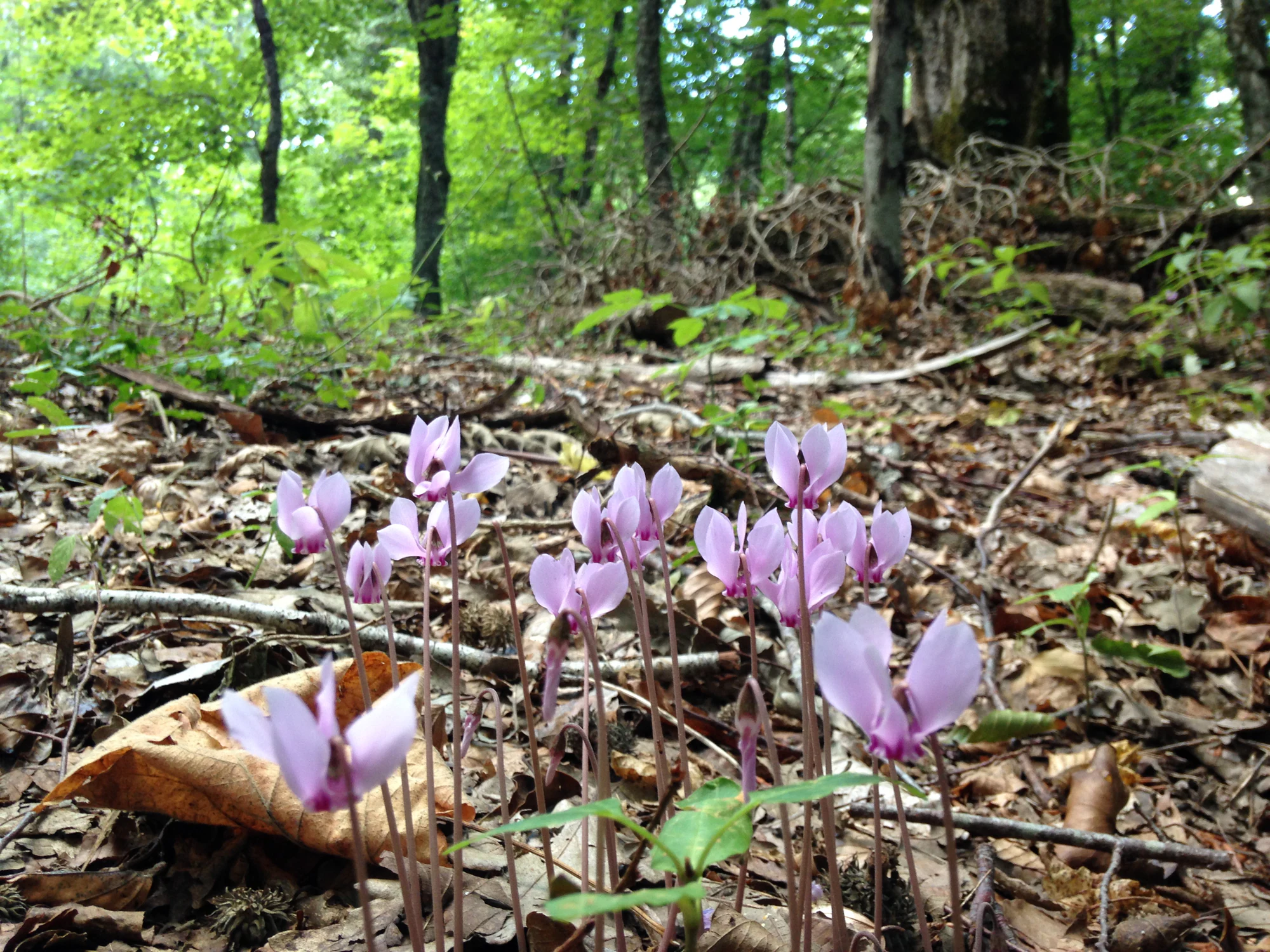
Pale pink flowers rise through dry leaves and fallen twigs beneath green woodland and tree trunks.

Flowers on the forest floor at Montedimezzo, photographed by Mario Rainaldi on 29 August 2015. This historical view illustrates a small-scale woodland detail, not current flowering or trail conditions.

Mario Rainaldi (Elbarto90cds). Preserve supplied statement: 29 Agosto 2015 - Autore Mario Rainaldi - citare l'autore per l'utilizzo. The file page additionally offers attribution-only reuse; this packet uses the explicit CC BY-SA 4.0 license. · Creative Commons

Walks and routes

Colle San Biagio · S1

The visitor-page table describes a 1.9 km pedestrian circuit with 70 m of cumulative uphill gain, graded turistica. Older Carabinieri material gives a 2.06 km version and a reduced 940 m loop: ask which alignment is available. This purpose-built interpretation walk explores the lower woodland.

Original facilities included a handrail, Braille interpretation and a surface usable by dedicated electric scooters. Confirm today’s usable distance, surface, gradients, equipment and parking-to-trail approach for your requirements.


Colle San Biagio · S1

Sentiero del Faione · woodland circuit

The 4.7 km loop starts by the visitor centre and uses S8, S9, S10 and S2, mostly on forest track with some narrower path. Published walking times differ: 1½ hours on the biosphere itinerary and three hours on the Carabinieri description. Allow the slower figure with stops, plus museum time.

This uneven woodland outing is not the designated accessible route. Confirm the signed circuit with staff; adding individual trail lengths does not establish a usable loop.

Sentiero del Faione · woodland circuit

Sentiero dei piccoli · S2

Ask about S2 for a shorter conventional walk. The table gives 1.1 km, 98 m of cumulative uphill gain and turistica difficulty. This is a trail section, not a guaranteed loop back to the car. Agree a return plan; the friendly name does not mean level ground.

Pedestrian-only, without wheelchair certification. It offers less distance than the full Faione circuit, subject to conditions.

Sentiero dei piccoli · S2

A gentle visit centred on the museum

Register, talk through access and explore the museum. Add only an outdoor area or short path staff confirm is suitable. Finish with your own lunch plan or the outside picnic area if its arrangements suit you. Allow about two to three hours overall.

A fuller forest half-day

Arrive early and check the Faione circuit and S8 work area. Walk the authorised loop with woodland stops, then visit the museum. Budget four to five hours including breaks; shorten the plan if necessary on a 15:00 closing day. This suggestion depends on confirmation that the circuit is usable.

Things to try

Start with registration and the current access plan

Checked on 19 October 2026, the calendar effective from 14 October gives the reserve and museum these hours: Monday 09:00–15:00; all other days, including Sundays and public holidays, 09:00–16:00. Recheck the dated calendar and news before travelling, then register on arrival. Reserve opening does not automatically reopen every trail.

Choose walking or a specifically permitted bike route

The route table distinguishes footpaths from cycle-permitted tracks: S1 and S2 are pedestrian; S8 and S10 allow walking and cycling; S9 is pedestrian-only. For a bike visit, ask for a complete permitted connection and a current map, and give walkers space.

Let the museum carry a wet-weather visit

If the approach is safe and the museum is open, its geology, woodland and wildlife displays can be the main event. Do not regard the forest canopy as shelter from a thunderstorm or strong wind. In hazardous weather, postponing is a better option than trying to fit in a short trail.

Wildlife and habitats

European beech

A defining tree of the upper woodland. Compare its presence with the oak-dominated lower forest from an authorised path.

European hornbeam

Part of the oak-and-hornbeam forest described by the operator. Notice the woodland mixture rather than seeking one labelled specimen.

Silver fir

A documented introduced forest component here. Do not confuse it with the native fir woodland of separate Collemeluccio.

Great spotted woodpecker

Recorded among woodland breeding birds. Listen from the path; never investigate cavities or play calls to attract birds.

Stock dove

Another recorded woodland breeder. A sighting is a possibility, not a scheduled stop.

European honey-buzzard

Included among woodland-breeding raptors. Protect quiet habitat rather than searching for a nest.

Roe deer

Recorded in the wild-fauna account. Keep any free-ranging sighting distinct from animals in enclosures or museum displays.

Wolf

Uses the forest within a wider home range. No close encounter is promised and no den locations are provided.

Stories and discoveries

A forest with several histories

Beech, Turkey oak and European hornbeam form much of the woodland character. Silver fir also occurs, but the operator describes its introduction beneath the existing canopy and conifer planting on former agricultural ground. The arboretum began in 1920 and includes non-native trees. That mixture makes the reserve a useful place to ask how conservation, experiments and older land use have shaped what you see.

The Faione name and the old grass road

The walking circuit approaches the Celano–Foggia tratturo, a historic livestock-movement corridor. It takes its name from Re Faione, also written Re Fajone, the great beech associated with this route. Older official descriptions still present a standing tree, but contemporary reporting and a later CAI account record its fall in November 2017. Visit for the woodland and the place’s history, without expecting the intact tree shown in old photographs.

When to visit

Leafy months

A spring or early-summer visit suits a slow look at fresh foliage and woodland life; summer is a useful time for shade, but it does not remove the need for water, weather checks or fire precautions. Follow the reserve’s current instructions rather than interpreting a picnic installation as permission to light a fire.

Colour, cold and shorter visits

Autumn can be rewarding for changing leaves. Allow extra care on wet leaf litter, and choose a shorter outing when the calendar gives an early closing time. Snow or ice can make an easy-rated route unsuitable. Check the regional weather bulletins and the reserve’s local advice, particularly after strong winds or heavy rain.

Getting there and practical advice

Inside the natural-history museum

Three themes shape the museum: rocks and minerals, woods and traditional forestry tools, and preserved local wildlife. The displays connect the trees outside with Alto Molise’s materials, work and animals. Buildings are described as barrier-free; ask about the entrance and facilities you need.

Wildlife under care

Aviaries and enclosures hold animals found in difficulty in the region and nearby areas. Animals and visitor access can change with care needs. Keep to the permitted areas and do not expect particular species or hands-on encounters. The approach also overlaps the S8 works notice.

Parking, toilets and lunch

The official Faione itinerary places parking near the kiosk on SP Carovillense, with a small paved approach to the visitor centre; the operator puts the centre about 300 m uphill from the entrance. Toilets, including accessible facilities, are listed at the visitor complex. The picnic area outside the reserve is privately managed. Bring water and a simple backup lunch rather than assuming the kiosk will be operating, and check any picnic charges or booking directly.

Arriving by road

Use the reserve entrance on Strada Provinciale Carovillense, not Vastogirardi’s town centre, as your destination. From Isernia, the operator directs drivers along SS650 towards Vasto, then via Pescolanciano on SP78 and Carovilli on SP86, continuing towards San Pietro Avellana on the Carovillense road. The entrance is roughly 4–4.5 km before San Pietro Avellana when approaching from Carovilli. Check local road and weather conditions before the final upland section.

Without a car

Plan the final transfer before buying a train or bus ticket. The municipality lists bus links involving Isernia and nearby towns, but that page does not establish a current stop at the reserve gate or a usable same-day return. Ask the office or a local transport provider to confirm both directions for your actual date. The nearby Sulmona–Isernia railway also hosts special heritage trains; a tourist departure is not a daily connection to Montedimezzo. A prearranged road transfer is the more predictable way to bridge the last leg if no suitable bus is confirmed.

Make the access plan before travelling

Ask separately about the museum entrance, accessible toilet, parking or drop-off, uphill approach and trail. The visitor page advertises a Braille guide, audio guide and two free electric scooters; confirm availability, suitability and assistance. If S1 remains unavailable, focus on the museum and outdoor spaces staff confirm you can safely use.

Sources and useful links

Wildlife you might spot

8

Each card links to a full Explore page with photos, traits, and fun facts.

Snap map for this place

Start with the big picture, then zoom in to explore individual wildlife observations around this place.

Loading map…

Good to know before you go

Call +39 0865 3935 before a visit that depends on a particular trail, accessible equipment or group arrangements.

Take drinking water. The official Faione itinerary advises against drinking from fountains and troughs along the walk.

Bring suitable footwear and follow the reserve’s own numbered signs; the Faione itinerary says its marking is not to CAI standard.

Keep to authorised paths and obey barriers and work-site signs, even where an old map shows a continuous route.

Check the current rules before bringing an animal: the visitor page prohibits pets inside the reserves. Arrange assistance-dog access directly if relevant.

Watch quietly and never feed animals, approach enclosures beyond the permitted visitor area or seek out nests.

The published network marks S5 (Sentiero delle creste 1) and S18 (Sentiero delle zeppe) as not passable. Choose a different authorised route.

Frequently asked questions

The current visitor page says access is free during published hours, after registration. Organised groups need advance authorisation; guided educational or natural-history visits are described for groups of at least 12, with at least 15 working days’ notice. Other official route pages retain different notice requirements, so agree your intended group visit or walk directly with the office.
Roe deer and wolves are recorded in the wild fauna, without any sighting guarantee. Animals in recovery enclosures are under human care, and museum specimens are preserved displays. Keep those three situations separate.
Its inclusive design does not establish current passability. Ask staff whether it has reopened, which section is usable and whether suitable equipment is available. The museum is the practical lower-effort starting point.
No. S9 is pedestrian-only, although other sections permit bicycles. Ask staff for a complete authorised cycling route.
The picnic area outside the reserve is separately managed; check its opening, charges and booking. Neither a picnic area nor an old camping label on a map grants permission to stay overnight in the reserve.

Recent snaps at this place

Recent snaps will appear here as new observations are added.

View all ›

Take the discovery with you

Exploring Montedimezzo State Nature Reserve?

Identify the wildlife you spot, learn as you go, and keep a collection of the adventure.

  1. 1Spot it
  2. 2Snap it
  3. 3Keep the discovery