Snappit logo
Snappit
Get App
Generic illustration, not a photograph of this venueIllustration
ParkÎle-de-France, FR

Vallée-aux-Loups Arboretum

The arboretum occupies 12.

About

The arboretum occupies 12.7 hectares in the Val d’Aulnay, within the larger Domaine départemental de la Vallée-aux-Loups. Its character comes from horticulture: trees were selected, planted and displayed here. This cultivated collection brings together specimens from different parts of the world.

In the historic English-style garden, water, old trees and ornamental structures create a sequence of views. Look for the grotto, cascade, landing stage and kiosk from the visitor paths. These small structures help frame the trees and make a botanical collection feel like a composed landscape.

The themed gardens change the scale. A collection devoted to alders or chestnuts invites comparison between related trees; the fruit garden recalls the nursery’s productive past; the autumn garden makes seasonal colour a subject in its own right. Choose whichever is most appealing on the day. You do not need botanical knowledge to enjoy the differences. Be ready to snap and learn! Get the Snappit app to identify any nature species you find here.

The Croux family developed a major nursery business in the Val d’Aulnay during the nineteenth century. Gustave Croux acquired the future arboretum site in 1890 and used its landscaped garden to show customers what the nursery’s trees could become. The department bought the historic property in 1986; the public arboretum opened in 1995. Its large specimens are therefore more than decorative survivors: they preserve the memory of a working horticultural business.

What to do here

Begin with the historic garden and weeping blue cedar, then add a contrasting tree or one themed garden. Use the labels to connect a name with the actual specimen; photograph a label separately if you want to look it up later.

Seasonal info

Flowering and autumn colour depend on the weather and on the particular plant. Treat photographs as inspiration, not a calendar of guaranteed displays. In colder months, the shorter opening window makes a morning or early-afternoon arrival easier than a late start.

Accessibility

The north entrance at 102 rue de Chateaubriand is the place to ask about a suitable route and advertised wheelchair loans. Confirm the surfaces and gradients that matter to you before choosing a circuit.

Don't miss

1

The extraordinary spreading form of the weeping blue cedar

2

Historic specimen trees in an English-style garden

3

Themed collections that reward a seasonal return visit

4

A separately timed greenhouse displaying bonsai trees

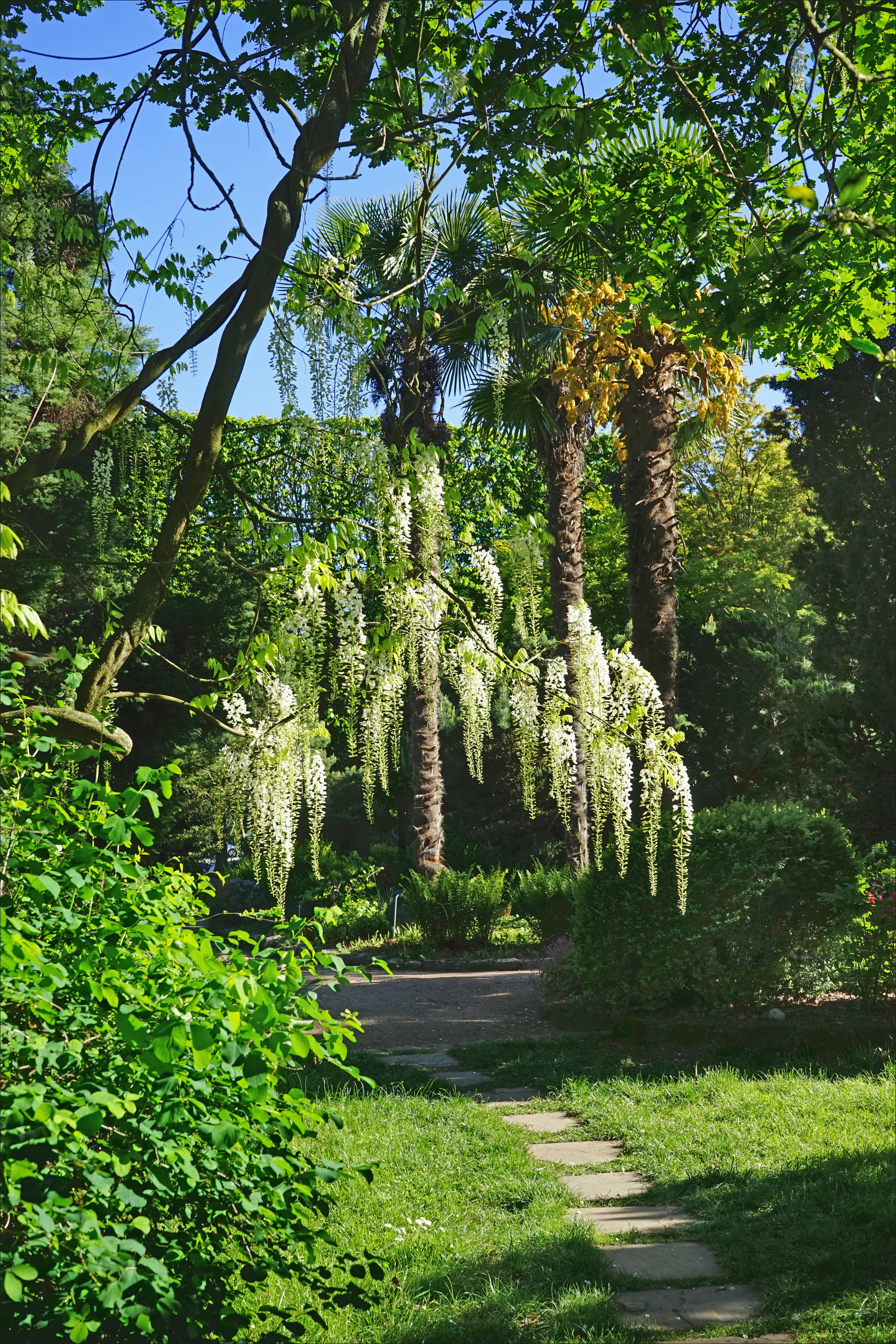
White flower clusters hang before palm trunks and dense foliage above a stepping-stone garden path.

Flowering branches and palms in the Vallée-aux-Loups Arboretum, photographed in May 2019. This is a detail of the botanical collection, not the weeping cedar.

“l'Arboretum de la Vallée-aux-Loups (Chatenay-Malabry)” — Jean-Pierre Dalbéra, CC BY 2.0. Source: https://www.flickr.com/photos/dalbera/32900471967/. License: https://creativecommons.org/licenses/by/2.0/. Original unchanged. · Creative Commons

Walks and routes

The cedar and the historic garden

From the north entrance at 102 rue de Chateaubriand, use the displayed plan to locate the weeping blue cedar in the historic garden. Follow the open visitor paths to reach it, then spend time looking at how its branches spread. Continue to a contrasting specimen, such as the Lebanon cedar, and take in the waterside garden views before returning to your chosen gate. Allow 1–2 hours including stops. This suggested visit sequence is flexible; follow the entrance plan rather than expecting a waymarked circuit.

Ask the entrance staff to identify a suitable out-and-back path before setting off. Detailed gradients and step-free continuity to each specimen have not been established here; do not use small garden shortcuts as assumed wheelchair routes.


A family morning with a clear finish

Agree on three stops: the spreading cedar, a tree with a different outline, and one garden that catches someone’s eye. Give each person a turn choosing what to notice. End with time to retrace the path comfortably. If you have brought lunch, leave the arboretum for a permitted picnic area such as the separate Jardin de l’Aigle Blanc.

A return visit for garden enthusiasts

On your next visit, start with a themed collection instead of repeating the same circuit. In autumn, compare the colour and leaf shapes in the Jardin de l’Automne flamboyant; at another season, choose the alders, chestnuts or hydrangeas. Leave time for the bonsai greenhouse if its opening suits. A focused return makes it easier to notice changes than trying to cover every garden in one afternoon.

Things to try

Read a botanical label together

Pick one tree whose shape you like, find its label and choose a feature you could recognise again. A botanical name identifies the plant; an extra cultivar name may describe a form selected and maintained by gardeners. Children can make a simple drawing and add the feature they noticed. Let their questions guide the next stop.

Make a portrait in two scales

Try one photograph showing the whole tree and another of a detail visible from the path. Notice how an upright crown, a sweeping branch or a dense curtain of foliage changes the composition. Keep paths clear while framing and avoid moving plants for a better view. Personal photography is permitted; professional or commercial shoots need the manager’s prior authorisation.

Visit the bonsai greenhouse

The department acquired 66 bonsai from the Rémy Samson collection in 2013. In their dedicated greenhouse, look at how the outline of a mature tree is suggested within a small container. After the outdoor giants, the change of scale is striking. Check the separate greenhouse timetable before making this the centrepiece of your day.

When to shorten or postpone

A light shower can suit a brief garden visit if the gates remain open, but this is predominantly an outdoor outing. During strong winds, thunderstorms or intense rain, check the department’s weather-closure information and obey the gate notices. The policy explicitly covers the arboretum. Do not shelter under old trees, and do not assume that the bonsai greenhouse or neighbouring museum will remain accessible during an estate closure.

Wildlife and habitats

Weeping blue cedar

The weeping blue Atlas cedar is the signature cultivated specimen. Follow the sweep of its branches from a public path. Its unusual growth form arose in a seedling; gardeners have preserved that character through propagation. Give the whole crown space in your photograph to capture its extraordinary spread.

Lebanon cedar

This is a separate specimen from the blue weeping cedar. The department’s portrait identifies it as one of the arboretum’s oldest trees, with a broad, layered crown. Compare the two trees’ outlines rather than relying on the shared word cedar. Confirm the label before assigning a name to a photograph.

Bald cypress

The labelled bald cypress, Taxodium distichum, belongs to a group of conifers that lose their foliage. Autumn is a good time to notice its russet colour before the winter silhouette is revealed. Use the named specimen and its label for identification: not every conifer beside water is the same kind.

Coast redwood

The coast redwood is one of the arboretum trees recognised nationally in 2026. Start with a full-tree view and follow the trunk upwards with your eyes. Then compare it with the much broader spreading cedar. Both are conifers, but their contrasting silhouettes make a satisfying pair for a sketchbook page.

Tulip tree

Look for the broad leaves with a cut-off-looking tip, an outline that can suggest a cat’s head. The arboretum’s tulip tree received national recognition in 2026. Leaves are often easier to appreciate than flowers high in the canopy, and make a good starting point for recognising it.

Stories and discoveries

A nursery’s living display

Unusual forms made good advertisements for the nursery. A tree’s distinctive outline could be a quality growers deliberately preserved and offered to customers. That commercial history gives another way to read the arboretum: as a living display of horticultural possibilities.

More remarkable trees to discover

In September 2026, six further arboretum trees received the national Arbre remarquable de France label: a fastigiate hornbeam, Lebanon cedar, myrsine-leaved oak, bald cypress, coast redwood and tulip tree. The weeping blue cedar had received the distinction in 2001. This gives a repeat visit a useful new theme: choose one of these other specimens and give it the attention normally reserved for the star cedar.

A collection beyond trees

The arboretum also conserves a national collection of Convolvulaceae, the plant family that includes morning glories. It has held national-collection recognition since 1999. Conservation collections can include plants kept behind the scenes, so look for the displays that are open rather than assuming access to every greenhouse.

When to visit

Spring and summer

Fresh leaves make small differences in shape easy to compare. Choose a flowering garden if it is at its best, and look without disturbing any insects visiting the flowers. In warm weather, a short morning visit with water is a comfortable option; a long opening day is not a reason to stay out through the hottest part.

Autumn

The Jardin de l’Automne flamboyant is an obvious seasonal focus, but also look at individual trees beside the historic garden. The bald cypress changes colour and sheds its foliage, a useful surprise if you associate all conifers with evergreen leaves. Fallen wet leaves can be slippery, so take your time at corners and beside water.

Winter

Bare branches reveal differences hidden by summer foliage. Compare an upright tree with a weeping form, and notice the spaces between the branches as well as the branches themselves. Keep the visit shorter in cold weather and leave ample daylight for the journey home.

Getting there and practical advice

Opening and gates

The departmental FAQ lists daily opening: November–February 10:00–17:00; March–April 10:00–19:00; May–July 10:00–20:00; August–September 10:00–19:00; October 10:00–18:00. Closing starts 15 minutes beforehand. Check the current notice and gate display: published official schedules differ, particularly for spring and summer.

Bonsai opening

The FAQ lists Monday–Thursday 10:00–12:00 and 13:30–16:30; Friday 10:00–12:00 and 13:30–15:30; Saturday–Sunday 14:00–18:00. Confirm holiday arrangements and any shorter seasonal access.

Toilets and refreshments

The department locates arboretum toilets near the bonsai greenhouses and by the gate towards the Jardin de l’Aigle Blanc. Check their availability on arrival. Bring a filled water bottle; plan meals outside the arboretum instead of assuming a café or a drinking-water refill is available within the collection.

Choose the arboretum entrance

Use 102 rue de Chateaubriand, 92290 Châtenay-Malabry, for the north entrance and visitor enquiries. Check your destination carefully: the house, the woodland and Île Verte have different entrances, so a generic Vallée-aux-Loups search can deliver you to the wrong starting point.

Public transport

RER B to Robinson is a useful rail approach, followed by a planned walk to the chosen arboretum gate. Vallée Sud Bus line 14 serves the stop Arboretum and connects with Robinson and La Croix de Berny. Check the operator for your travel date and return journey, especially on Sundays and holidays; do not assume a daily shuttle or a particular connection.

Driving or cycling to the gate

The visitor-information page identifies arboretum parking opposite 127 avenue Jean Jaurès, available during the arboretum’s opening period. Check its own closing notice before leaving the car. Cycle parking is listed at 102 rue de Chateaubriand; secure your bicycle outside the garden and continue on foot.

Arrange a visit around your needs

Confirm wheelchair-loan availability before travelling. Ask about the route to the cedar, toilet access, resting places and any slopes or loose surfaces; the estate’s general accessibility statement does not describe every garden path. For a stroller, favour the main paths and be ready to turn back instead of using narrow stepping-stone passages.

Sources and useful links

Wildlife you might spot

5

Each card links to a full Explore page with photos, traits, and fun facts.

Snap map for this place

Start with the big picture, then zoom in to explore individual wildlife observations around this place.

Loading map…

Good to know before you go

Bring a small notebook or use your phone to pair a tree photograph with its label.

Look at the whole crown before concentrating on leaves, bark or cones.

Keep children close beside water and let them choose one favourite tree.

Leave branches, flowers, fruits and seeds in place; enjoy the collection without collecting it.

Pack water and shoes with grip, particularly when wet leaves cover the paths.

Check the exit time on arrival and head back before gate-closing begins.

Frequently asked questions

The arboretum and the park around the Maison de Chateaubriand are separate parts of the same estate. Aim for the arboretum entrance at 102 rue de Chateaubriand; 87 rue de Chateaubriand is the house and its park.
Pet dogs and bicycles are not admitted to the arboretum, and picnics are prohibited inside. For an assistance dog, confirm the arrangements with the manager. The separate Jardin de l’Aigle Blanc has picnic facilities, useful for a break before or after this visit.
Ordinary entry to the arboretum is free. Booked activities and visits elsewhere in the estate have their own arrangements. The bonsai greenhouse also has a separate timetable, so an open garden does not mean every collection is accessible.

Recent snaps at this place

Recent snaps will appear here as new observations are added.

View all ›

Take the discovery with you

Exploring Vallée-aux-Loups Arboretum?

Identify the wildlife you spot, learn as you go, and keep a collection of the adventure.

  1. 1Spot it
  2. 2Snap it
  3. 3Keep the discovery