




Aleppo pine
Pinus halepensis
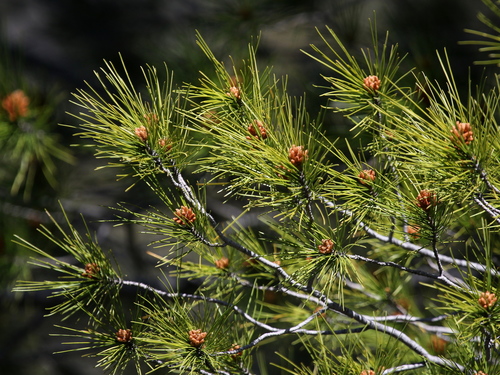
The Aleppo pine is a tall tree with long, green needles and a rough bark. It loves sunny places and can grow in dry areas. This tree is great for providing shade and homes for animals.
Habitat: Dry forests
The Aleppo pine has an often-crooked trunk with reddish-brown bark that peels in plates. Its open, irregular crown holds short, bright green needles growing in pairs, and shiny, conical cones that stay on the branches for years.
Category
PlantsRarity
Common
Danger
1/5 · Very low
Snaps
Be the first to snap!
Aleppo pines grow curvy and twisty, like they're dancing in the wind!
Did you know its seeds, called pine nuts, are yummy and loved by people and animals?
Its wood has been used for centuries to build ships and even make musical instruments!
This brave tree is often the first to grow back after a forest fire!
Aleppo pine's cones are serotinous, meaning intense heat helps them burst open to release seeds and grow new trees.
Aleppo pine has long taproots that dive deep into dry soil to find hidden water sources, helping it survive droughts.
Aleppo pine creates sticky resin that oozes out to trap insects and heal wounds, protecting it from pests and diseases.

Sciurus vulgaris
Feeds on its nutritious pine nuts.
Loxia curvirostra
Extracts seeds from its tough cones.

Passer domesticus
Builds nests securely within its dense canopy.
Shade tolerant plants are adapted to grow and thrive in areas with low light levels, requiring less direct sunlight.
Coniferous plants are typically evergreen, bearing needles or scales and reproductive cones.
Evergreen plants retain their foliage throughout the year, never shedding all their leaves at once.
Drought-tolerant plants can survive and flourish in conditions with limited water availability.
Timber refers to wood that has been prepared for use in building and carpentry.
Forest habitats are terrestrial environments dominated by dense tree cover, supporting a high diversity of plant and animal life.
This trait characterizes organisms with an exceptionally long lifespan compared to others of their kind.
Describes a species whose presence and role have a disproportionately large effect on its environment.
No aliases listed yet.
Danger
1/5 · Very low
Stay away from sharp pine cones and branches.
Start with the whole plant, then compare leaf arrangement, leaf edges, stems and any flowers or fruit. Opposite leaves grow in pairs; alternate leaves come one at a time along the stem. These details tell you far more together than a single green leaf does. Plant Identifier: upload a photo and compare the visible details.
1500-2500 cm
500-1000 cm
Spring
Yes
None
Perennial
Wind
Zoom in to split clusters and explore where this object has been snapped.
Recent snaps will appear here as new observations are added.
Spain, ES
You might spot Aleppo Pine, Mastic, and Tree Spurge.
View guide →
Illes Balears, ES
You might spot Aleppo Pine, Mastic, and Duck.
View guide →
Comunitat Valenciana, ES
You might spot Little Egret, Black-Winged Stilt, and Pied Avocet.
View guide →
Región de Murcia, ES
You might spot Aleppo Pine, Mediterranean Fan Palm, and Mastic.
View guide →
IT
You might spot Eurasian Otter, Golden Eagle, and White-Throated Dipper.
View guide →
Cataluña, ES
You might spot Aleppo Pine, Olive, and Holm Oak.
View guide →
Take the discovery with you
Snap it with Snappit to identify it, learn what makes it special, and add the discovery to your collection.