




Alsike clover
Trifolium hybridum
Alsike clover is a lovely plant with small, round leaves and pretty pink flowers. It grows in fields and meadows, making the world a little brighter and helping bees and butterflies.
Habitat: Grasslands
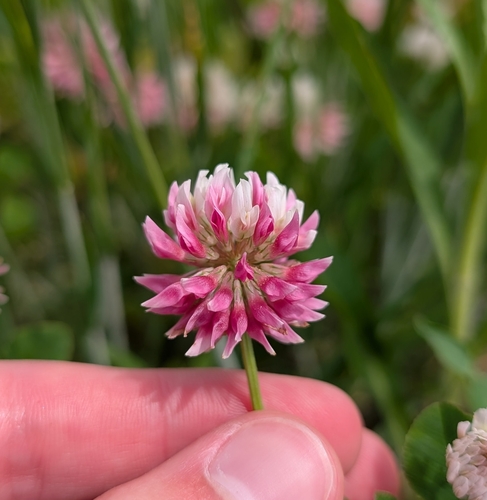
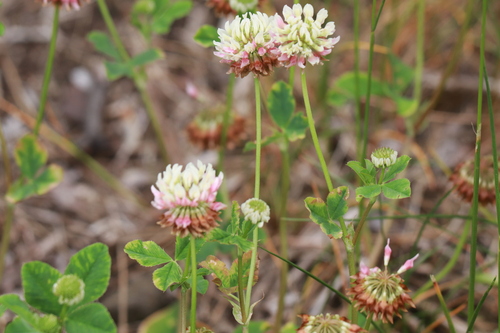
The Alsike clover has soft, globe-shaped flower heads that bloom in a beautiful mix of white and pink, often deepening to rose as they mature. Its distinctive leaves are trifoliate, meaning three leaflets, typically with a pale green V-mark on each.
Category
PlantsRarity
Common
Danger
1/5 · Very low
Snaps
9
Although called clover, it's actually a natural hybrid of two other Trifolium species.
Bees absolutely adore its sweet nectar, making it a busy bee hangout!
It's named after a village in Sweden where it was first widely grown centuries ago!
Its beautiful flowers change color from white to pink as they get older!
Alsike clover has special root nodules that grab nitrogen from the air, making the soil richer for other plants to grow.
Alsike clover can thrive in tough, wet, or heavy clay soils where many other plants struggle, helping it survive anywhere.
Apis mellifera
collects nectar and pollen for honey
Bombus terrestris
attracted to its abundant flowers
Rhizobium leguminosarum
lives in root nodules, converts nitrogen

Bos taurus
grazes on its nutritious leaves
Flowering plants are any plants that produce flowers as part of their reproductive cycle.
Describes organisms capable of converting atmospheric nitrogen into compounds usable by plants.
Medicinal plants possess chemical compounds that can be used for therapeutic purposes to treat illnesses or maintain health.
This human use trait describes species cultivated or domesticated by humans for agricultural purposes, including crops and livestock.

Edible plants are those parts of a plant that are considered safe for human consumption.

Grassland habitats are terrestrial biomes dominated by grasses and herbaceous plants, supporting a variety of grazing animals.

Describes plants that are particularly attractive and beneficial to a wide range of pollinating organisms.

Rapid growing plants exhibit accelerated growth rates, quickly increasing in size and biomass within a short period.
No aliases listed yet.
Danger
1/5 · Very low
Always check with an adult before picking plants, as some may not be safe.
The easiest way to identify Alsike clover is to use the Snappit nature identifier app.
30-60 cm
20-40 cm
1-2 cm
Summer
Yes
Mild
Perennial
Zoom in to split clusters and explore where this object has been snapped.
Jun 10, 2026
Bellevue Avenue Historic DistrictPhoto attribution
(c) Tyler Ekholm, some rights reserved (CC BY)
License: CC BY 4.0 ↗
Image may be shown cropped inside the card frame.
Jun 7, 2026
East Windsor Hill Historic DistrictPhoto attribution
(c) Mark Apgar, some rights reserved (CC BY)
License: CC BY 4.0 ↗
Image may be shown cropped inside the card frame.

Rhode Island, US
You might spot Rugosa Rose and American Herring Gull.
View guide →

Connecticut, US
You might spot Eastern Gray Squirrel, Dark-Eyed Junco, and House Sparrow.
View guide →
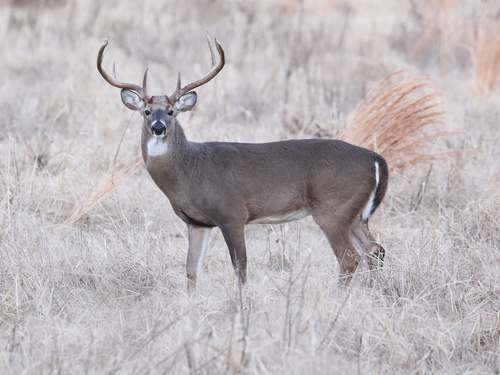
Ohio, US
You might spot White-Tailed Deer, Mayapple, and American Beech.
View guide →

New York, US
You might spot Bald Eagle, Common Eastern Bumble Bee, and Tree-Of-Heaven.
View guide →

Massachusetts, US
You might spot Painted Turtle, American Pokeweed, and Canada Goose.
View guide →

Colorado, US
You might spot Mule Deer, Woodhouse's Scrub-Jay, and Black-Billed Magpie.
View guide →
Take the discovery with you
Snap it with Snappit to identify it, learn what makes it special, and add the discovery to your collection.








.jpg&width=800)



_001.jpg&width=800)



